
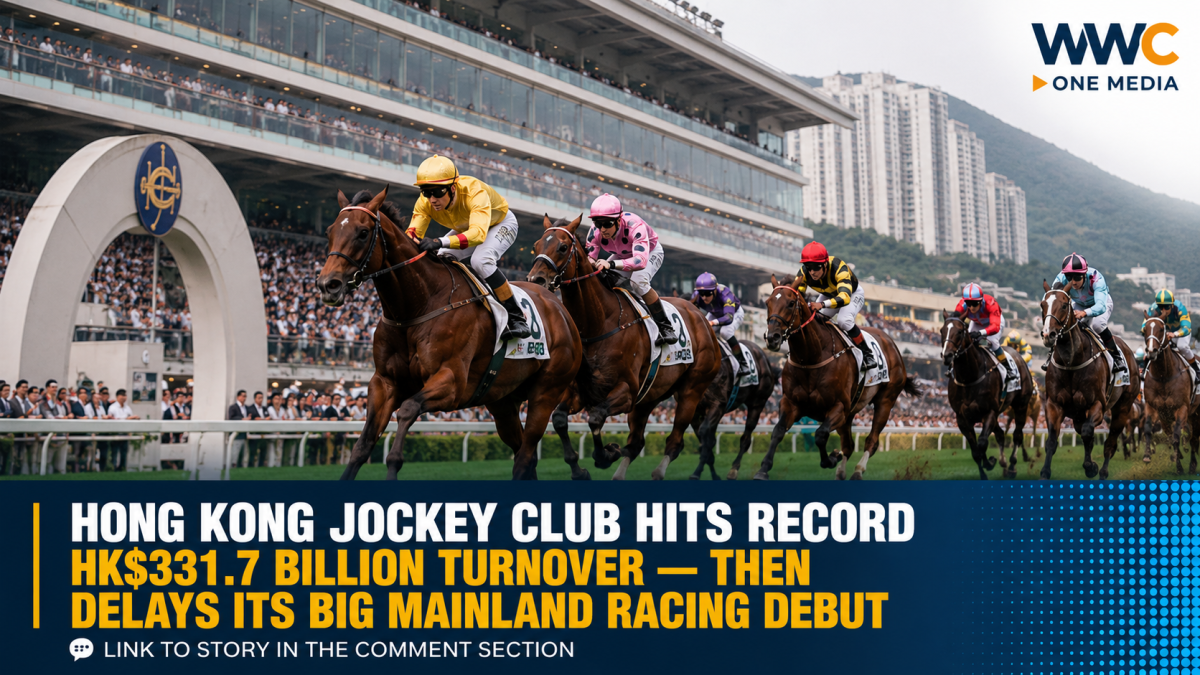
HONG KONG — The Hong Kong Jockey Club is celebrating a record financial year, a dramatic surge in racing tourism and stronger betting activity. But behind the headline numbers is a major setback: the planned launch of regular racing at its Conghua Racecourse in Guangzhou has been postponed.
At its annual general meeting on September 2, the Club reported HK$331.7 billion in total wagering and lottery turnover for FY2025/26, up 3.6% from the previous financial year. It also contributed HK$39.3 billion to the community through taxes, the Lotteries Fund and charitable donations.
The timing is striking because the Club had been preparing for what it described as a major new chapter: bringing regular world-class thoroughbred racing to mainland China.
Now, that opening has been pushed back.
Conghua launch postponed after new risk assessment
The HKJC had been preparing to stage its first regular racing meeting at Conghua Racecourse in Guangzhou on October 31, 2026.
That event has now been postponed.
The Club said it had completed the necessary statutory and procedural requirements and had been working closely with relevant mainland authorities. However, it recently received a new risk assessment from relevant mainland departments.
Following discussions, the two sides agreed to continue developing mitigation measures before proceeding with the event. No new opening date has yet been announced.
Importantly, the HKJC has not said that the Conghua project has been cancelled. The current announcement is a postponement while additional measures are worked out.
Why Conghua matters so much
Conghua has operated as a major training and rehabilitation centre for Hong Kong racehorses since 2018.
The facility was supposed to evolve into the third point of the Club’s proposed Sha Tin–Happy Valley–Conghua racing triangle, linking Hong Kong’s two established racecourses with the mainland venue.
The HKJC sees Conghua as more than another racetrack.
It is intended to become part of a broader Greater Bay Area strategy involving horse racing, equestrian sports, tourism, entertainment and the development of China’s equine industry.
The Club has already invested substantially in the facility, including its grandstand and visitor experience infrastructure.
And there is another unusual detail:
There will be no wagering on races held at Conghua.
That means the mainland venue is being positioned primarily as a sports, entertainment and equine-industry destination rather than another betting venue.
Meanwhile, Hong Kong’s racing business is booming
Despite the Conghua delay, the numbers from the 2025/26 financial year were strong.
The Club reported:
- HK$331.7 billion in total wagering and lottery turnover, up 3.6%
- HK$143.3 billion in racing wagering turnover, up 3.6%
- HK$179.0 billion in football betting turnover, up 3.6%
- HK$9.4 billion in Mark Six turnover, up 4.2%
- HK$39.3 billion contributed to the community
The Club said racing turnover was helped by larger fields, while international commingling also continued to grow.
Wagering on Hong Kong races through commingling from 26 countries and jurisdictions reached HK$34.3 billion, representing 23.9% of total racing wagering turnover.
Tourists are becoming a major part of the racing story
Perhaps the biggest surprise was the explosion in racing tourism.
The HKJC recorded 401,259 tourist visits to its two Hong Kong racecourses during the 2025/26 season.
That was:
105% higher than the previous season and roughly four times the level recorded in 2023/24.
The distinction matters: the figure represents visits, not necessarily 401,259 unique individuals.
Major events helped drive the surge.
The Year of the Horse Raceday on February 19 attracted 98,000 spectators, including a single-day record of more than 20,000 visitors from mainland China and overseas.
The BMW Hong Kong Derby also drew its largest-ever attendance, with more than 72,000 people attending.
Hong Kong wants racing to become a tourism engine
The tourism surge fits into a broader Hong Kong government strategy to use major sporting events to attract visitors.
The HKJC has partnered with China Travel Group and coordinated with the Hong Kong Tourism Board’s mega-events strategy.
It has also experimented with cross-sport experiences including Racing with Golf, Racing with Rugby and Racing with Football.
That helps explain why Conghua matters beyond horse racing.
The Club wants visitors to see racing as an entire entertainment experience — and eventually connect that experience across Hong Kong and the Greater Bay Area.
But the Club is facing a financial squeeze
Record turnover does not mean the Club’s finances are completely comfortable.
The HKJC warned that its operating surplus is expected to decline further over the next few years.
One reason is the scale of investment being made in Conghua and technology, including a new sports-wagering platform.
Another is the Club’s preparation for regulated basketball betting, which has now been paused by the Hong Kong government. The HKJC said it respects that decision but warned that the absence of a legal betting channel could allow illegal basketball gambling to expand.
The Club says it is responding by cutting costs, improving efficiency and searching for additional non-wagering sources of revenue.
The bigger picture: record success meets a major test
There is an interesting contradiction at the heart of the HKJC’s latest results.
On one side, Hong Kong racing is attracting unprecedented numbers of tourists and generating record turnover.
On the other, the Club is spending heavily to expand beyond Hong Kong — while its flagship mainland expansion has suddenly been delayed.
Conghua was supposed to symbolize the next stage of Hong Kong racing’s evolution: two established Hong Kong racecourses plus a new mainland venue serving the Greater Bay Area.
For now, that third piece is on hold.
The Club says discussions with mainland authorities will continue and mitigation measures will be developed.
So the immediate question isn’t whether Conghua will happen.
It’s when — and what needs to change before the gates finally open.
WWC ONE MEDIA J.M.D


Leave a Reply