
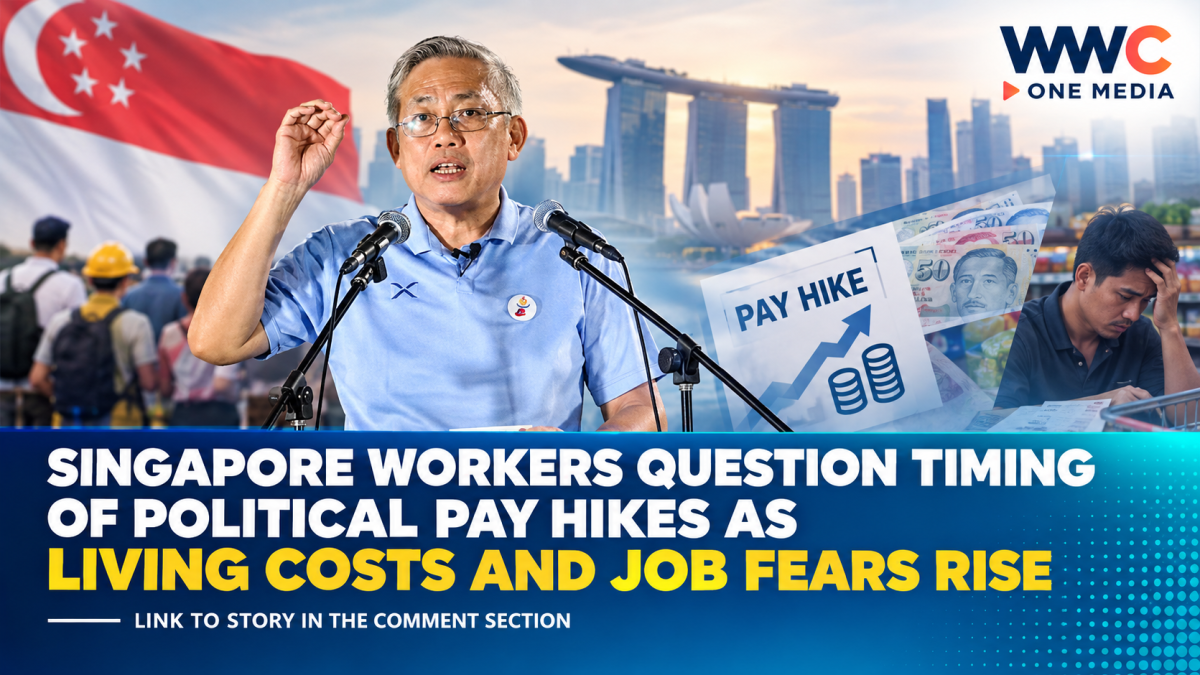
SINGAPORE — Workers are questioning whether now is the right time to raise the salaries of Singapore’s political officeholders and Members of Parliament, with concerns over the rising cost of living, job security and the impact of artificial intelligence on livelihoods taking centre stage in a heated parliamentary debate.
Labour MP Yeo Wan Ling said workers she had spoken with were not simply questioning the proposed salary adjustments themselves — they were asking whether political leaders truly understood the financial pressures ordinary Singaporeans are facing.
“It was not simply a question about salary adjustments. It was a question about timing,” Yeo said in Parliament on Sept. 10, adding that workers wanted to know whether political leaders were experiencing the same realities as the people they serve.
Workers Say Higher Wages Are Being Eaten Up by Higher Costs
Yeo, a Punggol GRC MP and labour representative, said Singapore’s economic indicators may appear healthy, but many workers do not necessarily feel better off.
While wages have increased, she said, everyday expenses have also risen.
Some workers told her that after accounting for the higher cost of living, they did not feel substantially better off despite government support measures.
The concerns go beyond household expenses.
Workers are also worried about jobs, business conditions, economic restructuring and what artificial intelligence could mean for their future livelihoods.
That has made the timing of the proposed political pay increases particularly sensitive.
Why a 9% Increase Is Raising Eyebrows
Some workers Yeo spoke to said they understood why political salaries might need to be periodically reviewed.
But others questioned whether a proposed increase of up to 9% was too large, especially when compared with their own wage increases and annual wage agreements.
Under the government’s revised framework, political officeholders will receive a one-time adjustment of up to 9% from Oct. 15, with actual increases depending on performance and responsibilities rather than an immediate jump to the new benchmark levels.
The broader review would raise the benchmark annual salary for the lowest ministerial grade from S$1.1 million to S$1.8 million, although ministers will not immediately receive the full benchmark amount. Most junior ministers are expected to earn about S$1.35 million by the end of the current government term.
‘Political Service Should Be About Serving’
For some workers, Yeo said, the issue is also about principle.
They believe political service should fundamentally be driven by a desire to serve the public and questioned the need for further increases when political salaries were already considered substantial.
The debate highlights a long-running tension in Singapore’s political system.
The government argues that competitive salaries are necessary to attract capable people from the private sector and maintain a high-quality government while reducing corruption risks.
But critics and members of the public continue to question whether extremely high political salaries can remain acceptable during periods when ordinary households face financial pressure.
Yeo: Don’t Judge the Review by One Number Alone
Despite relaying workers’ concerns, Yeo also urged Parliament not to assess the issue solely by looking at the 9% headline figure.
Drawing on her experience in wage negotiations, she said unions, employers and the government normally consider a broader range of factors.
Those include:
- Salary benchmarks
- Economic conditions
- Labour market conditions
- Sustainability
- Performance and outcomes being rewarded
Yeo argued that the same approach should be applied to political salaries.
“When we negotiate wages, we never look only at the headline number,” she said, stressing the importance of examining what lies behind any proposed adjustment.
Political Salaries Have Been Frozen for 15 Years
Yeo also noted an important piece of context in the debate.
Political salaries have not been adjusted for 15 years, following a major restructuring in 2011 that significantly reduced ministerial pay. The annual salary of an entry-level MR4 minister was cut by about 37% under that restructuring.
However, Yeo stressed that the length of time without an increase does not automatically justify the current proposal.
Nor does it automatically prove that 9% is the right figure.
Instead, she said the entire period and the factors behind the proposed changes should be considered rather than focusing on one percentage in isolation.
PM Lawrence Wong Defends the Review
Prime Minister Lawrence Wong has defended the salary review, arguing that political salaries have fallen behind comparable compensation in the private sector, civil service and other parts of the public sector.
Wong acknowledged that political pay is an emotionally sensitive issue, particularly because the sums involved are far higher than what most Singaporeans earn.
He has also pledged to donate his salary increase to charity for the next five years.
Under the new framework, Wong’s benchmark annual pay is set to rise from S$2.2 million to S$3.6 million, although the implementation of salary adjustments is being phased rather than delivered as an immediate full increase.
The Bigger Question: Are Leaders and Workers Living the Same Reality?
Yeo’s comments may have captured the most politically sensitive part of the entire debate.
The argument is no longer just about whether ministers deserve higher salaries.
It is about whether Singaporeans believe the timing sends the right message.
Workers are dealing with higher household expenses.
Some are worried about job security.
Businesses are navigating economic uncertainty.
And AI is raising fresh concerns about how work could change in the coming years.
Against that backdrop, even a technically justified salary review can become a question of public trust.
The Bottom Line
Singapore workers are raising concerns over the timing of proposed political salary increases, saying higher living costs, job uncertainty and fears surrounding AI are making the issue particularly difficult to accept.
Labour MP Yeo Wan Ling said these concerns must be taken seriously, while also urging Parliament to examine the broader context behind the proposed adjustments rather than focusing only on the headline figure of up to 9%.
The government, meanwhile, argues that political salaries must remain competitive to attract capable leaders and maintain effective governance.
But as Singapore debates how much its political leaders should earn, one question may matter more than the numbers themselves: at a time when workers are worried about their future, can the government convince them that its leaders truly understand the pressures they face every day?
WWC ONE MEDIA J.M.D

Leave a Reply