
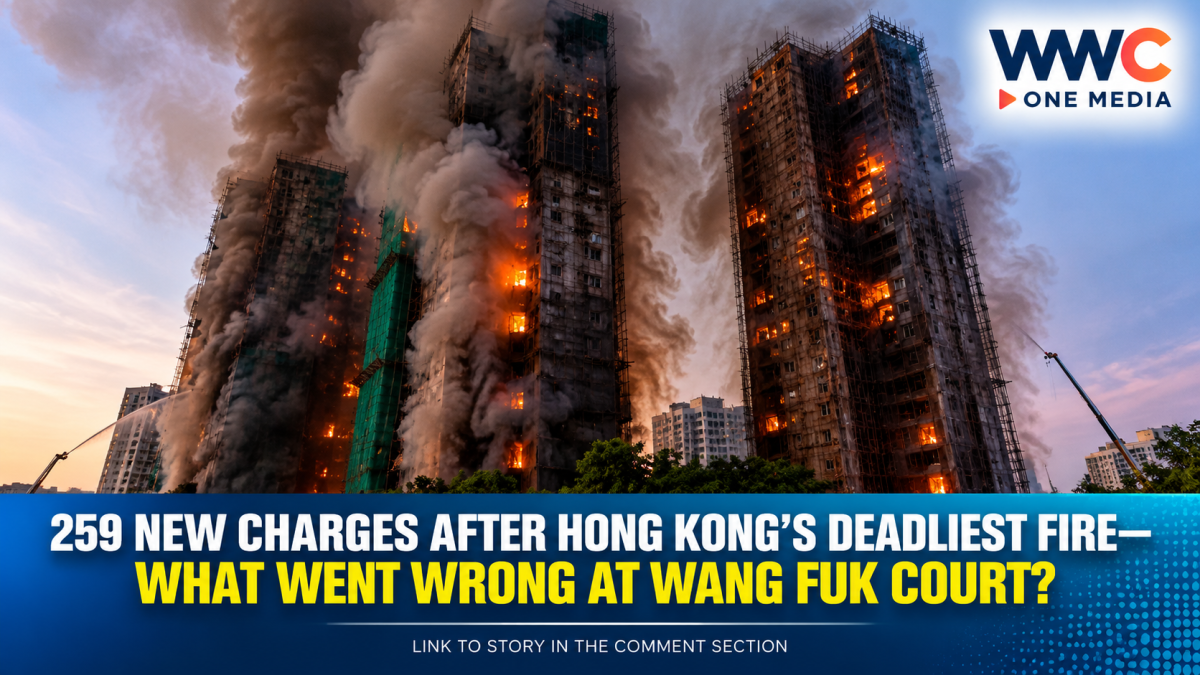
HONG KONG — Nearly 10 months after the devastating Wang Fuk Court fire in Tai Po killed 168 people, Hong Kong authorities have filed 259 additional charges against two companies and four individuals linked to renovation works at the housing estate.
The latest prosecutions were announced by Hong Kong’s Buildings Department on September 9, adding another major development to an investigation that has already resulted in separate criminal charges over the tragedy.
The two companies facing the new charges are Will Power Architects Company Limited, the consultancy firm involved in the estate’s renovation project, and Prestige Construction & Engineering Company Limited, the project’s main contractor.
The four individuals are Will Power director Wong Hap-yin, registered inspector Ng Yeuk, and Prestige directors Hau Wa-kin and Ho Kin-yip.
What are the 259 charges about?
According to the Buildings Department, the allegations center on the way renovation works were carried out at Wang Fuk Court.
The defendants are accused of allegedly allowing or authorizing the use of defective or non-compliant materials during building works. They are also accused of allowing work to proceed in a manner that caused or could cause injury or property damage, as well as failing to properly supervise prescribed repair works.
The allegations are particularly significant because the fire spread rapidly through the estate while renovation work was underway.
Investigators have previously examined the use of non-fire-retardant scaffolding netting and other combustible materials, as well as the condition of fire-safety systems in the affected buildings.
The November 2025 disaster
The Wang Fuk Court blaze erupted on November 26, 2025, at the public housing estate in Tai Po.
The fire engulfed seven of the estate’s eight high-rise blocks, killing 168 people and injuring 79, according to subsequent reports. Thousands of residents were also displaced from their homes.
The scale of the tragedy made it one of the deadliest residential building fires in decades.
Investigators and an independent committee have been examining not only how the fire started but also why it spread so quickly and why residents had difficulty escaping.
Fire-safety failures came under intense scrutiny
Evidence presented during public hearings indicated that numerous fire-safety measures had failed during the blaze.
CNA previously reported that fire alarm systems in seven of the eight blocks had been deactivated, which investigators said significantly reduced the time residents had to evacuate.
Authorities also investigated the use of scaffolding materials that did not meet required fire-retardant standards and the presence of foam boards covering windows—factors that were examined for their potential role in allowing the fire to spread into apartments.
The Fire Investigation Task Force previously maintained that an ignited cigarette caused combustible material to catch fire, triggering the blaze. However, the broader investigation has focused heavily on the renovation and safety conditions that allowed the fire to become catastrophic.
These are not the first charges in the case
The latest 259 charges should not be confused with an earlier criminal case.
In June 2026, Hong Kong police and the Independent Commission Against Corruption (ICAC) charged seven people and two companies with 25 offenses connected to the Wang Fuk Court fire.
Those earlier charges included manslaughter, conspiracy to defraud, money laundering, attempting to pervert the course of public justice and tax evasion.
The defendants in that earlier case included people associated with the renovation consultancy and the main contractor.
The June prosecutions followed a joint investigation by police and the ICAC into both the fire and possible corruption surrounding the major renovation project.
More charges over workers’ deaths
There was another development on September 9.
Hong Kong’s Labour Department filed 25 charges against a contractor, a consultant and an individual in connection with the deaths of five workers during the Wang Fuk Court fire.
Those prosecutions relate to alleged breaches of general-duty requirements under Hong Kong’s Factories and Industrial Undertakings Ordinance.
This means the latest wave of legal action involves different regulatory and criminal proceedings, rather than a single 259-count case covering every aspect of the disaster.
Authorities are tightening oversight
The tragedy has also prompted Hong Kong authorities to increase inspections and enforcement involving major building renovation projects.
The Buildings Department said it has strengthened regulation and inspections since the Wang Fuk Court fire. A special operation was also launched to inspect scaffolding nets and fire-safety measures at about 400 buildings undergoing large-scale repair works across Hong Kong.
Meanwhile, the independent committee investigating the fire continues to examine evidence and testimony surrounding the disaster. Its official record shows multiple rounds of evidential hearings have taken place, with the committee’s work continuing into 2026.
The bigger question: Could the tragedy have been prevented?
That remains one of the most important questions surrounding Wang Fuk Court.
The latest prosecutions do not, by themselves, establish criminal guilt. The allegations will have to be dealt with through the appropriate legal processes.
But the growing number of charges—and the separate investigations into renovation practices, fire safety, possible corruption and worker deaths—underscore how authorities are examining multiple layers of responsibility for a disaster that claimed 168 lives.
The focus is no longer simply on how the fire started.
The investigation is increasingly asking a much bigger question:
Were critical safety rules ignored, inadequate materials used and renovation works insufficiently supervised—and could those failures have turned a building fire into one of Hong Kong’s worst residential disasters?
That question remains at the center of the continuing Wang Fuk Court investigation.



Leave a Reply