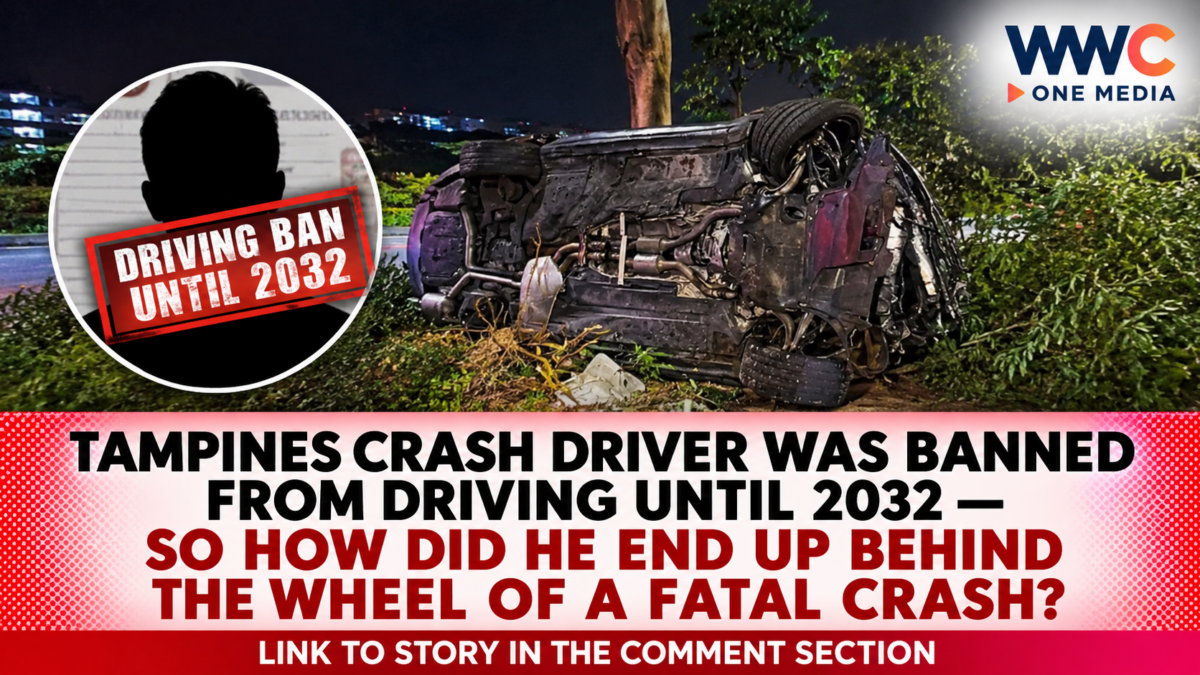
SINGAPORE — November 4
A fatal traffic accident in Tampines has raised serious questions about road safety and repeat driving offences after investigators revealed that the driver accused of causing the collision had been disqualified from driving until 2032.
Muhammad Zulfiqar Abdul Aziz, 30, allegedly drove a deregistered vehicle fitted with a cloned number plate despite being under a six-year driving ban. The vehicle subsequently crossed a road divider and collided with a motorcycle and another car along Tampines Avenue 12 on October 29, 2026.
The collision claimed the lives of a 24-year-old motorcyclist and his 24-year-old wife, who was riding pillion. The couple were reportedly expecting their second child and left behind a six-year-old son.
What makes the case particularly concerning is that the accused had previously been convicted twice for driving while disqualified, in November 2021 and July 2025.
According to court documents reported on November 3, his latest driving disqualification was in effect from March 2026 until March 2032.
The 30-year-old was subsequently arrested and charged with nine traffic offences, including dangerous driving causing death, driving while disqualified and failing to render assistance after an accident.
The case has drawn renewed attention to Singapore’s enforcement of driving bans, the use of deregistered vehicles and the consequences of motorists allegedly ignoring restrictions intended to protect other road users.
Driver Allegedly Ignored Six-Year Driving Ban Until 2032
One of the most significant developments in the case concerns the accused’s driving history.
Court documents revealed that Zulfiqar was allegedly prohibited from driving between March 2026 and March 2032.
The six-year disqualification did not come without previous violations.
He had reportedly been convicted of driving while disqualified on two separate occasions, first in November 2021 and again in July 2025.
Despite those previous convictions and the latest driving ban, investigators allege that he was behind the wheel of a deregistered vehicle when the fatal collision occurred.
The case therefore involves more than an alleged dangerous-driving incident. It also raises questions about how individuals who have repeatedly breached driving restrictions can continue accessing vehicles and operating them on public roads.
Under Singapore’s Road Traffic Act, driving while disqualified is a serious offence.
A first conviction can carry a fine of up to S$10,000, imprisonment of up to three years, or both. Repeat offenders face a maximum fine of S$20,000, imprisonment of up to six years, or both.
These penalties reflect the seriousness with which Singapore treats motorists who disregard court-imposed driving restrictions.
How the Fatal Tampines Avenue 12 Collision Happened
The accident occurred at approximately 10:35 p.m. on October 29 along Tampines Avenue 12.
According to the Singapore Police Force, the incident involved two cars and a motorcycle.
Preliminary investigations indicated that the car driven by Zulfiqar crossed the central road divider before colliding with vehicles travelling in the opposite direction.
Court documents subsequently alleged that he failed to maintain proper control of the vehicle while negotiating a left bend.
The car allegedly continued straight through the central divider, breached metal railings and entered the opposing traffic lane, where it struck a motorcycle and another car.
The impact caused the motorcycle collision that would ultimately claim two lives.
A 24-year-old male motorcyclist and his 24-year-old female pillion passenger were taken to hospital unconscious.
Both subsequently died from their injuries.
The 25-year-old woman driving the other car was also taken to hospital, although she was conscious when transported.
The crash quickly attracted public attention after images and videos showing the overturned vehicle and damaged road infrastructure circulated online.
Couple Killed in Crash Were Expecting Their Second Child
Beyond the criminal charges, the tragedy has left a family facing an enormous loss.
The two victims were a married couple, both aged 24, who were reportedly expecting their second child at the time of the accident.
They already had a six-year-old son.
Their deaths have left the young child without both parents, prompting relatives to make arrangements for his care and future needs.
The families also organised an online fundraising campaign to support the boy’s living expenses, education, medical needs and long-term welfare.
Reports indicated that the campaign attracted thousands of contributors and raised more than S$170,000 during its initial period.
A gag order was imposed to protect the identities of the victims because of their surviving child.
The couple were buried next to each other at Choa Chu Kang Muslim Cemetery on October 30.
The tragedy has also prompted renewed discussion about the consequences of dangerous driving, particularly when motorists allegedly disregard legal restrictions and place other road users at risk.
Driver and Passenger Allegedly Fled After the Collision
Another major element of the investigation concerns what happened immediately after the crash.
According to police, the driver did not render assistance to those involved and abandoned the vehicle before leaving the scene with his 29-year-old female passenger.
Both individuals were subsequently identified through police ground enquiries and images obtained from police cameras and closed-circuit television systems.
Officers arrested them on October 30 in the vicinity of West Coast Road.
The passenger was arrested in connection with the investigation, but she had not been charged in the reports available as of November 4.
Zulfiqar was charged the following day.
The allegations that the driver and passenger left the scene have added another dimension to the case, particularly because two people were critically injured and later died.
Singapore’s Road Traffic Act requires motorists involved in accidents to stop and fulfil their legal responsibilities, including providing assistance where required.
Failing to stop or render assistance after an accident can result in additional criminal penalties.
Nine Charges Filed Against Muhammad Zulfiqar Abdul Aziz
On October 31, Zulfiqar appeared in court and was handed nine charges relating to the fatal collision and the vehicle he allegedly used.
The charges include:
- Dangerous driving causing death.
- Dangerous driving causing hurt.
- Driving while under disqualification.
- Failing to stop after an accident.
- Failing to render assistance after an accident.
- Using a motor vehicle without insurance coverage.
- Using a deregistered vehicle.
- Using a vehicle without a valid licence.
- Exhibiting a false licence plate.
The Singapore Police Force said preliminary investigations revealed that the accused was driving a deregistered vehicle fitted with a cloned number plate while under disqualification.
The use of a false registration plate and an unregistered vehicle adds further seriousness to the allegations.
Each charge carries its own potential penalties, depending on the applicable legislation and the circumstances established through the legal process.
However, the accused has not been convicted of these charges, and the allegations remain subject to court proceedings.
Court Denies Bail as Prosecution Raises Flight-Risk Concerns
During his first court appearance on October 31, the prosecution requested that Zulfiqar be denied bail, arguing that he posed a flight risk.
The accused reportedly questioned the prosecution’s position, saying that this was his first court appearance and disputing the suggestion that he would abscond.
The prosecution pointed to the allegation that he had already fled the scene following the collision.
The court ultimately did not offer him bail, and he was remanded for further investigations.
His next court mention is scheduled for November 27, 2026.
If convicted of dangerous driving causing death, he could face imprisonment of up to eight years under the applicable provisions of the Road Traffic Act.
A conviction for repeat driving while disqualified could also result in imprisonment of up to six years and a fine of up to S$20,000.
The final penalties, however, will depend on the court’s findings and the outcome of the proceedings.
Singapore Sees Growing Concerns Over Deregistered Vehicles
The Tampines tragedy has also brought attention to the wider problem of deregistered vehicles being used illegally on Singapore roads.
A deregistered vehicle is one that no longer has valid registration and cannot legally be used on public roads unless it has been properly re-registered or otherwise authorised under applicable rules.
Such vehicles may be associated with additional risks when they are operated without valid road tax, insurance or proper registration.
The Singapore Police Force has highlighted the seriousness of motorists using deregistered vehicles, driving while disqualified and committing other major traffic offences.
Figures reported by Channel NewsAsia showed that cases involving deregistered vehicles increased from 75 in 2024 to 245 in 2025.
During the first five months of 2026, the Land Transport Authority had already investigated 122 such cases, according to reporting by The Straits Times.
The figures have raised concerns about enforcement and the systems used to prevent illegally deregistered vehicles from returning to public roads.
In October 2026, Parliament passed tougher measures concerning the disposal of deregistered vehicles, including requirements for their export through companies authorised by the Land Transport Authority.
The changes are intended to strengthen oversight and reduce opportunities for deregistered vehicles to be misused.
A Wider Pattern of Fatal Road Accidents Raises Safety Questions
The Tampines crash is part of a broader series of serious traffic incidents that have placed Singapore’s road-safety enforcement under public scrutiny.
In September, WWC ONE MEDIA reported on another fatal Tampines collision involving excessive speed and a driver who ran a red light.
In that case, a driver faced a potential 13.5-year jail term after a devastating multi-vehicle crash that killed two people.
Another incident involved a trailer driver who was arrested after allegedly leaving the scene of a fatal collision involving a cyclist in Singapore’s Defu industrial area.
The report, Trailer Driver Arrested After Fleeing Fatal Crash Involving Cyclist in Singapore, highlighted the importance of remaining at an accident scene and cooperating with authorities.
More recently, a fatal accident near Queen Street Bus Terminal resulted in the death of a woman, with a bus driver arrested as investigations continued.
WWC ONE MEDIA covered the incident in Fatal Accident Near Singapore’s Queen Street Bus Terminal Leaves Woman Dead, Bus Driver Arrested.
These separate incidents involved different circumstances and should not be treated as evidence of a single underlying cause.
However, they illustrate the continuing importance of responsible driving, compliance with traffic laws and effective enforcement against serious road offences.
What Penalties Could the Accused Face?
The nine charges expose Zulfiqar to several potential penalties under Singapore law.
Among the most serious is dangerous driving causing death, which carries a maximum prison term of eight years.
Driving while disqualified is another significant charge, particularly because the accused has reportedly faced previous convictions for the same offence.
For repeat offenders, the maximum punishment includes a fine of S$20,000, imprisonment of up to six years, or both.
Other alleged offences carry additional penalties:
- Failing to stop after an accident: A fine of up to S$3,000, imprisonment of up to 12 months, or both.
- Failing to render assistance: A fine of up to S$3,000, imprisonment of up to 12 months, or both.
- Using a deregistered vehicle: A fine of up to S$20,000, imprisonment of up to two years, or both.
- Using a vehicle without insurance: A fine of up to S$1,000, imprisonment of up to three months, or both.
- Exhibiting a false licence plate: A fine of up to S$5,000, imprisonment of up to 12 months, or both.
These are statutory maximum penalties, not predictions of the sentence the accused will receive.
The court will determine the appropriate outcome after considering the evidence, applicable laws and circumstances of the case.
The Bigger Question: How Did a Disqualified Driver Get Back Behind the Wheel?
The most troubling aspect of the Tampines case may extend beyond the fatal collision itself.
The accused was reportedly subject to a six-year driving ban that was supposed to remain in effect until March 2032.
He had also previously been convicted twice for driving while disqualified.
Yet investigators allege that he was operating a deregistered car with a cloned number plate when the fatal accident occurred.
The case raises important questions about how authorities can prevent disqualified motorists from accessing vehicles, how deregistered cars are monitored and whether existing enforcement measures are sufficient to deter repeat violations.
It also highlights the devastating consequences that can follow when motorists allegedly ignore restrictions intended to protect the public.
For the families of the two victims, however, the consequences are already irreversible.
A young couple have lost their lives, and their six-year-old child must now grow up without his parents.
The Bottom Line
The fatal Tampines collision has become a major road-safety case after investigators revealed that the accused driver was allegedly operating a deregistered vehicle with a cloned number plate despite being disqualified from driving until 2032.
The 30-year-old faces nine charges, including dangerous driving causing death, repeat driving while disqualified and failing to render assistance after the accident.
The tragedy claimed the lives of a 24-year-old husband and wife who were reportedly expecting their second child, leaving behind a six-year-old son.
With the accused denied bail and scheduled to return to court on November 27, attention will now turn to the legal proceedings and the evidence presented by prosecutors.
The case also raises broader questions about Singapore’s ability to prevent disqualified motorists and illegally registered vehicles from returning to public roads.
But one question remains: If a driver had already been banned from driving until 2032, how was he allegedly able to get behind the wheel again — and could stronger enforcement have prevented another fatal tragedy?