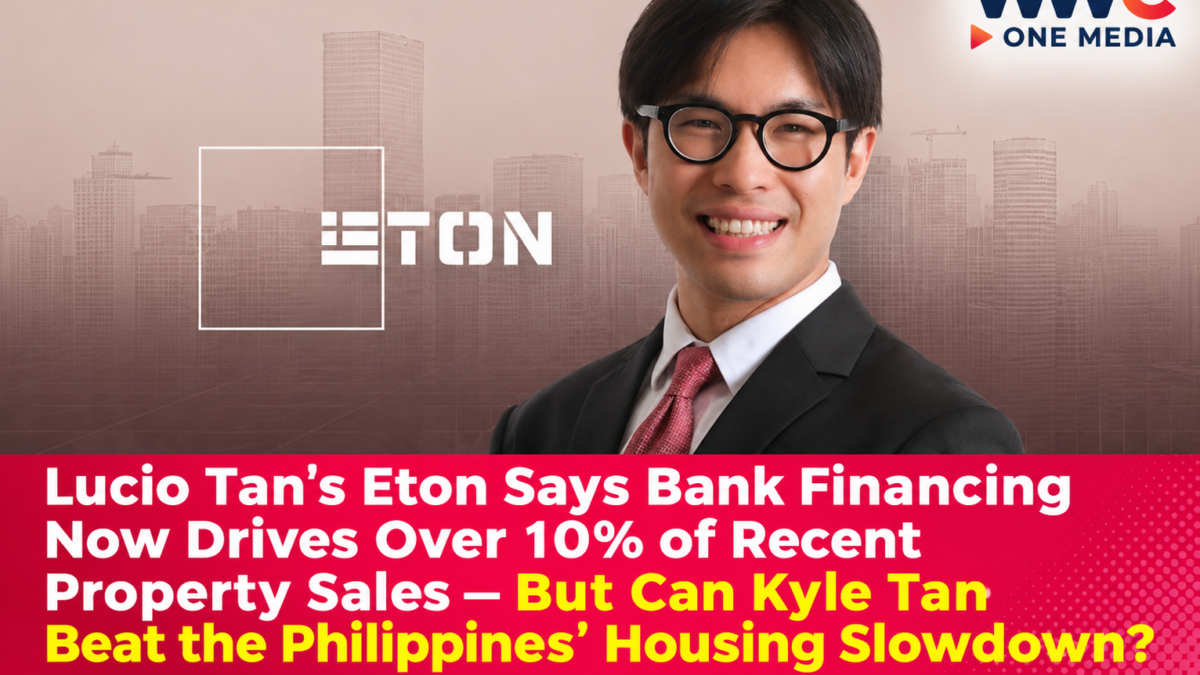
MANILA, Philippines — November 4, 2026 | WWC ONE MEDIA | Business, Real Estate & Banking
The battle for Filipino homebuyers is entering a new phase, and Lucio Tan’s property development company is betting that easier access to bank financing could be the key to unlocking stalled real estate transactions.
Eton Properties Philippines Inc., led by President and CEO Kyle Ellis C. Tan, revealed that more than 10% of its recent property sales were completed through developer undertaking arrangements with partner banks, including Philippine National Bank (PNB).
The development comes as the Philippine property sector continues to grapple with cautious buyers, affordability concerns and uneven demand for residential and commercial properties.
In an interview on Bilyonaryo News Channel’s Follow The Money, Tan said the bank financing arrangements have helped simplify transactions and improve the experience of customers purchasing Eton properties.
The company is also offering longer payment periods and early move-in arrangements as it adjusts to a challenging market.
But behind the encouraging sales figures lies a bigger question.
Can Eton turn easier home financing into sustainable sales growth—or will high property prices, borrowing costs and cautious Filipino buyers continue to hold back the market?
Eton Says Bank Partnerships Account for More Than 10% of Recent Sales
Eton’s latest update highlights a financing arrangement known as a developer undertaking, or DOU.
Under such arrangements, a property developer and a participating bank coordinate aspects of the home financing and purchase process.
The specific responsibilities of each party depend on the agreement, but the structure can help buyers move from property reservation and documentation toward approved bank financing.
For Eton, the approach appears to be contributing to completed transactions.
Kyle Tan said more than 10% of recent sales had been processed through DOU arrangements.
He also indicated that these arrangements had improved transaction completion and customer experience.
However, the company did not disclose the exact number of transactions, the peso value of DOU-financed sales or the specific period covered by the reported percentage.
That limits how much can be concluded from the figure.
It establishes that bank-assisted purchases are becoming an important sales channel for Eton, but not that the partnerships have independently generated a particular percentage increase in overall sales.
The distinction matters because a larger share of bank-assisted purchases can also reflect changes in how existing buyers finance their transactions.
Why Eton Is Working With Philippine National Bank
Eton’s partnership with Philippine National Bank forms an important part of the developer’s financing strategy.
In December 2025, Eton and PNB formalized an agreement aimed at making housing loans more accessible to qualified local customers and overseas Filipinos purchasing residential properties.
The partnership was designed to create a more coordinated financing process.
For overseas Filipino workers and professionals, this could be particularly useful because purchasing property from abroad often involves additional documentation, communication and timing challenges.
Eton and PNB are both associated with the Lucio Tan Group, giving the arrangement an existing corporate connection.
However, the partnership does not mean that every Eton buyer automatically qualifies for financing.
PNB remains responsible for evaluating loan applications under applicable credit policies.
Borrowers must still satisfy income, creditworthiness, documentation, collateral and repayment requirements.
The commercial opportunity for Eton lies in making the financing process easier for qualified buyers—not eliminating the financial risks associated with taking out a mortgage.
Blakes Tower and Other Eton Developments Could Benefit
One of the residential projects covered by Eton’s PNB financing initiative is Blakes Tower at WestEnd Square in Makati City.
The mixed-use development combines residential and commercial functions within a major urban business corridor.
Eton’s broader portfolio also includes properties such as Eton Tower Makati, Eton Residences Greenbelt, 68 Roces in Quezon City and residential communities in Sta. Rosa, Laguna.
These developments serve different segments of the property market.
For buyers considering condominium units or house-and-lot properties, access to bank financing may influence their decision to proceed.
But financing availability is only one consideration.
Customers must also evaluate the development’s location, turnover status, association dues, mortgage costs and suitability for their long-term plans.
A property can become easier to finance without necessarily becoming affordable for every household.
Philippine Property Developers Face a Difficult Sales Environment
Eton’s decision to strengthen its financing partnerships comes amid a challenging period for Philippine real estate.
Developers are increasingly competing for financially qualified buyers rather than relying solely on new project launches.
Some customers remain interested in purchasing homes but are delaying commitments because of monthly payment obligations, economic uncertainty or concerns about property prices.
Others are comparing multiple developers before making a purchase.
The financing problem has become particularly important in the condominium sector.
WWC ONE MEDIA previously examined these challenges in Megaworld Offers Free Condo Upgrades and Pag-IBIG Loans Up to ₱10 Million — But a Bigger Housing Affordability Challenge Remains.
The report covered Megaworld’s efforts to stimulate demand through promotional benefits and expanded financing arrangements.
The strategy illustrates a broader market shift.
Developers are no longer competing only through location, amenities and project design.
They are also competing through the accessibility and flexibility of financing.
For Eton, this makes its bank partnerships particularly relevant.
Eton Extends Payment Terms and Offers Early Move-In Options
Beyond DOU arrangements, Eton is modifying its sales approach to address buyer concerns.
According to Bilyonaryo, the developer has extended payment terms and introduced early move-in programs.
Longer payment arrangements may help some buyers manage the timing of their required payments.
Early move-in programs could also appeal to customers who want to occupy a property sooner rather than continue paying rent while waiting for turnover.
However, the exact financial benefit depends on individual contract terms.
Longer repayment periods may reduce monthly installments while increasing total financing costs.
Likewise, early occupancy may involve specific conditions relating to down payments, loan approval, occupancy permits and payment schedules.
Consumers should review the entire cost of purchasing a home rather than focusing only on the advertised monthly payment.
The central challenge remains affordability over the full life of the loan.
Other Philippine Developers Are Using Similar Strategies
Eton is not alone in turning to lender partnerships.
Robinsons Land Corporation has also expanded its financing options through Pag-IBIG Fund.
WWC ONE MEDIA covered that development in Robinsons Land Opens More Homes to Pag-IBIG Financing — But Affordability Will Still Decide Who Can Actually Buy.
The arrangement aims to make selected residential properties more accessible to qualified Pag-IBIG members.
Meanwhile, SM Development Corporation has worked with Pag-IBIG Fund to introduce additional financing pathways for prospective homebuyers.
As previously reported by WWC ONE MEDIA in its coverage of the SMDC–Pag-IBIG partnership, eligible borrowers may seek financing subject to government housing fund requirements.
These arrangements are different from Eton’s commercial bank partnerships.
However, they reflect the same broad objective: helping qualified buyers convert interest in a property into a completed purchase.
For the industry, financing accessibility is becoming a significant competitive factor.
Smaller Developers Are Also Entering the Financing Race
The trend extends beyond the country’s largest property companies.
WWC ONE MEDIA previously reported on NEXTASIA Land Expands Home Financing Options Across Southern Luzon.
The developer expanded its financing arrangements through Land Bank of the Philippines and Chinabank Savings.
Similarly, Asialink Adds Four Developers to Its Housing Network — But Financing May Be Only Half the Battle for Filipino Homebuyers examined the expansion of non-bank property financing.
These developments show how banks, government housing funds and alternative lenders are becoming increasingly involved in property developers’ sales strategies.
For Filipino consumers, additional financing channels can create more choices.
However, having more lenders does not guarantee that every borrower will qualify or that every loan will carry favorable terms.
Borrowers must still compare interest rates, fees, repayment schedules and the possibility of future rate adjustments.
Eton’s 2025 Results Show the Value of Operating Efficiency
The company’s financing strategy comes after a period of improved financial performance.
According to Eton’s published 2025 annual results, the developer recorded net income of approximately ₱758.4 million, an increase of 256% from ₱212.8 million in 2024.
Revenue rose 4% to approximately ₱3.3 billion.
Its residential sales increased 46% to ₱731.4 million, while earnings before interest, taxes, depreciation and amortization increased 43% to approximately ₱1.8 billion.
The company also reported receiving a ₱3.52-billion capital infusion from LT Group.
These figures provide important historical context.
They show that Eton entered 2026 after improving profitability and strengthening its financial position.
However, those are 2025 results.
They should not be presented as proof that the November 2026 bank financing arrangements produced equivalent increases in net income or residential sales.
A separate, comparable 2026 financial disclosure would be required to establish that relationship.
Kyle Tan Focuses on Costs Instead of Aggressive Expansion
Eton’s management is also adopting a more cautious approach to capital spending.
According to Bilyonaryo, the developer is prioritizing customer experience, operating efficiency and financial discipline rather than pursuing aggressive expansion in an uncertain market.
The company is seeking to reduce electricity and other operating costs while managing capital expenditure more carefully.
That strategy could help preserve financial flexibility while buyer demand remains uneven.
Eton has also pursued energy efficiency through renewable electricity procurement.
In June 2026, the company announced a transition to geothermal electricity across 14 developments through First Gen.
BusinessMirror separately reported the arrangement, including an initial contracted demand of 8.7 megawatts across six developments.
Energy procurement initiatives may help the company manage operating costs.
However, the actual contribution to profitability depends on contract prices, electricity consumption and other expenses.
The available information does not establish how much the renewable energy arrangements have saved in pesos.
A Slower Property Market Creates Both Risks and Opportunities
A weaker real estate market can place pressure on developers.
Projects may take longer to sell, and companies may need to provide incentives to attract buyers.
Extended collection periods can also affect cash flow.
At the same time, selective demand may create opportunities for developers with attractive locations, completed inventory and reliable financing partners.
For Eton, the combination of bank-assisted sales and operational discipline could help it navigate uncertain market conditions.
But the strategy has limits.
A smoother mortgage application cannot overcome a buyer’s inability to afford monthly payments.
Likewise, flexible payment arrangements may not compensate for weak location demand or unfavorable property pricing.
The success of Eton’s approach will depend on whether it attracts financially qualified customers who can complete purchases and sustain their loan obligations.
What Other News Outlets Confirm
Bilyonaryo reported on November 3 that more than 10% of Eton’s recent property sales were handled through DOU arrangements with partner banks.
The figure came directly from Kyle Tan’s interview on Bilyonaryo News Channel’s Follow The Money.
PhilSTAR Property, InsiderPH and BusinessWorld separately documented Eton’s December 2025 partnership with PNB to expand housing loan access for local buyers and overseas Filipinos.
The Philippine Star also published Eton’s 2025 financial performance, while the company’s own annual report confirms its reported net income, revenue, residential sales and capital infusion.
Together, these sources establish that Eton has pursued a bank-financing strategy alongside broader efforts to improve its operations.
However, the precise contribution of DOU arrangements to recent sales remains a management-reported figure.
No independent transaction-level audit or detailed breakdown of the latest DOU sales was located in the reviewed material.
The Bigger Question: Can Easier Financing Revive Property Sales?
Eton’s latest announcement highlights a growing reality in Philippine real estate.
Selling property is no longer simply about convincing customers that a condominium or house is desirable.
Developers must also help qualified buyers navigate the financial process required to complete a purchase.
For Eton, its partnerships with PNB and other lenders appear to be helping customers move through the transaction process.
The fact that more than one in ten recent sales were handled through DOU arrangements shows that the financing channel has become commercially relevant.
But a larger share of bank-assisted transactions does not establish a full recovery in the property market.
The long-term test will involve completed sales, collection performance, profit margins and the sustainability of buyers’ financing arrangements.
The Bottom Line
Eton Properties is using bank partnerships, longer payment terms and early occupancy options to strengthen its residential sales strategy amid challenging market conditions.
Its latest figures suggest that financing arrangements have become an important tool for converting buyer interest into completed transactions.
But for Kyle Tan, the challenge is not merely to close more accounts.
It is to protect profitability, manage project costs and ensure that the company’s growth remains sustainable.
Can Lucio Tan’s property business turn more accessible home financing into a lasting sales recovery—or will the Philippines’ affordability crisis prove too difficult for even the strongest developer-bank partnerships to overcome?