WASHINGTON — November 4, 2026
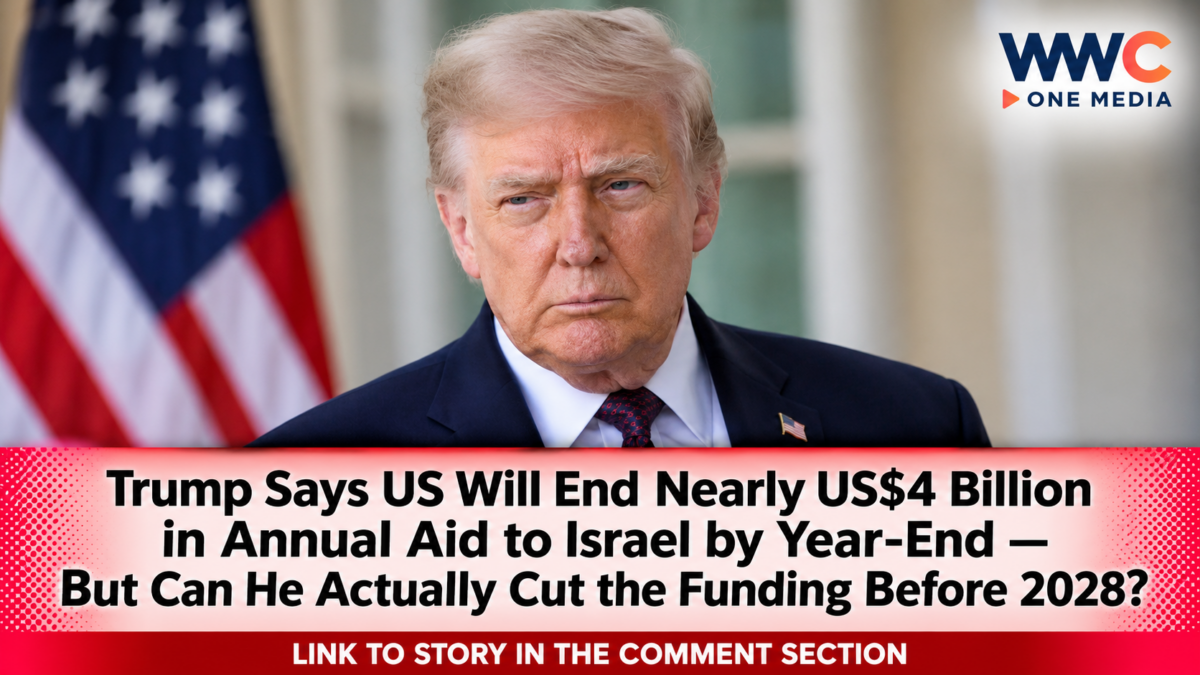
US President Donald Trump has announced that the United States will stop providing nearly US$4 billion in annual funding to Israel after the end of 2026, claiming that he and Israeli Prime Minister Benjamin Netanyahu had already agreed to end the assistance.
The surprise announcement came on November 3, as Americans headed to the polls for the 2026 midterm elections, with control of Congress at stake and US support for Israel becoming an increasingly divisive political issue.
Speaking to Fox News’ Fox & Friends, Trump said Israel no longer needed the financial assistance but would remain able to purchase American weapons.
He also suggested that Washington would continue helping Israel if necessary.
However, the announcement immediately raised questions about how such a major change could happen, particularly because the existing US-Israel military assistance agreement runs through September 2028.
Trump did not explain exactly which funding arrangements would end, how the proposed cutoff would be implemented or whether Congress had agreed to the change.
The announcement could mark a significant shift in one of Washington’s longest-standing strategic relationships in the Middle East. But whether the proposed deadline can actually be met remains uncertain.
Trump Says Netanyahu Agreed to End the Funding
Trump presented the announcement as an agreement reached with Netanyahu months earlier.
He said the United States had been providing Israel approximately US$4 billion annually and that both leaders had agreed to stop the payments by the end of this year.
According to Trump, Israel had become economically and militarily capable enough to manage without the assistance.
He also made clear that ending the annual funding would not necessarily mean ending the wider military relationship.
Israel would still be able to purchase American weapons, while Washington could provide assistance if circumstances required it.
That distinction is important.
Direct financial assistance and commercial weapons sales are not the same thing. Ending one funding arrangement would not automatically prevent Israel from buying American military equipment using its own resources.
Reuters reported that neither the White House nor Netanyahu’s office immediately responded to requests for comment following Trump’s announcement.
The absence of an immediate official explanation leaves important questions about the supposed agreement unanswered.
Why the US$4 Billion Figure Is More Complicated Than It Sounds
The United States currently provides Israel with approximately US$3.8 billion annually under a 10-year Memorandum of Understanding signed in 2016.
The agreement covers fiscal years 2019 through 2028 and represents a total commitment of approximately US$38 billion.
The annual assistance is generally divided into two major components:
- US$3.3 billion in Foreign Military Financing, primarily supporting Israel’s purchases of American-made defence equipment.
- US$500 million for joint missile-defence programmes.
This means Trump’s reference to US$4 billion is a rounded figure rather than the exact annual amount under the existing agreement.
The distinction also matters because the funding is not simply a cash payment that can be switched off without considering existing commitments, appropriations and defence contracts.
Under the current arrangement, the United States has a framework for continuing assistance through 2028.
Trump’s proposed year-end cutoff would therefore represent an acceleration of the expected transition, rather than merely the natural expiration of the existing agreement.
Can Trump End the Aid Without Congress?
One of the biggest unanswered questions concerns the authority to end the funding.
Although the president directs US foreign policy and plays a major role in relations with foreign governments, Congress has constitutional authority over federal spending.
The annual military assistance arrangement is supported through congressional legislation and appropriations.
Congress passed legislation in 2020 authorising the existing funding framework, while lawmakers must also approve appropriations to distribute the money.
That creates a complicated situation for Trump’s announcement.
Even if the president and Netanyahu have reached a political understanding, changing the funding schedule could require action involving Congress and the relevant government agencies.
The precise legal and administrative steps needed to implement the proposed cutoff have not been explained.
There are also existing defence commitments and orders to consider. Ending future assistance would not necessarily cancel weapons contracts already approved or equipment already scheduled for delivery.
The announcement should therefore be understood as Trump’s stated intention, not confirmation that the funding has already been legally terminated.
Why the Announcement Came on US Election Day
The timing was particularly significant.
Trump made the announcement as American voters were deciding whether Republicans would retain control of Congress in the November 3 midterm elections.
Support for Israel has become an increasingly sensitive political issue, particularly among Democratic voters following the war in Gaza.
Trump openly connected the funding decision to domestic political criticism.
He argued that Democrats were using American military assistance to Israel as an argument against Republicans, portraying the annual payments as unfair spending when American citizens faced their own financial pressures.
He specifically mentioned Abdul El-Sayed, a Democratic Senate candidate in Michigan who has opposed unconditional military assistance to Israel.
Trump said he wanted to remove what he described as an easy political talking point for his opponents.
This suggests that the announcement was not only about foreign policy. It was also tied to the political consequences of maintaining American support for Israel.
The issue has increasingly divided both major American political parties, with some Republicans and members of Trump’s own political movement also questioning the level of US involvement in foreign conflicts.
American Public Opinion on Israel Is Changing
The political pressure surrounding the funding reflects a wider change in American public opinion.
A Quinnipiac University poll conducted in June found that 48 per cent of US voters believed their country was too supportive of Israel.
Among Democrats, the figure reached 66 per cent.
When the same question was first asked in 2017, the figures were substantially lower: 16 per cent among all voters and 20 per cent among Democrats.
The change reflects growing disagreement over the United States’ relationship with Israel, particularly following the October 2023 Hamas-led attack and Israel’s subsequent military campaign in Gaza.
The conflict has become a major source of debate over military assistance, civilian protection and Washington’s responsibilities toward its allies.
Trump’s announcement arrives against that backdrop, with politicians facing increasing pressure to explain why billions of dollars in American resources should continue going toward overseas military support.
Netanyahu Had Already Discussed Reducing American Dependence
Although Trump’s announcement appeared sudden, the possibility of reducing US assistance had been discussed before.
Netanyahu has previously indicated that Israel should gradually become less dependent on American military funding.
In June, he wrote to US Representative Marlin Stutzman that the time had come for Israel to move from being an aid recipient to a partner.
He also discussed the possibility of phasing out American financial assistance over time while maintaining military and technological cooperation.
That position suggests that the idea of reducing direct funding is not entirely new.
However, a gradual transition is different from an abrupt cutoff at the end of 2026.
The existing agreement runs through 2028, and an accelerated change could create financial and planning challenges for Israel’s defence establishment.
It also raises questions about whether the two governments share the same understanding of the timing and terms of the proposed change.
Israeli Opposition Questions Netanyahu’s Handling of the Announcement
The announcement also triggered criticism inside Israel.
Gadi Eisenkot, a political rival of Netanyahu and leader of an opposition bloc, criticised the way the proposed change became public.
He argued that Israeli citizens and the country’s security establishment should not have to learn about a major change in the strategic relationship with Washington through media reports.
His criticism focused on the potential consequences for Israel’s national security and the importance of maintaining a reliable relationship with its closest military ally.
The dispute is particularly significant because Israel is also navigating political uncertainty following its October 27 election.
Netanyahu’s political position and the negotiations surrounding the formation of a government add another layer of uncertainty to the country’s relationship with Washington.
For Israel’s opposition, the issue is not simply whether the country can eventually become less dependent on American funding. It is also whether such a transition is being handled carefully enough to protect national security.
Ending Direct Aid Does Not Mean Ending US-Israel Military Cooperation
Even if the proposed funding reduction becomes official, the broader relationship between the two countries could remain extensive.
Trump explicitly said Israel would still be able to purchase American weapons.
The two countries are also discussing deeper cooperation in defence technology, research and development.
A provision in the proposed 2027 National Defense Authorization Act, known as Section 219, seeks to expand cooperation in areas including missile defence and military technology.
That means the relationship could evolve from a traditional assistance arrangement toward a model involving greater joint investment, technology development and commercial weapons purchases.
However, critics have raised concerns about the implications of deeper military cooperation, particularly if it creates new forms of support that are less visible than direct annual aid.
The distinction is important because a reduction in one category of assistance would not necessarily mean a complete withdrawal of American support.
For additional context on the controversy surrounding US military backing for Israel, WWC One Media previously examined the allegations and political debate surrounding the documentary NAZA, which brought renewed attention to Washington’s role in the Gaza conflict:
The Bigger Question: Is the US-Israel Relationship Entering a New Era?
Trump’s announcement could represent an important turning point in the relationship between Washington and Jerusalem.
For decades, American military assistance has been a central part of Israel’s defence planning and a major symbol of the two countries’ strategic partnership.
Now, Trump is suggesting that the financial arrangement should end earlier than originally expected, while maintaining weapons sales and other forms of cooperation.
The reasons are both strategic and political.
Israel may want to become more financially independent, while American politicians face growing pressure to reconsider the country’s overseas commitments.
But the announcement also exposes a difficult reality: a presidential declaration does not automatically rewrite an existing funding framework.
Congressional authority, defence contracts, appropriations and the details of the US-Israel agreement will all matter.
For now, the White House and Netanyahu’s government have yet to publicly clarify the precise terms of the proposed change.
The biggest question is whether Trump can turn his Election Day announcement into an actual policy shift — or whether the US$4 billion promise will become another major foreign-policy dispute that Congress and Israel’s political leadership must resolve.