
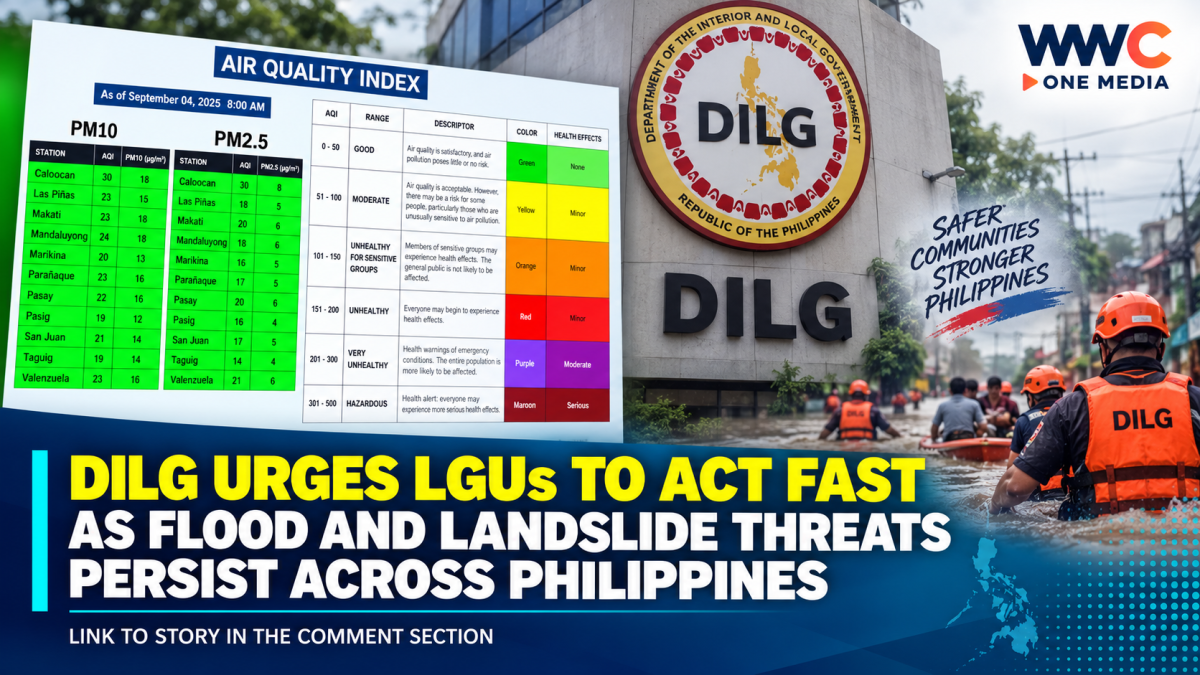
MANILA, Philippines — The Department of the Interior and Local Government (DILG) is pressing local government units (LGUs) to move quickly once disaster warnings are issued, stressing that timely decisions and early action can make the difference between preventing casualties and responding after tragedy strikes.
The warning comes as several parts of the country continue to deal with flooding, landslides and other hazards associated with heavy rains.
The Philippine News Agency reported that the DILG is emphasizing the importance of acting on disaster information immediately rather than waiting for conditions to deteriorate.
DILG: Don’t wait until disaster strikes
For local officials, receiving a warning is only the beginning. Authorities are expected to translate weather and hazard information into concrete actions on the ground—including monitoring vulnerable communities, preparing evacuation facilities, deploying response personnel and, when necessary, moving residents away from danger.
The DILG has repeatedly emphasized this preventive approach.
In an August 2026 advisory, the department directed LGUs to intensify preparations against flooding, flash floods and rain-induced landslides. The directive followed an assessment that more than 17,000 barangays had moderate to very high susceptibility to flooding and rain-induced landslides during the period covered by the advisory.
LGUs were instructed to conduct pre-disaster risk assessments, identify communities at risk using hazard maps, preposition personnel and equipment, monitor waterways and prepare for preemptive or mandatory evacuations when conditions warrant.
Why early evacuation matters
The latest push comes against the backdrop of a particularly difficult rainy season.
Recent flooding has affected communities across Luzon, with 178 cities and municipalities placed under a state of calamity as of September 2, according to a report by The Philippine Star. The same report cited National Disaster Risk Reduction and Management Council figures placing the death toll at 34 at that point, with people still reported missing.
The situation has reinforced the importance of moving residents before floodwaters, landslides or debris flows become life-threatening.
DILG guidance has called for immediate preemptive evacuation in highly flood- or landslide-susceptible communities. In areas where landslides have already occurred, residents should not be permitted to return until authorities have determined that the area is safe.
The Bureau of Fire Protection has also echoed the call for proactive evacuation.
During a DILG forum on September 3, BFP Public Information Service chief Fire Supt. Anthony Arroyo said proactive measures are crucial, particularly in low-lying and flood-prone communities. He acknowledged that responders sometimes encounter resistance from residents who do not want to leave their homes, but said authorities are coordinating with LGUs and other agencies to facilitate evacuations.
For people who cannot evacuate on their own, the BFP said rescue teams can transport them to safer areas when necessary.
Preparedness must happen before the warning becomes an emergency
The DILG’s message is not simply about evacuation.
LGUs are also expected to make sure evacuation centers are ready, emergency equipment is available and critical routes remain accessible to responders.
The department has specifically instructed LGUs to ensure dependable power supplies and functioning generator systems in health facilities and evacuation centers, while also prepositioning personnel and equipment for clearing roads and maintaining emergency access.
The emphasis on preparedness is also being reinforced in the Cordillera.
DILG-CAR recently urged LGUs to strengthen their use of Operation LISTO, the department’s disaster preparedness framework. Officials stressed that local disaster plans should be updated, early-warning systems kept functional, evacuation procedures clearly understood and food and rescue equipment positioned where they can be rapidly deployed.
However, the same report highlighted a significant challenge: nearly 70 percent of LGUs monitored by DILG-CAR reportedly have outdated or incomplete Local Disaster Risk Reduction and Management Plans.
That gap matters because a disaster plan is only useful if local officials can actually implement it when conditions suddenly change.
The bigger lesson: speed can save lives
The government’s recent disaster-response messaging points to one central principle: waiting for certainty can be dangerous when communities are already facing escalating hazards.
Floodwaters can rise quickly. Saturated slopes can collapse with little warning. Roads can become impassable, cutting off communities and slowing rescue operations.
That is why DILG has consistently pushed LGUs toward early monitoring, early warnings, prepositioning of resources and preemptive evacuation rather than relying solely on rescue operations after disaster strikes.
The approach also fits the government’s broader effort to strengthen local disaster-response capacity.
In a previous disaster-response operation, DILG reported that coordination among LGUs, police, fire personnel and emergency responders allowed thousands of families to be moved ahead of severe weather.
The message is becoming increasingly clear: disaster response does not begin when floodwaters enter a home. It begins when authorities receive the first credible warning.
And with heavy rains continuing to pose risks in vulnerable areas, the question facing local governments is no longer simply whether they have a disaster plan.
It is whether that plan can be activated fast enough when every minute matters.




Leave a Reply