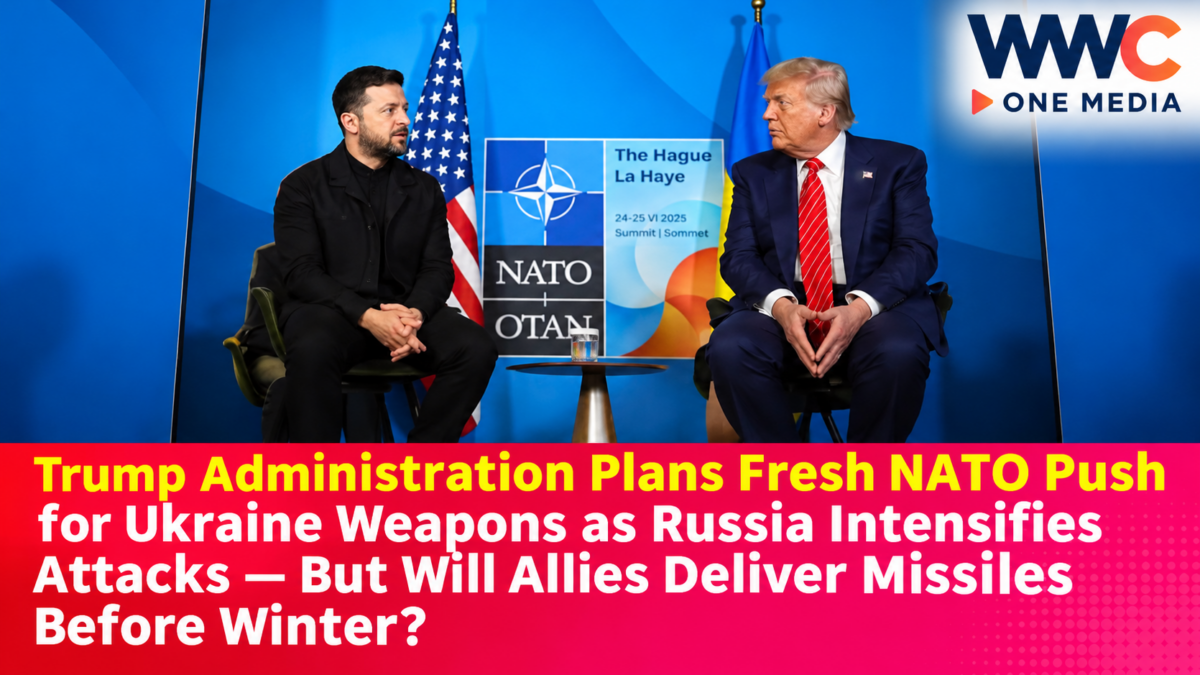
WASHINGTON / BRUSSELS / KYIV — November 3, 2026. The United States is reportedly preparing a renewed diplomatic push to persuade NATO allies to provide additional funding for American-made weapons destined for Ukraine, as Kyiv struggles to obtain urgently needed air-defense missiles amid intensifying Russian attacks.
According to Bloomberg’s November 2 report, Washington intends to seek new contributions to the NATO-coordinated weapons procurement initiative known as the Prioritised Ukraine Requirements List, or PURL.
The initiative enables European allies and other participating partners to purchase American military equipment for Ukraine, keeping vital weapons deliveries moving even as the Trump administration faces competing defense priorities and growing pressure on US military stockpiles.
The latest development comes at a particularly dangerous moment.
Russia has stepped up attacks against Ukrainian cities, electricity networks and critical infrastructure ahead of winter, while President Volodymyr Zelenskyy has repeatedly warned that shortages of air-defense interceptors could leave millions of civilians exposed.
On October 30, Washington approved a proposed $2.1-billion sale of 500 Patriot air-defense interceptors to Ukraine.
But there is a serious complication: the newly approved missiles have yet to be manufactured, and normal delivery schedules could stretch into the early 2030s.
Ukraine cannot afford to wait that long.
Meanwhile, Washington is preparing renewed peace discussions involving Ukraine and Russia, raising questions about whether the proposed NATO funding effort represents a commitment to Kyiv’s defense or another instrument of diplomatic pressure.
The crucial question is whether NATO allies can deliver more weapons quickly enough to protect Ukraine’s cities — or whether shortages, political disagreements and production delays will leave Kyiv dangerously exposed during the coming winter.
US Plans Fresh NATO Funding Push for Ukraine
Bloomberg reported on November 2 that the United States is planning to ask NATO allies to contribute more money to a key weapons-delivery program for Ukraine.
The planned initiative would build on PURL, established in July 2025 to facilitate the purchase of priority American military equipment using funding provided primarily by allied governments.
Unlike direct military assistance financed entirely by Washington, PURL allows participating countries to fund the procurement of US-produced weapons.
NATO coordinates the identification of Ukraine’s urgent military requirements and facilitates the delivery process.
The arrangement gives Ukraine access to advanced American weapons systems while distributing the financial burden among participating allies.
It has become especially important as the Trump administration seeks greater European responsibility for defense spending.
But the latest Bloomberg report describes a planned request for further contributions, not a finalized new funding agreement.
The amount Washington intends to seek has not been independently verified.
Nor has a complete list of countries agreeing to new commitments been announced.
The immediate challenge will be converting diplomatic requests into firm financial pledges, procurement decisions and actual deliveries.
NATO’s PURL Program Has Already Secured Billions
NATO’s official disclosures confirm that the weapons procurement initiative has become an important part of Ukraine’s defense support.
As of June 2026, participating allies and partners had committed more than $6 billion in funding for US military equipment through PURL.
The alliance later reported that combined allocations through PURL and US Foreign Military Sales for Ukraine exceeded $10 billion over the preceding year.
These are not identical accounting measures and should not be added together.
The program has supported the procurement of ammunition, air-defense equipment and other military supplies.
NATO Secretary General Mark Rutte has repeatedly emphasized the importance of ensuring that weapons reach Ukraine without unnecessary delays.
However, committed funding and physical deliveries are not the same.
A country may pledge money before a contract is finalized, and a signed contract can involve equipment that has yet to be produced.
For Ukraine, that distinction is critical.
A future missile shipment cannot intercept a Russian attack happening tonight.
Zelenskyy Warns of Dangerous Patriot Missile Delays
Ukraine has publicly expressed frustration over the pace of American weapons deliveries.
On October 26, President Zelenskyy said his country had been waiting almost a month for US Defense Secretary Pete Hegseth to approve the transfer of missiles for Patriot and NASAMS air-defense systems.
According to Reuters, Zelenskyy instructed Ukrainian officials to raise the issue again with Washington.
The Ukrainian government argued that the delayed interceptors were urgently needed to counter Russian missile and drone attacks.
US Secretary of State Marco Rubio acknowledged that a batch of interceptors might not have reached Ukraine but disputed suggestions that the delay was politically motivated.
NATO officials offered a different assessment.
On October 30, Supreme Allied Commander Europe General Alexus Grynkewich said paid-for PURL shipments were continuing and that equipment covered by approved packages had been delivered.
These statements should not be presented as though they describe exactly the same transaction.
The disagreement may involve different approval stages, transfer arrangements or missile batches.
Nevertheless, it illustrates how complicated the weapons supply process has become.
Ukraine needs immediate access to equipment, while Washington and allied governments must manage export approvals, inventories and defense commitments elsewhere.
US Approves $2.1-Billion Patriot Missile Sale — But Deliveries Could Take Years
On October 30, the US State Department approved a proposed sale of 500 Patriot PAC-3 interceptors to Ukraine.
The transaction is valued at approximately $2.1 billion.
Lockheed Martin is the principal contractor associated with the proposed purchase.
Canada, Germany and Norway, alongside EU-backed Ukrainian financing, are expected to help fund the acquisition through the US JUMPSTART program.
The agreement represents a potentially significant reinforcement of Ukraine’s long-term air defenses.
But the immediate benefit is limited by production schedules.
Reuters, the Associated Press and The Guardian reported that the missiles have yet to be manufactured and may not arrive until the early 2030s under existing delivery expectations.
Zelenskyy welcomed the US approval but stressed that Ukraine needs weapons much sooner.
Kyiv has urged Washington and NATO partners to consider supplying interceptors from existing military stockpiles, with newly manufactured missiles replacing those inventories later.
Such arrangements could accelerate Ukraine’s access to defensive systems.
However, they would also require allied governments to accept temporary reductions in their own inventories.
That creates a difficult decision for NATO capitals balancing national defense requirements against Ukraine’s urgent needs.
NATO Urges Allies to Release Missiles From Existing Stockpiles
Ukraine’s request has received support from senior NATO officials.
On October 29, NATO Deputy Secretary General Radmila Šekerinska appealed to allied governments to release available Patriot PAC-2 and PAC-3 interceptors rather than waiting for new production.
The proposal involves drawing from existing national inventories and replenishing them through future procurement contracts.
The argument is straightforward: Ukraine’s present air-defense needs are immediate, while industrial production can take years.
But member countries also have their own security responsibilities.
Some NATO states face military threats along the alliance’s eastern flank.
Others must maintain air defenses for critical infrastructure and military installations.
Transferring existing interceptors therefore involves operational trade-offs.
The next challenge is securing enough political agreement and logistical coordination to move equipment quickly.
For Ukraine, the difference between receiving missiles within weeks and waiting years can be decisive.
Russian Strikes Leave Hundreds of Thousands Without Electricity
The renewed NATO funding push comes as Russia intensifies attacks on Ukrainian energy infrastructure.
On October 30, strikes against electricity facilities in Dnipro caused widespread blackouts affecting more than 350,000 people, according to contemporaneous reporting.
The attacks highlighted the vulnerability of Ukraine’s electricity system as temperatures begin falling.
WWC ONE MEDIA examined the escalation in Russia’s Energy Strikes Leave 350,000 Without Power as Ukraine Hits Another Oil Refinery — But Has Trump’s Ceasefire Plan Collapsed?.
The report also covered Ukrainian attacks against Russian oil infrastructure and the diplomatic tensions surrounding those operations.
Power outages during winter can disrupt heating, water supplies, hospitals, transport and essential public services.
Repeated damage also forces Ukraine to divert limited resources toward emergency repairs.
Restoring damaged equipment is difficult when facilities face the risk of another attack shortly afterward.
That is why Ukrainian officials continue treating air defense as a critical national priority.
Russia’s Missile Campaign Is Putting More Pressure on Ukraine
Russia has continued adapting its missile and drone operations.
Ukrainian officials have reported growing use of faster attack drones and a wide range of ballistic and cruise missiles.
These weapons can force defenders to deploy different interceptors depending on the threat.
Some advanced ballistic missiles require sophisticated systems such as Patriot.
Other drones may be intercepted using cheaper short-range weapons or electronic countermeasures.
But the economics of air defense are challenging.
An attacking drone can cost far less than the missile required to destroy it.
Large coordinated attacks can also overwhelm defensive systems by forcing them to engage multiple targets simultaneously.
WWC ONE MEDIA previously explored the problem in Russia Repurposes Training Missiles in Intensifying Ukraine Missile Campaign, Reuters Reports.
That report examined Russia’s evolving missile tactics and the pressure they place on Ukraine’s limited interceptor stocks.
The latest US and NATO funding discussions are therefore not simply about the overall quantity of military assistance.
They concern whether Ukraine can obtain the right systems in sufficient numbers at the moment they are needed.
NATO Faces an Expanding Weapons Production Problem
The challenge extends beyond financing.
American and European defense manufacturers are struggling to meet growing demand for advanced missiles, artillery ammunition and other equipment.
The conflict involving Iran has placed additional pressure on US precision-weapons inventories.
Bloomberg reported in September that Washington had warned allies about potentially lengthy delivery delays for certain military equipment.
Some orders could face postponements lasting several years.
This creates a strategic dilemma.
Ukraine depends on American weapons to defend itself against Russian attacks.
European countries also need those weapons for their own national defense.
Meanwhile, US forces require stocks for commitments in other regions.
Even if governments provide more funding, manufacturers may not be able to increase output immediately.
Factories require production capacity, specialized components, trained workers and reliable supply chains.
Expanding that infrastructure can take years.
The latest NATO funding proposal must therefore be evaluated alongside the industrial capacity required to fulfill new orders.
Europe Is Developing Its Own Missile Defense Capabilities
European governments are increasingly recognizing the need to strengthen their domestic defense industries.
In September, Poland joined a European anti-ballistic missile development coalition involving Ukraine and several other countries.
The initiative seeks to develop a new generation of missile-defense capabilities using European and Ukrainian industrial expertise.
WWC ONE MEDIA reported the development in Poland Joins Ukraine’s Missile Shield Coalition — But Europe’s Bigger Defense Plan Is Only Beginning.
The project aims to supplement existing defensive systems over time.
But newly developed technology cannot immediately replace established Patriot capabilities.
Research, testing, production and deployment all require substantial resources.
For now, Ukraine remains dependent on a combination of American-produced systems, European assistance and its own developing defense technologies.
That dependence is one reason the PURL initiative remains strategically important.
The EU’s €90-Billion Ukraine Support Plan Is Another Critical Factor
Military assistance is only one part of Ukraine’s financial requirements.
The European Union has also developed a €90-billion support framework intended to help sustain Ukraine’s government and defense needs.
WWC ONE MEDIA examined the plan in EU Has a €90 Billion Ukraine Plan — But Brussels Says the Money Still Isn’t Enough.
The program includes support for defense procurement and industrial capacity.
European funding can also help Ukraine purchase equipment from American suppliers when the necessary arrangements are approved.
However, the EU financing program and NATO’s PURL mechanism are separate initiatives.
Their headline amounts should not be combined without accounting for how funds are allocated and whether individual purchases overlap.
The broader picture is that Ukraine increasingly relies on complex international financing arrangements to sustain military operations.
Those arrangements can provide substantial support, but they also require political agreement and continued funding from participating governments.
Trump-Zelenskyy Tensions Threaten the Weapons Pipeline
The proposed US funding drive comes after another difficult period in relations between Washington and Kyiv.
President Donald Trump has criticized Ukraine’s strikes against Russian oil refineries, arguing that such attacks can aggravate global energy-market pressures.
Ukraine maintains that Russian energy facilities support Moscow’s war effort and are legitimate military targets under applicable international law when they meet the relevant military-objective criteria.
Kyiv has also expressed concern about disruptions affecting US intelligence and communications support.
Reuters reported restrictions affecting Starshield, the military satellite communications system associated with SpaceX.
The circumstances surrounding those restrictions remain disputed by the US administration and SpaceX.
These disagreements have increased concerns that political tensions could complicate Ukraine’s access to vital assistance.
However, NATO officials have publicly stated that the PURL procurement mechanism continues operating.
The distinction matters.
Political disagreements may threaten future cooperation without necessarily establishing that every existing weapons shipment has been suspended.
NATO Says Support for Ukraine Is Continuing
Despite uncertainty surrounding the relationship between Trump and Zelenskyy, NATO has emphasized that military assistance remains active.
Secretary General Mark Rutte said in September that PURL shipments continued to deliver critical equipment to Ukraine.
The alliance has also argued that providing defensive weapons helps Ukraine maintain a stronger position in any future peace negotiations.
This reflects the central Western argument for military assistance.
Ukraine should have sufficient defensive capabilities to protect its population and resist further Russian attacks while diplomatic efforts continue.
Russia, by contrast, has repeatedly criticized Western weapons deliveries and portrayed them as prolonging the conflict.
Moscow argues that expanded NATO assistance undermines negotiations.
NATO governments maintain that their support is intended to help Ukraine exercise its right of self-defense.
The disagreement remains a central feature of the war.
New US-Russia-Ukraine Peace Talks Are Planned for November 10–11
The proposed funding effort is unfolding alongside renewed diplomacy.
According to Reuters and the Financial Times, US envoy Steve Witkoff announced plans for trilateral discussions involving Washington, Kyiv and Moscow in Abu Dhabi on November 10–11.
The talks are expected to address efforts to end the war, security guarantees, humanitarian issues and possible measures to reduce hostilities.
Separate consultations with European and NATO representatives are also expected.
The discussions represent another attempt to identify possible grounds for a settlement.
However, Russia and Ukraine remain divided over territorial control, security guarantees and the conditions for ending the war.
A meeting being scheduled does not mean a ceasefire has been agreed.
Nor does it guarantee that the parties will accept the same peace framework.
The US now faces the challenge of supporting negotiations while maintaining a weapons-supply mechanism Ukraine considers essential to its survival.
Could the New Weapons Push Strengthen Ukraine’s Negotiating Position?
Supporters of continued military assistance argue that reliable weapons deliveries could improve Kyiv’s negotiating position.
If Ukraine can protect its cities and defend its territory, it may face less immediate pressure to accept unfavorable settlement terms.
Critics argue that expanded military support could prolong fighting and create additional escalation risks.
These competing views reflect the broader debate over how the war can be ended.
The effectiveness of the proposed NATO funding push will depend on more than the amount pledged.
It will also depend on how quickly equipment reaches Ukraine, whether it matches battlefield requirements and whether governments maintain political support.
Long-term military production agreements could strengthen future capabilities.
But Ukraine’s immediate problem is obtaining enough air-defense ammunition to protect critical infrastructure during the coming months.
What the Funding Push Means for Global Security
The new initiative could have implications far beyond Ukraine.
NATO countries are reassessing their defense-industrial capacity as military stockpiles face competing demands.
Manufacturers are being asked to increase output while governments consider how much equipment they can transfer without weakening their own readiness.
The United States is also balancing security commitments in Europe, the Middle East and the Indo-Pacific.
For countries outside Europe, including the Philippines, these developments offer a reminder of how defense production and procurement constraints can influence international security relationships.
But the proposed Ukraine funding initiative does not directly establish changes to American military assistance for the Philippines.
The relevant concern is broader: major conflicts can compete for the same categories of advanced equipment.
Missile production capacity, defense spending and delivery schedules are becoming increasingly important factors in international security planning.
What Happens Next?
The immediate focus will be whether Washington formally announces new PURL funding targets and secures additional commitments from NATO countries.
Ukraine will also be watching how quickly previously approved defense equipment can be transferred.
Another major issue is whether the United States and European allies can identify interceptors available for immediate shipment from existing stocks.
Manufacturers’ ability to accelerate production will remain important.
Meanwhile, the planned November 10–11 peace negotiations could influence the political environment surrounding future assistance.
But diplomatic progress and military readiness are not mutually exclusive.
Ukraine and its allies may continue seeking stronger defenses while participating in talks.
The ultimate outcome will depend on decisions by Washington, NATO governments, Kyiv and Moscow.
The Bigger Question: Can NATO Deliver Before Winter Intensifies?
The United States’ reported plan to seek additional NATO funding for Ukraine highlights the widening gap between military requirements and the speed of international weapons procurement.
Ukraine urgently needs Patriot and other air-defense interceptors.
Russia continues striking electricity infrastructure and civilian areas.
NATO has already coordinated billions of dollars in military support.
And Washington has approved another major weapons sale.
But financial commitments do not immediately create missiles.
Weapons must be available, transfers must be approved, and production facilities must meet delivery schedules.
These challenges are becoming more urgent as winter approaches.
For Ukraine, the consequences could be measured not only in battlefield outcomes but also in the ability of cities to keep electricity, heating and other essential services operating.
As Washington prepares a fresh push for NATO-funded weapons and Ukraine warns that essential air-defense missiles are running short, can the alliance overcome political tensions and industrial bottlenecks in time — or could Russia’s intensifying winter attacks expose the limits of Western military support?