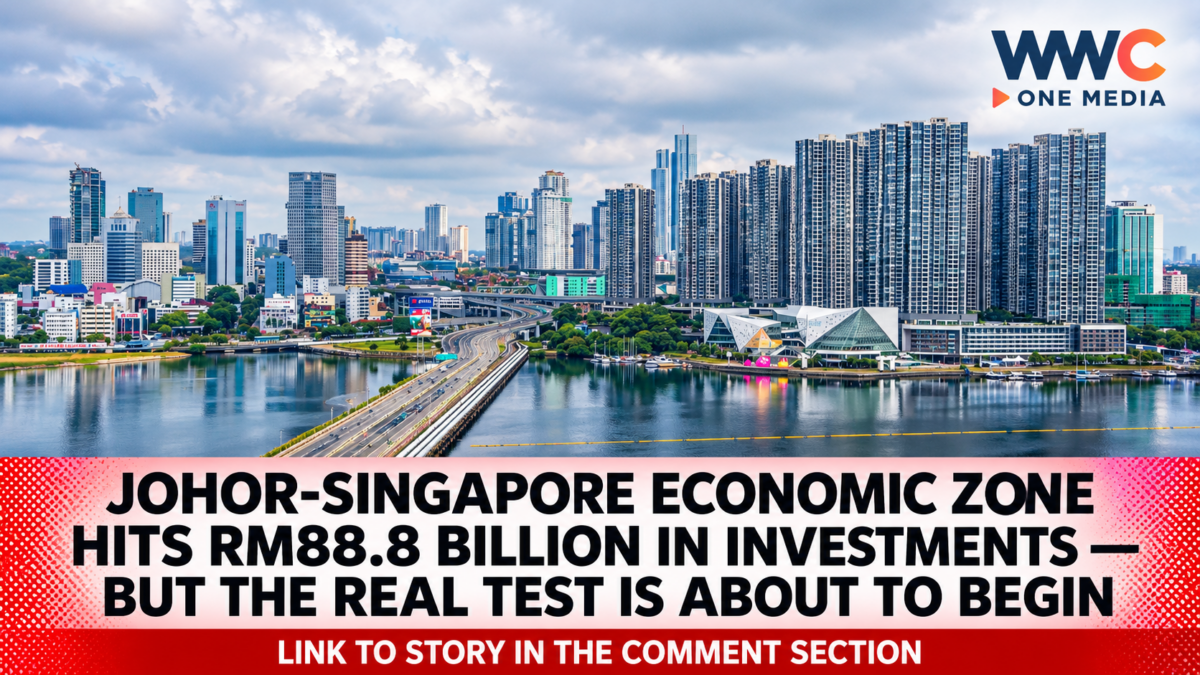
SINGAPORE — November 3, 2026 — The Johor-Singapore Special Economic Zone (JS-SEZ) has attracted RM88.83 billion (about S$28 billion) in approved investments between January 2025 and June 2026, marking a major early milestone for one of Southeast Asia’s most closely watched cross-border economic projects.
But the headline investment figure tells only part of the story.
About RM40.3 billion, or roughly 45%, has already been implemented, while approved projects are associated with 28,755 potential employment opportunities. Of those, 12,796 jobs are linked to projects that have already been implemented.
The figures were announced after the inaugural meeting of the Johor-Singapore Cooperation Ministerial Committee (JSCMC) in Singapore on Nov. 2.
The meeting signals that the two neighbours are moving beyond simply attracting investment and are now focusing on how to turn the SEZ into a functioning cross-border economic ecosystem.
RM88.83 billion approved — but implementation is the real test
The JS-SEZ was established through a bilateral agreement between Singapore and Malaysia in January 2025, with the aim of strengthening investment, improving the movement of goods and people, and making the region more competitive.
The latest investment numbers suggest strong early interest.
However, approved investment is not the same as completed investment.
With approximately 45% of the approved amount already implemented, authorities now face the more difficult task of ensuring that projects move from commitments and approvals into actual operations, employment and economic activity.
Singapore National Development Minister Chee Hong Tat said the progress reflected the close partnership between the two countries, while Malaysia’s Economy Minister Akmal Nasrullah Mohd Nasir stressed the importance of turning investment prospects into tangible outcomes.
That distinction could become increasingly important as both countries prepare the next phase of the zone.
A new ministerial committee takes charge
The Nov. 2 meeting was the first gathering of the Johor-Singapore Cooperation Ministerial Committee, which replaces the previous Joint Ministerial Committee for Iskandar Malaysia.
The new committee has a broader mandate covering the JS-SEZ as well as other areas of bilateral cooperation.
Its responsibilities include providing strategic direction and coordinating efforts involving:
- Investment and trade
- Talent development
- Movement of people and goods
- Cross-border connectivity
- Infrastructure and utilities
- Joint investment promotion
- Transportation
The committee brings together senior ministers and officials from both countries, including Chee, Akmal, Johor Menteri Besar Onn Hafiz Ghazi and Singapore Senior Minister of State Sun Xueling.
This broader coordination could prove crucial because the success of the SEZ depends on more than factories, offices and investment capital.
Businesses also need workers to move efficiently, goods to cross the border smoothly and infrastructure to keep pace with expansion.
The RTS Link could become a major economic catalyst
One of the most important pieces of that infrastructure puzzle is the Johor Bahru-Singapore Rapid Transit System (RTS) Link.
The rail connection between Bukit Chagar in Johor Bahru and Woodlands North in Singapore is expected to begin passenger operations in February 2027. The journey itself is expected to take around five minutes.
The system is designed to carry up to 10,000 passengers per hour in each direction, potentially providing a major alternative to the heavily congested Causeway.
For the JS-SEZ, that matters because easier cross-border movement could make it more practical for companies to operate across Singapore and Johor rather than treating the border as a major logistical barrier.
WWC One Media previously reported that the RTS is approaching its final testing and commissioning stage, although Johor still faces questions about whether supporting transport infrastructure will be ready to absorb the expected passenger volumes.
The project is therefore not simply a transport upgrade.
It could become one of the physical foundations of the wider economic zone.
Master plan expected in December
The next major milestone is expected in December 2026, when Singapore and Malaysia are scheduled to launch the JS-SEZ master-plan blueprint during their annual Leaders’ Retreat.
The blueprint is intended to establish the zone’s medium- to long-term direction, including plans for talent development, trade, investment, transportation and cross-border movement.
The master plan was previously expected earlier in 2026 but was delayed.
Malaysia’s Akmal said having the blueprint in place should help strengthen investment momentum in 2027.
Both countries have also agreed to hold another JS-SEZ Joint Investment Forum in the first quarter of 2027, providing another platform to attract businesses and encourage additional investment commitments.
Johor’s AI and data-centre boom adds another layer
The SEZ’s development is also unfolding as Johor becomes an increasingly important location for data centres and other technology infrastructure serving Southeast Asia.
WWC One Media recently reported that Singapore-based Princeton Digital Group (PDG) was seeking financing for a major data-centre campus in Johor, illustrating the scale of technology investment flowing into the state.
The growth of digital infrastructure could complement the JS-SEZ’s broader investment ambitions, particularly as companies look for land, energy, connectivity and access to Singapore’s business ecosystem.
But it also creates new demands on Johor’s infrastructure, workforce and utilities.
Infrastructure will determine whether the numbers become reality
Malaysia’s Budget 2027 initiatives include the development of Nexus Sedenak, improvements to infrastructure and transport connectivity, support for strategic investments and efforts to strengthen financial services in Forest City.
These measures are intended to make the zone more attractive to investors.
At the same time, Johor must prepare for substantially greater movement across the border.
WWC One Media has previously reported on the scale of traffic pressure at Woodlands Checkpoint, highlighting how quickly congestion can build when large numbers of travellers cross between Singapore and Johor.
Very Heavy Traffic Hits Woodlands Checkpoint as Queue Stretches to BKE
The upcoming RTS Link is expected to ease some of that pressure, but the wider road, public transport and border infrastructure will still matter.
A partnership bigger than one economic zone
The JS-SEZ was originally conceived as a way for Singapore and Malaysia to combine complementary strengths.
Singapore brings a highly developed financial, logistics and business ecosystem, while Johor offers additional land and room for large-scale industrial and infrastructure development.
When the agreement was signed in January 2025, both countries targeted attracting 50 projects and creating 20,000 skilled jobs within the first five years.
The latest figures suggest the initiative has generated significant investment interest well before that five-year target period has elapsed.
But the next stage may be more difficult.
Investment approvals have to become functioning businesses. New businesses need workers. Workers need transport. Transport needs infrastructure. And infrastructure needs long-term planning and investment.
That is why the December master plan could be more consequential than the RM88.83 billion headline figure.
The bigger question for 2027
For now, the JS-SEZ has a strong early number to point to: RM88.83 billion in approved investments.
But the more important question is what happens next.
Can Singapore and Johor turn those commitments into completed projects, thousands of new jobs and a genuinely integrated cross-border business hub?
With the RTS Link approaching its launch, a new ministerial committee now overseeing cooperation and the master plan expected in December, 2027 could be the year when the Johor-Singapore economic experiment moves from investment promise to measurable economic reality.
And that is where the biggest test begins.
Related WWC One Media Coverage
- Johor’s RTS Link Is Almost Ready — But One Missing Piece Could Decide Whether It Really Eases Singapore Traffic
- Singapore’s PDG Seeks $1.2 Billion for Malaysia AI Data Center — But Asia’s Growing Debt Boom Faces a Bigger Test
- RTS Link Checkpoint to Introduce Body Scanners as Singapore and Malaysia Strengthen Border Security
- RTS Link CEO Explains Why the JB-Singapore Rail Project Is More Complex Than It Looks
- Very Heavy Traffic Hits Woodlands Checkpoint as Queue Stretches to BKE