ZHUHAI, China — October 30, 2026. China’s prolonged real estate crisis has entered another troubling chapter after Fitch Ratings reportedly placed state-controlled Zhuhai Huafa Group on Rating Watch Negative over mounting refinancing concerns, intensifying questions about whether even government-backed developers can remain insulated from the country’s property downturn.
The reported rating action follows a turbulent week for the Guangdong-based conglomerate.
Huafa has been seeking extensions on loans from at least three Chinese banks, according to Bloomberg reporting, while people familiar with the matter said the group recently missed payments on two trust financing products.
The conglomerate had approximately 413 billion yuan, equivalent to US$61.9 billion, in interest-bearing liabilities as of March 2026.
It also reported a loss of 16.9 billion yuan in 2025, a sharp warning about the financial pressure caused by weak property activity.
Unlike the private developers that initially dominated China’s real estate crisis, Huafa is controlled by government authorities.
That makes its problems particularly significant.
If a major locally owned conglomerate is finding it difficult to refinance debt, investors may have to reassess how much protection state ownership actually provides.
Fitch’s negative watch puts Huafa’s financing risks in focus
Bloomberg reported on October 30 that Fitch Ratings had placed Zhuhai Huafa on negative watch over refinancing risks.
A Rating Watch Negative designation means a credit rating agency is reviewing the possibility of a rating downgrade because of developments that may weaken the borrower’s credit profile.
It does not, by itself, constitute an actual downgrade.
It also does not mean the borrower has been declared bankrupt or that every outstanding debt obligation has defaulted.
For creditors, the immediate concern is whether Huafa can meet upcoming payment obligations, negotiate extensions and maintain adequate access to financing.
The distinction is important.
A company may own substantial assets and still experience liquidity pressure if those assets cannot be converted into cash quickly enough to pay lenders.
Conversely, refinancing difficulties do not necessarily mean that a company’s total assets are worth less than its liabilities.
The outcome will depend on the terms lenders are willing to accept, the availability of new funding and any support from the company’s government shareholders.
Huafa is negotiating with banks to delay repayments
Before the reported Fitch action, Huafa had already drawn attention for its efforts to renegotiate bank financing.
According to Bloomberg reporting cited by The Business Times and other financial outlets, the group approached at least three banks seeking extensions to loan maturities and reductions in interest rates.
The company was reportedly seeking more favorable repayment arrangements as it confronted weakening profitability and a difficult property market.
Those negotiations matter because refinancing is essential for many large businesses.
Companies often repay maturing obligations by using operating cash flow, raising new funds or rolling existing debt into new financing arrangements.
When lenders become reluctant to extend credit, borrowers may be forced to find cash quickly, sell assets or negotiate payment changes.
Huafa’s difficulties therefore reflect more than a single disputed payment.
They reveal the challenge of managing a large debt portfolio during a period of weakening property sales and tightening financial confidence.
However, the public reporting reviewed does not establish that all bank facilities have been accelerated or that lenders have demanded immediate repayment of the entire outstanding balance.
Missed trust payments intensified investor concern
Huafa reportedly missed payments on two trust products that had recently reached maturity.
Trust financing is one of several channels Chinese companies have historically used to obtain funding outside conventional bank loans.
These products can involve different legal structures, underlying assets and investor protections.
Failure to pay a maturing trust product can damage confidence because it raises questions about the availability of cash and the reliability of other payment commitments.
Subsequent Bloomberg-linked reporting indicated that Huafa had repaid some investors on one of the overdue products.
That would represent partial progress in addressing the problem.
But repayment of some investors should not be described as evidence that every overdue obligation has been fully settled.
Nor does an overdue trust product automatically establish default on all bonds issued by the conglomerate.
The critical questions concern the precise obligations affected, the remaining unpaid amounts and whether the company can reach acceptable arrangements with creditors.
Why Huafa’s $62-billion debt burden matters
Huafa’s approximately 413 billion yuan in interest-bearing liabilities includes borrowing arrangements such as loans, trust financing and bonds.
That is a substantial exposure for a business whose fortunes remain closely tied to the property market.
The conglomerate also reported approximately 765 billion yuan in total assets as of March.
Those assets include interests in real estate and other business activities.
But comparing the two headline figures does not provide a complete measure of financial health.
Total assets and interest-bearing debt are different accounting categories.
Other liabilities may exist, while asset values can depend on market conditions and accounting assumptions.
More importantly, the group needs sufficient liquid resources to meet payments as they fall due.
Buildings, land and project investments may be valuable over the long term but difficult to sell immediately without accepting steep discounts.
That is why refinancing risk can become serious even for a company with substantial reported assets.
A 16.9-billion-yuan loss highlights the property downturn
Huafa reported a net loss of approximately 16.9 billion yuan for 2025.
The company has attributed fluctuations in profitability partly to the prolonged weakness of China’s property industry.
Real estate development and urban operations accounted for roughly half of its revenue during the year.
That leaves the group exposed to housing demand, construction activity, property prices and financing conditions.
When buyers delay purchases and developers face falling prices, cash inflows can weaken.
At the same time, lenders may become more cautious because they fear further deterioration in property collateral values.
The combination can create a damaging cycle.
Lower sales reduce cash.
Reduced cash makes repayment more difficult.
Greater repayment risk causes lenders to demand additional protection or higher returns.
That, in turn, can make refinancing even harder.
Huafa’s current situation illustrates how that cycle can affect a major state-linked company.
Why government ownership makes this case different
Zhuhai Huafa is not an ordinary privately owned real estate developer.
Approximately 93.5% of the group is held by Zhuhai’s state-owned assets authority, while the remaining stake belongs to provincial finance authorities in Guangdong.
The group has played an important role in local urban development, financial services and investment.
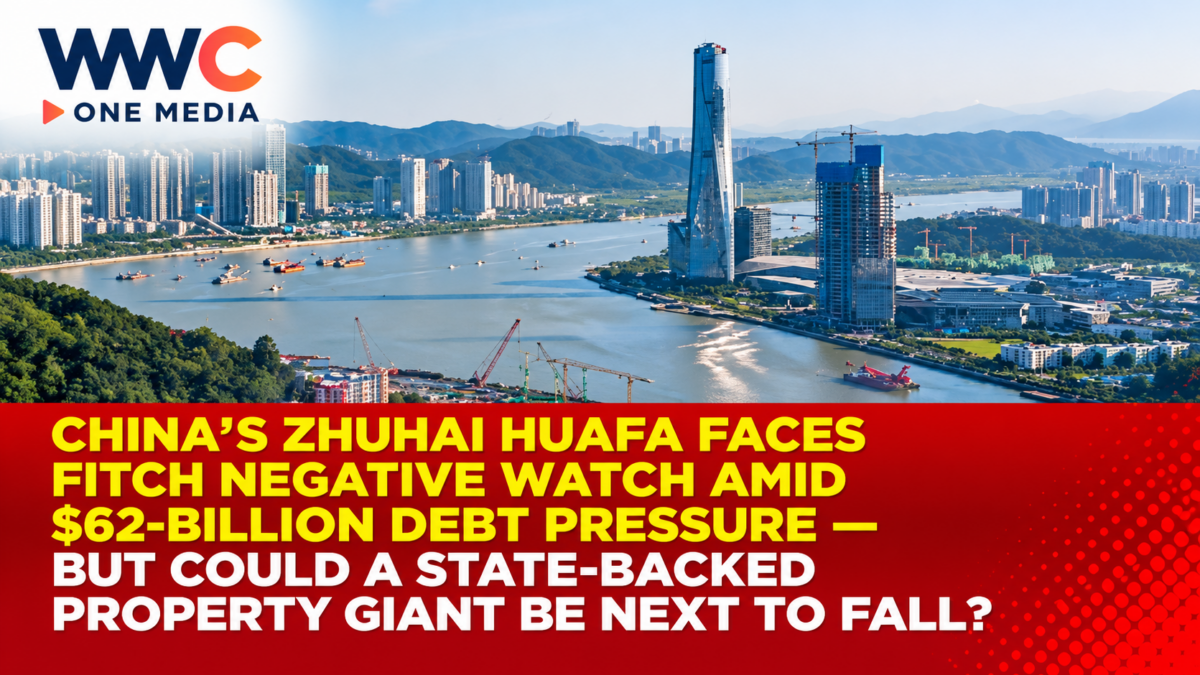
It has been associated with major projects, including the 330-meter Zhuhai Tower, and has developed more than 200 residential projects across China.
Government ownership can provide practical advantages.
A strategically important company may have established relationships with banks, public institutions and regional authorities.
It may also benefit from policy support or financial assistance intended to prevent disruption to local employment and economic development.
However, state ownership should not be confused with an unconditional guarantee of every borrowing obligation.
Unless a specific debt instrument benefits from an enforceable government guarantee, investors cannot automatically assume that taxpayers will cover all losses.
That uncertainty is now central to Huafa’s credit outlook.
A locally owned giant may have less support than a central state enterprise
China has multiple layers of state ownership.
Some enterprises are controlled by the central government, while others belong to provinces, cities or local government investment entities.
Those distinctions can matter greatly during a debt crisis.
Local governments may have more limited fiscal resources than the central government.
They may also face pressure from weaker land-sale income and slowing property-related tax collections.
Bloomberg Intelligence analysts have warned that local government-backed developers can face difficult refinancing conditions even when they remain strategically important.
The risk is not necessarily that authorities will provide no assistance.
It is that the amount, timing and form of any support may be uncertain.
That creates a challenge for credit investors who previously viewed state-linked borrowers as substantially safer than private property companies.
Huafa’s reported refinancing problems are testing those assumptions.
Huafa bond prices plunged as creditors reassessed risk
News of the group’s repayment difficulties triggered sharp movements in financial markets.
Bloomberg reporting indicated that one offshore yuan-denominated bond fell as much as 17% in a single day, reaching approximately 74% of face value.
A bond trading below its original face value may indicate that investors demand a higher effective return to compensate for perceived credit risk.
However, a steep decline in bond prices does not automatically establish that the issuer has stopped paying every bond obligation.
It reflects market pricing under prevailing conditions.
The listed property arm, Zhuhai Huafa Properties, also experienced selling pressure.
Its Shanghai-listed shares fell as much as 8.9% during trading on October 27.
These movements indicate a rapid reassessment of investor confidence.
But they should be presented as historical trading observations, not as the current market price of the securities.
China’s housing crisis is reaching companies once considered safer
The difficulties at Huafa come after years of turmoil involving major Chinese developers.
Evergrande became a symbol of the sector’s problems when its heavily indebted expansion model unraveled.
Other companies, including China Vanke, have also faced financing and repayment challenges.
The common problem is the legacy of a property system built on rapid construction, substantial borrowing and confidence that housing sales would continue expanding.
When property demand weakened, companies found themselves carrying large financing obligations without the same level of incoming cash.
The situation at Huafa suggests that refinancing stress is no longer restricted to the private developers most closely associated with earlier defaults.
The more consequential question is whether weaker confidence will affect other local government-backed companies whose businesses depend heavily on property development and land-related activity.
Beijing is trying to rebuild the property financing model
China has been pursuing reforms to reduce the housing market’s reliance on presales.
Under the traditional model, property developers frequently sold homes before completion and relied on incoming buyer funds to support construction.
The arrangement helped finance decades of rapid expansion.
But it also created vulnerabilities when sales slowed or projects were delayed.
WWC ONE MEDIA previously examined the reforms in China’s Property Reset Has Begun: Why Beijing Is Dismantling Housing Presales Without Killing Them Overnight.
The article explained how authorities are attempting to shift more construction-financing responsibility to developers and financial institutions.
Such reforms may improve consumer protection and financial discipline over time.
But they can also increase short-term pressure on companies that already have large debts and limited cash reserves.
The challenge is changing an unsustainable financing structure without creating another severe liquidity shock.
Banks face pressure as property-linked borrowers struggle
A prolonged property downturn affects more than developers.
Banks and other lenders may face weaker demand for credit, pressure on borrowers’ repayment capacity and uncertainty over real estate collateral.
In September, WWC ONE MEDIA examined China’s efforts to strengthen financial institutions in China Pumps US$54 Billion Into Banks and Insurers in Major Financial Powerhouse Push.
That report discussed a broader recapitalization initiative and the continuing effect of property-related financial stress.
The program is not evidence of a specific rescue package for Huafa.
Nevertheless, it provides context for the challenges facing China’s banking system.
Authorities must maintain financial stability while avoiding incentives that encourage companies to borrow excessively because they expect to be rescued.
That balance becomes more difficult when a troubled borrower is deeply connected to local infrastructure, banks and government finances.
Low Chinese bond yields do not eliminate corporate credit risk
Another important consideration is the difference between Chinese government borrowing costs and the financing conditions faced by individual companies.
China’s government bond yields have remained relatively low compared with yields in some major developed markets.
But low sovereign yields do not guarantee easy borrowing for every corporate issuer.
WWC ONE MEDIA explored that divergence in China-US Bond Yield Gap Nears Record as Global Debt Rout Sends Shockwaves Through Markets.
Government bonds and corporate bonds carry different risks.
Creditors may demand substantially higher returns from a business with uncertain cash flow or upcoming refinancing requirements.
In severe cases, investors may become unwilling to provide new financing at any commercially sustainable price.
Huafa’s bond selloff highlights why individual issuer risk remains important even in an economy with relatively low benchmark interest rates.
China’s weak domestic demand complicates the recovery
The property crisis is also linked to broader weakness in domestic economic activity.
Household confidence, consumption and private investment have all been affected by the prolonged housing downturn.
Although exports and technology manufacturing have supported portions of China’s economy, the real estate sector remains a significant source of financial pressure.
WWC ONE MEDIA examined the wider picture in China’s Q3 Economic Growth Set to Rebound as Export Boom Drives Manufacturing, but Weak Consumer Spending Raises Concerns.
That report discussed the contrast between export resilience and weak domestic demand.
It was based on economic expectations available before the official third-quarter figures were released, so it should not be used as proof of the eventual GDP outcome.
The broader point remains relevant: stronger manufacturing or exports do not automatically repair property companies’ balance sheets.
Developers need buyers, reliable financing and sufficient cash flow to service their obligations.
What must happen for Huafa to stabilize its finances?
Huafa’s immediate outlook depends on several developments.
The company needs clarity over how its overdue trust products will be resolved.
It also needs sufficient liquidity to meet upcoming payments and reach workable arrangements with lenders.
Support from government shareholders could provide additional confidence, but its actual form and extent remain important unknowns.
Investors will be watching whether the group can refinance maturing debt, sell assets without excessive losses or secure additional funding.
They will also be monitoring subsequent Fitch rating decisions and any formal disclosures from the company.
A successful extension could reduce immediate repayment pressure.
But pushing debt maturities into the future does not necessarily resolve an underlying problem if the business continues losing money or generating insufficient cash.
A durable recovery would require a credible combination of financing, operational improvement and sustainable debt management.
What the crisis means for Asian investors
The Huafa situation reinforces the importance of distinguishing different types of Chinese debt exposure.
A local government-controlled conglomerate is not necessarily equivalent to a central government borrower.
A listed property subsidiary also should not be confused with its unlisted parent group.
Their financial statements, debt obligations and legal responsibilities can differ.
Investors assessing Chinese corporate bonds need to examine the precise issuer, security terms, repayment priorities and any documented guarantees.
For Asian financial markets, the wider concern is whether refinancing problems spread to other state-linked companies.
A single company’s repayment difficulties do not prove that China’s entire banking system is facing a collapse.
But they can influence the cost and availability of capital for businesses viewed as having similar risks.
Could China’s property troubles affect the Philippines?
The Philippines is connected to China’s economy through trade, regional financial markets and investment.
A prolonged Chinese property slowdown may affect demand for certain imported commodities, industrial materials and construction-related products.
It could also influence business confidence and investment decisions across Asia.
However, the reported Huafa difficulties do not establish any direct losses for Philippine banks, property developers or households.
Such claims would require evidence of specific financial exposures.
The more immediate significance for the Philippines is the possibility that continued weakness in one of Asia’s largest economies could affect regional demand and investor sentiment.
The extent of any impact will depend on how China’s authorities, lenders and corporate borrowers respond.
The bigger question: Is China’s property crisis entering a more dangerous phase?
Zhuhai Huafa’s reported negative rating watch adds to evidence that financial stress in China’s property sector remains unresolved.
The group carries approximately $62 billion in interest-bearing debt.
It reported a substantial loss last year.
It has sought loan extensions and faced problems involving overdue trust financing products.
Those developments would be concerning for any large corporation.
They are especially significant for an enterprise closely connected to local government.
Huafa’s case raises difficult questions about how far public authorities will go to support strategically important borrowers and whether banks will continue extending financing to companies with weakened cash flow.
A government-backed rescue remains possible.
Creditors may also agree to repayment extensions that prevent an immediate escalation.
But the path forward remains uncertain.
China’s property crisis has already brought down major private developers and forced others into painful financial negotiations. With Zhuhai Huafa now facing heightened scrutiny, the next test is whether state ownership can still reassure creditors—or whether the country’s debt crisis is moving deeper into the institutions that once appeared safest.