
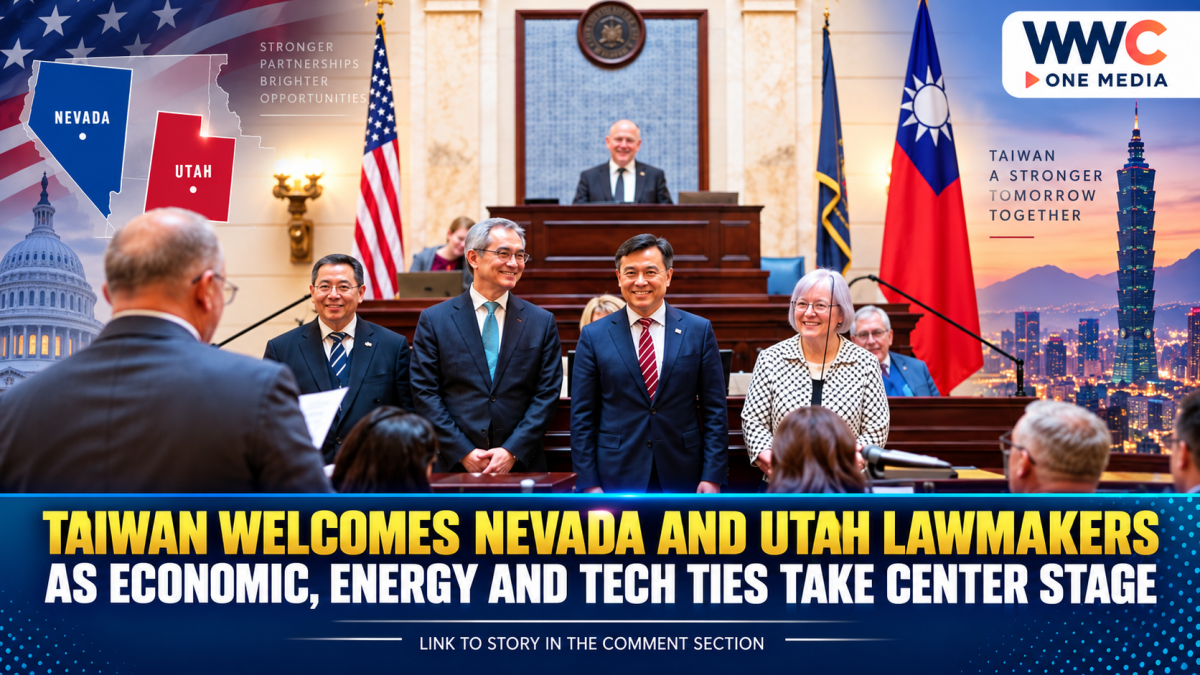
TAIPEI — Taiwan is stepping up engagement with U.S. state governments as senior lawmakers from Nevada and Utah visit the island for talks focused on investment, green energy, technology and talent development.
The delegation was welcomed at a luncheon on Thursday, September 3, by Taiwan Deputy Foreign Minister Chen Ming-chi, who highlighted opportunities to expand cooperation beyond existing economic ties.
According to Taiwan’s Ministry of Foreign Affairs, the discussions covered Taiwan-U.S. trade and investment, green-energy technology and talent cultivation, with potential future cooperation in semiconductors, electric vehicles and information and communications technology.
Why Nevada and Utah matter to Taiwan
The visit comes as Taiwan seeks to deepen relationships not only with Washington but also with individual U.S. states, particularly in sectors connected to advanced manufacturing, technology and investment.
Chen said Nevada and Utah have become important destinations for Taiwanese biotechnology companies and expressed hope that cooperation could expand into semiconductors, EVs and ICT.
He also encouraged the two states to establish representative offices in Taiwan, which could provide a more permanent channel for economic and educational exchanges.
The Taiwanese government also wants stronger connections between universities and institutions in Taiwan and the two U.S. states through the Taiwan-U.S. Education Initiative, placing workforce development and semiconductor talent high on the agenda.
Elaine Marzola leads the delegation
The delegation is headed by Elaine Marzola, Speaker Pro Tempore of the Nevada Assembly.
Taiwan’s Foreign Ministry said Marzola praised Taiwan’s development and specifically highlighted its achievements in education, semiconductor talent training and public healthcare.
She also expressed appreciation for long-running cooperation between Taiwan and the two states and said the delegation hoped to strengthen exchanges across multiple areas.
Marzola’s current position is also confirmed by the Nevada Legislature, which lists her as Speaker Pro Tempore of the Assembly.
Utah’s relationship with Taiwan has been building for decades
The latest visit is part of a much broader relationship.
Utah and Taiwan have maintained a sister-state relationship since 1980, and Utah lawmakers have repeatedly backed stronger economic, educational and cultural links with Taiwan.
In February 2026, the Utah State Senate unanimously approved a resolution supporting Taiwan’s participation in international organizations and calling for stronger exchanges in areas including economic and cultural cooperation.
More recently, Utah state Senator David Hinkins visited Taiwan in August, with discussions involving bilateral trade, Taiwanese companies expanding into the United States, energy resources and supply-chain development. The Importers and Exporters Association of Taipei said the talks also explored opportunities connecting Utah’s natural resources with Taiwan’s industrial capabilities.
That makes the latest delegation significant from an economic perspective: the relationship is increasingly extending into energy security, advanced manufacturing, technology and supply chains.
Taiwan’s semiconductor strength remains a major attraction
Semiconductors are at the heart of Taiwan’s global economic importance, and talent development has become an increasingly important part of its international partnerships.
During the latest meeting, Taiwan specifically highlighted semiconductor talent training as an area where cooperation with U.S. educational institutions could grow.
The emphasis reflects a broader trend in Taiwan-U.S. relations, with American policymakers increasingly focused on supply-chain resilience, advanced technology and Taiwan’s role in the global semiconductor ecosystem.
A separate U.S. congressional delegation led by Utah Senator John Curtis visited Taiwan earlier in 2026, illustrating that engagement is taking place at both the federal and state levels. That delegation met with Taiwan’s senior political leadership and discussed the broader U.S.-Taiwan relationship.
Green energy and EVs could become the next growth areas
The latest talks also put green energy and electric vehicles on the table.
For Taiwan, cooperation with U.S. states could provide opportunities to diversify investment and strengthen access to resources, technologies and markets.
For Utah and Nevada, deeper ties with Taiwanese companies could potentially bring investment, technology partnerships and supply-chain opportunities.
The exact projects or investment commitments resulting from the latest visit have not been announced, however. Taiwan’s Foreign Ministry described the discussions as opportunities for future cooperation rather than announcing a new bilateral deal.
A quiet but potentially important signal
The visit may not carry the headline-grabbing profile of a visit by a U.S. senator or Cabinet official, but it highlights something increasingly important in Taiwan’s international strategy: state-level relationships can create additional channels for trade, investment, education and technology cooperation.
Taiwan’s Foreign Ministry said it hopes visits by U.S. state legislators can create broader opportunities for substantive cooperation and strengthen support for Taiwan among political and economic communities across North America.
For now, the focus is on practical cooperation rather than a major new agreement.
But with semiconductors, EVs, green energy, biotechnology, education and supply chains all entering the conversation, the latest Nevada-Utah delegation could be another step in expanding Taiwan’s economic network across the United States.
And the bigger question is what comes next: will these discussions turn into concrete investments and long-term technology partnerships?
Accuracy & source check
I cross-checked the Taiwan News report against Taiwan’s official Ministry of Foreign Affairs announcement, the Nevada Legislature’s official profile for Elaine Marzola, and independent reporting/background on recent Utah-Taiwan economic engagement. The official Taiwanese account confirms the September 3 luncheon and the subjects discussed; no new investment agreement or specific dollar-value deal was announced in the sources reviewed, so this rewrite does not claim one.




Leave a Reply