
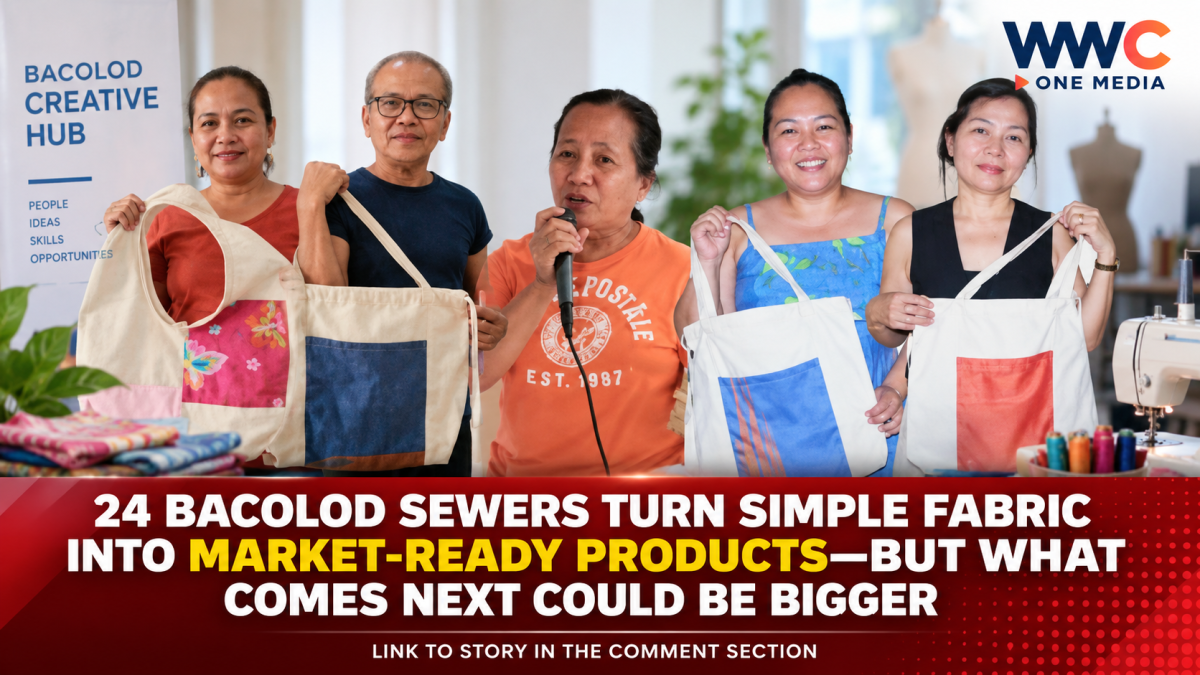
BACOLOD CITY — What started with sewing machines, fabric and raw creativity is now becoming a potential pathway to livelihood and entrepreneurship for a group of Bacolod artisans.
Twenty-four participants have completed the pilot G-Hive Artisan Makers Bootcamp Sewing Track, producing contemporary, market-oriented items while gaining technical and business skills designed to help turn their craft into sustainable income opportunities.
The five-day training, held from August 24 to 28, 2026, was organized by the Bacolod City Department of Local Economic Development and Investment Promotions (DLEDIP) through the G-Hive creative hub.
According to the Philippine News Agency, the participants learned how to transform canvas, hablon or handwoven textile, and other locally available materials into useful products such as tote bags. Beyond sewing, the program was designed to strengthen participants’ technical proficiency, creativity and ability to explore micro-enterprise opportunities.
From creative skills to potential businesses
The program reflects a broader vision behind G-Hive: to give Bacolod’s creative community a place where skills can move beyond hobby-level production and toward professional and commercial opportunities.
DLEDIP head and city investment officer Frances Mae Llamas said the initiative was created to provide local talent with a pathway from grassroots creativity toward wider opportunities.
The first batch of graduates finished the program with a certified portfolio, business and production plan, technical skills and a maker network, according to PNA.
That combination is significant because the training does not stop at teaching participants how to operate a sewing machine. It also introduces the production and entrepreneurial side of creating products that can potentially be sold in the market.
Five artisans recognized for their work
Five of the 24 graduates received special recognition during the completion of the pilot program.
Vida Hayes, founder of Vivo Handmade, received the Most Improved Artisan Award.
Other awardees were:
- Roselyn Olchondra — Artisan Excellence Award
- Jeanne Marie Alindog — Most Creative Maker Award
- Elvira Prado — Master of Precision Award
- Elizabeth Abad — Outstanding Artisan Spirit Award
The youngest participant, 23-year-old Zoey Tuclaud, said the free training gave her practical knowledge in sewing, cutting and properly using a sewing machine, while also giving her skills she could potentially use if she decides to establish a business.
Turning preloved materials into products
One of the program’s notable elements was the use of preloved canvas materials.
Trainer Jinky Cantancio, an interior designer and educator, said participants were guided in transforming used canvas into functional and attractive tote bags.
The approach highlights how creative training can combine craftsmanship, product development and the reuse of existing materials—while giving artisans an opportunity to develop products with potential commercial value.
G-Hive is bigger than sewing
The sewing bootcamp is only one part of Bacolod’s larger G-Hive initiative.
The city launched G-Hive in 2026 as a creative industry hub located at the Mansilingan Activity Center, designed to support artists, innovators and micro, small and medium enterprises.
The facility includes four major areas: The Foundry, The Studio, The Academy and The Gallery.
The Foundry is intended to help transform ideas and entrepreneurial projects into market-ready products and commercial intellectual property. The Studio provides professional-grade tools for digital creators, while The Academy serves as a training venue for MSMEs and the local workforce. The Gallery provides a space where local products, artworks and creative innovations can be showcased.
The city initially offered access to the facility free of charge while operational guidelines, including possible user or rental fees, were being developed.
More sewing batches are coming
The pilot batch may be just the beginning.
According to PNA, the second sewing batch is scheduled for September 28 to October 2, while the third batch is set for October 26 to 30, 2026.
That continuing schedule suggests that the city is positioning G-Hive not simply as a one-time livelihood workshop but as part of a broader effort to build Bacolod’s creative workforce.
The development also comes as Bacolod seeks to strengthen its creative economy and provide local talents with facilities, training and networks that could help them compete beyond the local market. PIA previously reported that G-Hive was designed to connect local creativity with technology, innovation and potential global markets.
For the 24 first-batch graduates, however, the immediate achievement is much simpler—and potentially more meaningful: skills that can now be turned into products, and products that could eventually become businesses.
And with two more sewing batches scheduled this year, Bacolod’s experiment in turning creative talent into livelihood may only be getting started.




Leave a Reply