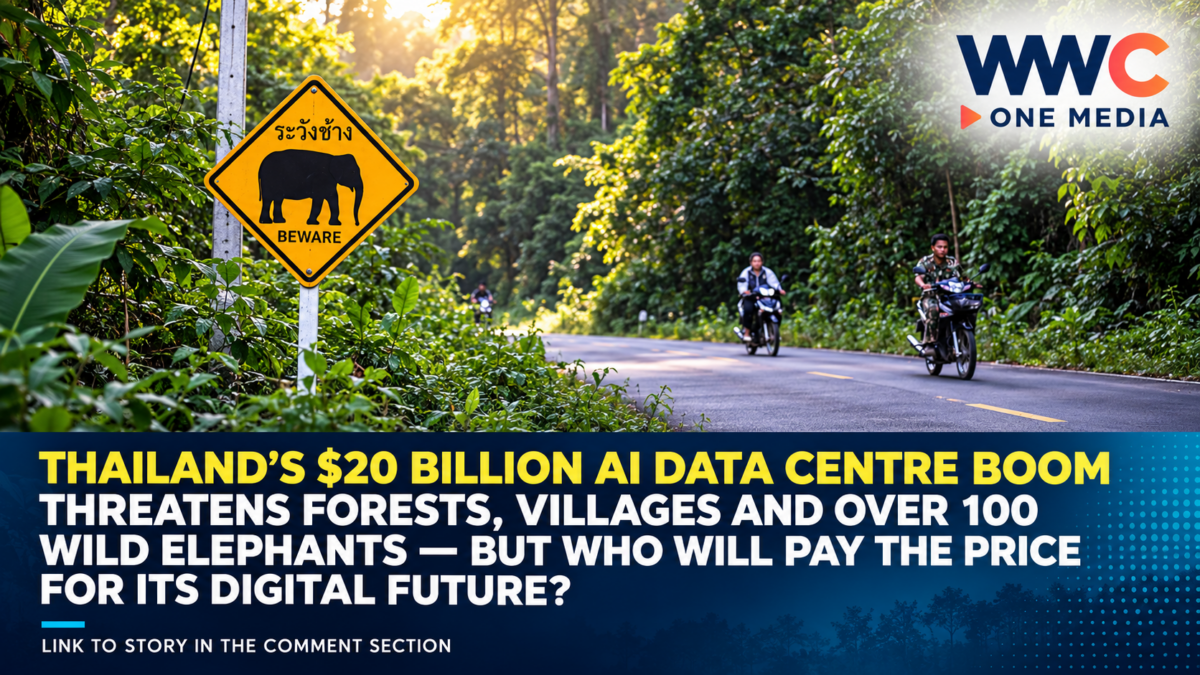
CHANTHABURI, Thailand — October 25, 2026 — Thailand’s ambitious push to attract billions of dollars in artificial intelligence, cloud computing and data centre investments is raising an increasingly urgent question: Who will pay the environmental price for the country’s digital transformation?
In eastern Thailand, a proposed reservoir capable of storing nearly 100 million cubic metres of water has emerged as a flashpoint between industrial expansion, agricultural security and wildlife conservation.
The Khlong Wang Tanot reservoir, planned for Chanthaburi province, could submerge extensive forest areas and affect villages near the protected Khao Sip Ha Chan landscape, according to a Channel NewsAsia investigation published on October 25.
The project is intended to strengthen regional water supplies amid growing demand from agriculture, households and industry. But conservationists fear it could disrupt the movements of more than 100 wild elephants and worsen encounters between the animals and nearby communities.
Meanwhile, farmers and residents are questioning whether they will receive their fair share of water if new infrastructure increasingly serves the country’s expanding industrial corridor.
Nearly 100 million cubic metres of water — but at what cost?
The proposed Khlong Wang Tanot reservoir would have a storage capacity of approximately 99.5 million cubic metres, making it the fourth and largest reservoir in the Wang Tanot watershed system.
Originally studied in the 1990s to address seasonal water shortages, the project has taken on greater significance as eastern Thailand transforms into a major industrial and digital infrastructure destination.
Thailand’s Cabinet approved the project in August 2026, with construction envisioned over seven years.
However, construction cannot proceed until the necessary authorisations to use protected forest land are obtained, including approval from the National Park Committee.
The potential impact on communities is substantial.
In Ban Klong Yang, a village located within the proposed reservoir area, local leader Seeda Saengkla represents a community of 334 households and 654 residents.
Some villagers are willing to relocate if the project benefits the wider country. Yet they remain deeply concerned about losing homes, farmland and established livelihoods without sufficient support.
For affected families, the issue goes beyond financial compensation. Relocation could disrupt generations of farming, community relationships and access to familiar resources.
The central demand from residents is that any relocation programme must provide a sustainable future rather than simply force families to start again.
More than 100 wild elephants could face disrupted habitat
One of the project’s most controversial implications involves Thailand’s wild elephant population.
Forests around Khao Sip Ha Chan form part of the country’s Eastern Forest Complex, an important network of wildlife habitat connecting protected areas.
More than 100 elephants are known to use the surrounding landscape as they travel between feeding grounds and water sources.
Wildlife specialists warn that flooding established routes could force elephant herds to move into new territories, including agricultural plantations and rural settlements.
Such movements could intensify existing human-elephant conflicts.
Elephants frequently travel along familiar routes learned across generations. Changes to those pathways can affect how herds find food, water and suitable habitat.
For farmers, the risks are already visible.
Rubber plantation owner Silchai Sae Jia, 73, told CNA that elephants regularly cross his property, damaging trees and creating dangerous conditions for workers.
Although his land would remain outside the reservoir’s flood zone, he fears that removing nearby habitat could push more elephants toward his plantation.
Wildlife experts caution that habitat fragmentation can worsen encounters between elephants and humans, particularly as agricultural and industrial developments reduce the land available to roaming herds.
Thailand’s Royal Irrigation Department has acknowledged the potential risks and says the project includes provisions for wildlife monitoring and habitat connectivity.
However, the effectiveness of those measures remains an important unresolved question.
Thailand’s data centre boom creates new pressure on water supplies
The reservoir controversy comes as Thailand accelerates efforts to position itself as a leading destination for artificial intelligence infrastructure.
Its Eastern Economic Corridor, spanning Chachoengsao, Chonburi and Rayong provinces, is emerging as a strategic location for industrial facilities, technology investments and large-scale data centres.
These facilities provide the computing infrastructure needed for cloud services, AI applications, digital payments and other technologies.
But powerful servers generate considerable heat, requiring cooling systems that can consume substantial electricity and, depending on their design, large volumes of water.
According to figures cited by CNA, 29 data centre projects have applied for investment incentives in the Eastern Economic Corridor, accounting for more than half of such applications nationwide.
The growing concentration of computing facilities presents a difficult challenge for policymakers attempting to balance technology investment with reliable water access for surrounding communities.
Thailand’s Office of National Water Resources expects industrial water requirements in the Eastern Economic Corridor to increase by 58% between 2024 and 2037.
Water suppliers and industrial estate operators are consequently expanding pipelines, treatment systems and storage infrastructure.
However, residents fear that industrial users with substantial financial resources could gain an advantage over farmers and households during periods of scarcity.
World Bank warns of possible 72% water-supply shortfall in dry years
The scale of eastern Thailand’s future water challenge is significant.
A World Bank assessment projects that the Eastern Economic Corridor could face a water-supply shortfall of almost 40% by 2037 under average hydrological conditions.
In particularly dry years, the projected gap could reach 72%, even after accounting for planned water infrastructure investments.
These figures describe the projected difference between regional water demand and available supply, not a forecast that 72% of existing water resources will disappear.
The projections underscore why water management has become central to Thailand’s industrial strategy.
For agricultural communities, the consequences could be particularly serious.
Durian cultivation, an important and increasingly lucrative agricultural activity in eastern Thailand, requires dependable water supplies.
Farmers who previously relied on seasonal rainfall and smaller ponds have become increasingly concerned about drought, irrigation availability and rising competition for water.
Some residents question why a new reservoir is needed when existing facilities have not consistently delivered sufficient water to all nearby farms.
The Royal Irrigation Department maintains that the proposed reservoir would improve agricultural supply and help reduce downstream flooding.
It also says any eventual transfers of surplus rainy-season water toward Rayong province would take local requirements into account.
The AI investment boom brings billions — and difficult choices
Thailand has strong economic incentives to expand its digital infrastructure.
In March 2025, Reuters reported that the country’s investment authorities approved approximately 90.9 billion baht, or US$2.7 billion, in new data centre and cloud-related investments.
The investments included projects by major international and domestic operators, reinforcing Thailand’s ambition to compete for growing demand across Southeast Asia.
The country’s digital infrastructure opportunity has continued expanding as technology companies search for locations offering industrial land, connectivity and dependable utilities.
But the rapid growth has prompted regulators to examine whether existing environmental safeguards can keep pace.
In September 2026, Thailand’s authorities initiated a temporary pause affecting 49 data centre projects under construction and 117 awaiting approval, according to The Nation.
The review was intended to establish clearer standards for electricity consumption, water requirements, site selection, environmental protection and economic benefits.
The broader concern is that attracting investment alone does not guarantee that surrounding communities will experience corresponding improvements in living standards.
Could recycled water help protect forests and communities?
As pressure mounts, government agencies, infrastructure operators and environmental advocates are examining alternatives to major reservoir construction.
Potential approaches include treating and reusing industrial wastewater, improving agricultural irrigation efficiency, upgrading existing reservoirs and reducing losses across regional distribution networks.
Thailand’s Eastern Economic Corridor Office has also been working to increase water efficiency and support the use of treated wastewater for industrial purposes.
In October 2026, officials outlined infrastructure plans intended to give data centres access to more suitable utilities while reducing direct competition with residential water users.
Conservation authorities have separately advocated a smaller Wang Tanot reservoir design, combined with improvements to existing water infrastructure.
The alternative would affect substantially less protected forest, although irrigation officials argue that smaller-scale measures would not meet projected water requirements.
That disagreement illustrates the central dilemma: Thailand needs dependable water supplies, but providing them through large-scale development can create additional environmental and social costs.
Thailand faces a defining test of sustainable development
The Khlong Wang Tanot dispute is not simply a disagreement over building another reservoir.
It raises broader questions about how Southeast Asian economies should manage the physical demands of rapidly expanding artificial intelligence infrastructure.
Thailand stands to benefit from new investment, greater computing capacity and opportunities to develop high-technology industries.
At the same time, forests, wildlife and farming communities face pressures that cannot be measured by investment figures alone.
A decision to proceed with the reservoir could strengthen long-term water storage but also permanently transform the surrounding landscape.
A decision to reduce or redesign the project would require authorities to demonstrate that alternative water-management strategies can reliably meet future demand.
For villagers facing displacement and farmers already encountering wild elephants, those choices are far from theoretical.
Thailand’s challenge is no longer simply how quickly it can become an Asian AI powerhouse. It is whether the country can build its digital future without sacrificing the people, forests and wildlife that share its increasingly limited natural resources.
The question now is whether economic growth and environmental protection can advance together — or whether one will come at the expense of the other.