Washington, Moscow and Beijing | October 25, 2026
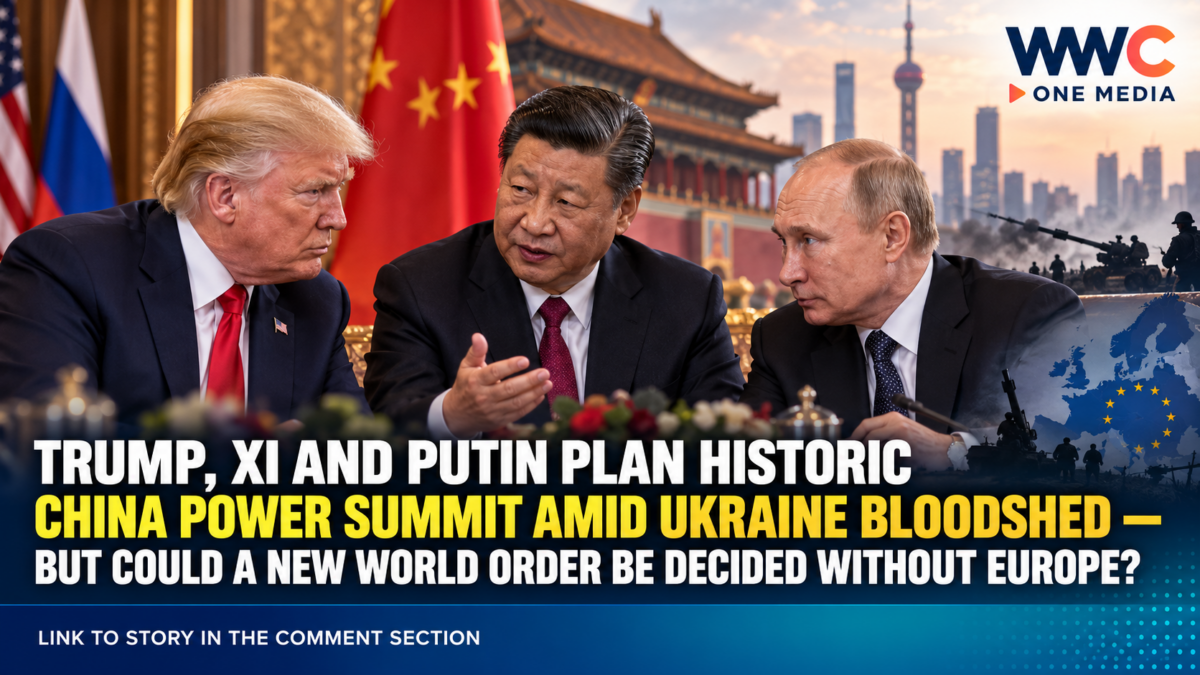
A proposed summit bringing together US President Donald Trump, Chinese President Xi Jinping and Russian President Vladimir Putin is raising a high-stakes question across the international community: Could three of the world’s most powerful leaders negotiate a new geopolitical arrangement while Ukraine and America’s European allies remain outside the room?
With the Asia-Pacific Economic Cooperation (APEC) leaders’ summit scheduled for November 18–19 in Shenzhen, China, speculation is intensifying over an unprecedented three-way meeting that could have major consequences for global security, nuclear weapons negotiations and the ongoing Russia-Ukraine war.
But behind the promise of historic diplomacy lies a potentially explosive controversy.
Critics warn that a summit involving Washington, Moscow and Beijing could strengthen Putin’s international standing without delivering meaningful progress toward ending Russia’s invasion of Ukraine.
Supporters of high-level diplomacy, meanwhile, see an opportunity to reduce tensions among three nuclear-armed powers, particularly if discussions focus on arms control rather than negotiating Ukraine’s future without Ukrainian participation.
As of October 25, no trilateral summit has been formally confirmed, and no agreed agenda has been announced.
Kremlin confirms discussions, but no agreement has been reached
The possibility of a Trump-Xi-Putin summit gained international attention after reports that Putin had proposed bringing the three leaders together during the upcoming APEC gathering in China.
On October 19, Kremlin spokesperson Dmitry Peskov acknowledged that the idea had been discussed.
However, Moscow emphasized that no specific agreement had been reached regarding the meeting, its participants or its agenda.
Trump subsequently indicated that he would be willing to meet Xi and Putin, although his preferred subject appeared to differ from Moscow’s reported objectives.
While Putin reportedly wanted discussions focused on the war in Ukraine, Trump said he was particularly interested in nuclear disarmament and reducing global nuclear threats.
This difference could become one of the biggest obstacles to organizing the gathering.
China has also stopped short of publicly committing to the proposed meeting, leaving considerable uncertainty over whether the diplomatic encounter will happen.
Why Putin could emerge as the biggest winner
For Moscow, a summit with Trump and Xi could deliver a significant diplomatic achievement even without an immediate breakthrough in Ukraine.
Since launching its full-scale invasion in February 2022, Russia has faced extensive Western sanctions, diplomatic pressure and efforts by European governments to isolate its leadership.
A high-profile meeting with the American and Chinese presidents would provide Putin with an opportunity to demonstrate that Russia remains central to global decision-making.
It could also strengthen Moscow’s argument that major security questions should be negotiated directly among the world’s leading powers.
In a commentary published by Channel News Asia on October 25, Bloomberg Opinion columnist Marc Champion warned that such a summit could benefit Putin by granting him international recognition and creating opportunities to discuss European security without the participation of affected countries.
The concern goes beyond diplomatic appearances.
A meeting that allows powerful states to negotiate territorial or security arrangements without consulting smaller nations could undermine longstanding principles of sovereignty and national self-determination.
For Ukraine and its European partners, the question is whether a great-power summit would accelerate peace negotiations or weaken Kyiv’s position at the negotiating table.
Ukraine pushes back against talks that exclude Kyiv
Ukrainian officials have strongly criticized the possibility of peace discussions conducted without their country’s participation.
Foreign Minister Andrii Sybiha argued that a meeting involving Ukraine, Russia and the United States would be more productive than one bringing together Russia, China and the United States.
Kyiv fears that an agreement reached without Ukrainian involvement could pressure it to accept unfavorable territorial, military or security concessions.
These concerns come at an increasingly difficult point in the war.
Russian missile and drone attacks have continued to hit Ukrainian targets, while diplomatic tensions between Washington and Kyiv have grown.
Recent reporting has highlighted disputes over Western military assistance, intelligence cooperation, attacks on Russian energy infrastructure and US efforts to reopen negotiations with Moscow.
The continuing violence underscores a central contradiction: World leaders are discussing potential diplomatic breakthroughs while the battlefield remains active.
For Ukraine, a genuine peace process would need to address territorial sovereignty, civilian protection, credible security guarantees and the risk of renewed Russian aggression.
Trump’s nuclear weapons agenda could change the summit
Despite the Ukraine controversy, the proposed gathering could serve another major strategic purpose.
Trump has expressed interest in negotiating nuclear arms reductions involving the United States, Russia and China.
Washington and Moscow possess the world’s two largest nuclear arsenals, while Beijing continues to expand and modernize its nuclear capabilities.
A successful agreement could potentially reduce the risks of a new nuclear arms race.
However, the negotiations would face enormous obstacles.
China’s nuclear arsenal remains substantially smaller than those of the United States and Russia, making Beijing potentially reluctant to accept restrictions that would preserve that imbalance.
Washington and Moscow would also need to overcome deep disagreements about military capabilities, verification requirements and strategic stability.
While nuclear arms control offers a legitimate reason for the three powers to meet, diplomatic experts caution that an agreement would require extensive technical negotiations rather than a single high-profile gathering.
Is the world heading toward a new Yalta agreement?
The proposed summit has triggered comparisons with the historic 1945 Yalta Conference, when US President Franklin D. Roosevelt, British Prime Minister Winston Churchill and Soviet leader Joseph Stalin met to discuss the postwar international order.
That gathering has long been associated with the great-power diplomacy that helped shape Europe’s geopolitical divisions after World War II.
The comparison is controversial.
A modern agreement that effectively recognizes exclusive spheres of influence could alarm countries concerned about their independence and security.
In Europe, governments could worry about negotiations that affect Ukraine or NATO without their participation.
In Asia, countries closely watching China’s regional ambitions could question whether Washington might make concessions on security matters in exchange for cooperation elsewhere.
However, the comparison remains a warning about possible consequences, not evidence that Trump, Xi and Putin have already agreed to divide influence or redraw national boundaries.
No such agreement has been publicly established.
China faces a delicate diplomatic calculation
For Xi Jinping, hosting a meeting between Trump and Putin could strengthen China’s position as an important center of international diplomacy.
Beijing maintains close relations with Moscow while simultaneously competing with Washington over technology, trade, military influence and regional security.
A trilateral summit could allow China to present itself as an indispensable participant in efforts to stabilize relations among major powers.
But Beijing also faces potential risks.
An unsuccessful meeting could expose disagreements between the three governments, while discussions focused on Ukraine could intensify international scrutiny of China’s relationship with Russia.
Nuclear arms negotiations could also place pressure on Beijing to accept limitations it considers unfavorable.
Whether China views the meeting as strategically beneficial will therefore be crucial to determining if the proposal advances.
Growing US-Ukraine tensions complicate the diplomatic picture
The summit discussions are unfolding during a particularly sensitive period in relations between Washington and Kyiv.
Associated Press and Reuters reporting in October described mounting disagreements over American policy toward Russia, Ukrainian attacks on energy infrastructure and the level of US assistance available to Kyiv.
The Trump administration has pursued renewed engagement with Moscow while arguing for a negotiated end to the conflict.
Critics believe Washington risks weakening Ukraine’s bargaining position by reducing pressure on Russia before securing concessions.
Others argue that negotiations between major powers may be necessary to break the diplomatic deadlock.
The challenge is ensuring that any diplomatic opening produces concrete results rather than simply allowing one side to improve its international standing.
Can the November summit actually end the Ukraine war?
Despite the international attention, there is currently no confirmed indication that a Trump-Xi-Putin summit would produce a ceasefire or peace agreement.
Russia and Ukraine remain deeply divided over territory, security arrangements and the terms of any eventual settlement.
The Kremlin has acknowledged that Ukrainian participation would be necessary for a final agreement, even as the proposed three-way summit has prompted fears of Kyiv’s exclusion.
Meanwhile, the continued fighting suggests that both sides face significant obstacles to making the concessions required for lasting peace.
Even if Trump, Xi and Putin meet in Shenzhen, a diplomatic photograph would not automatically translate into an end to hostilities.
Meaningful progress would require negotiated commitments, implementation arrangements and participation by the countries directly affected.
A summit that could define the next chapter of global diplomacy
The proposed meeting in China could become one of the most consequential diplomatic events of 2026.
For Trump, it offers an opportunity to pursue nuclear arms control and demonstrate his ability to engage rival powers.
For Putin, it could provide diplomatic recognition at a time when Russia continues to face international criticism over its invasion of Ukraine.
For Xi, it could reinforce China’s role in international security discussions.
But the ultimate test will be whether the leaders can deliver measurable progress toward peace and stability without compromising the rights and security of countries absent from the negotiating table.
As November approaches, one question continues to dominate the debate:
Will a historic Trump-Xi-Putin summit help bring peace to Ukraine — or create a dangerous precedent in which the world’s strongest powers decide the future of smaller nations?