
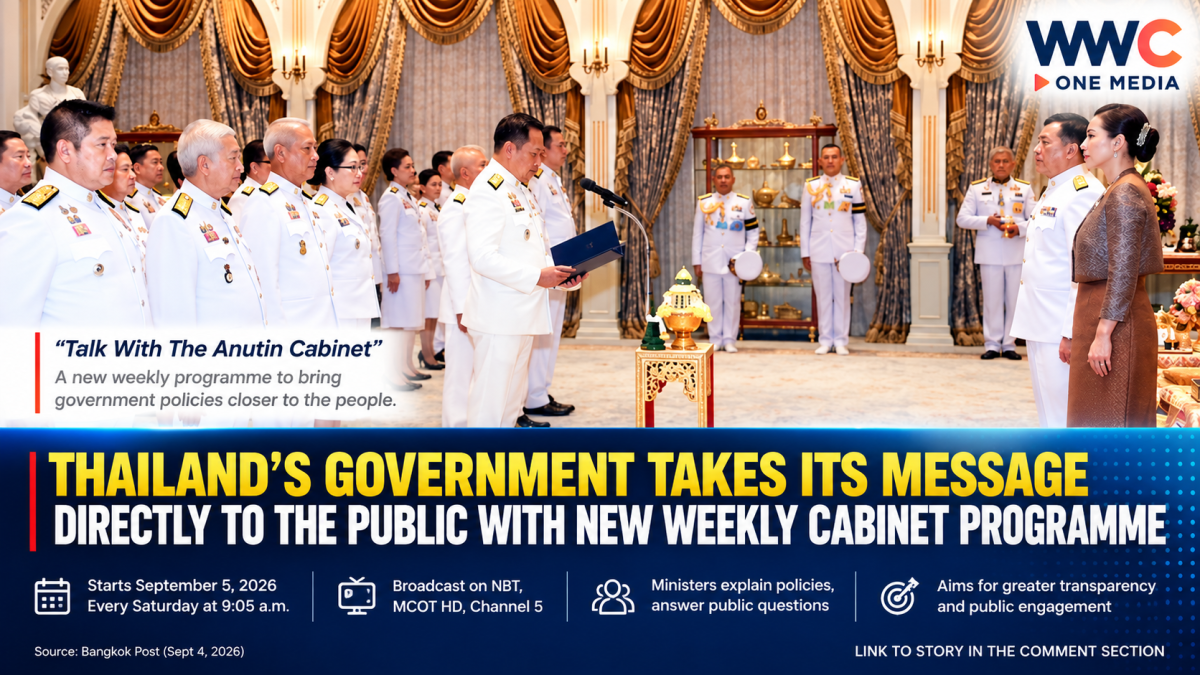
BANGKOK — Thailand’s government is launching a new weekly programme designed to put ministers directly in front of the public, giving the Anutin administration a regular platform to explain its policies, defend its decisions and answer questions about how it plans to run the country.
Called “Talk With The Anutin Cabinet” (คุยกับ ครม.อนุทิน), the programme will begin Saturday, September 5, 2026, and air every Saturday at 9:05 a.m.
The announcement was made on September 4 by government spokesperson Rachada Dhnadirek, who said the programme is intended to give the public clearer access to the ministers responsible for individual policies.
The programme will focus on more than simply announcing government policy. According to the government, ministers will explain the thinking behind policies, their objectives, implementation plans and expected benefits, while also addressing questions and issues attracting public attention.
The first episode will focus on government reform
The debut episode on September 5 will feature Pakorn Nilprapunt, Deputy Prime Minister responsible for legal affairs, with the discussion focusing on bureaucratic reform.
That subject could prove particularly significant because reforming Thailand’s public administration has increasingly become part of the government’s policy discussion.
Recent reporting has highlighted efforts to examine the management of the public-sector workforce, personnel expenditure, employment structures and compensation.
That gives the first programme an immediate policy angle rather than making it purely ceremonial.
Where can people watch it?
The government says “Talk With The Anutin Cabinet” will be broadcast every Saturday at 9:05 a.m. through:
- NBT
- MCOT HD
- Channel 5 (ททบ.5)
- Public Relations Department online channels
- NBT Connext
- Thai Khu Fah
The programme begins September 5.
Why the government is creating the programme
The stated objective is straightforward: improve communication between the government and the public.
Rather than relying exclusively on press conferences, parliamentary debates or individual ministry announcements, the administration wants ministers themselves to explain why particular policies are being pursued and what results people should expect.
Rachada said the government wants people to understand not only what a policy is, but also why it was introduced, what its goals are and what benefits it is expected to deliver.
That approach could become especially important for policies that directly affect household costs, employment, energy, public services and the wider economy.
Prime Minister Anutin Charnvirakul’s government has already placed issues including energy security and living costs high on its policy agenda, while also promoting investment, advanced industries and economic competitiveness.
But the programme is already attracting political scrutiny
The new initiative is not being viewed only as a communications exercise.
Opposition figure Sirikanya Tansakun has questioned the government’s decision to create a regular television platform for ministers, with criticism reported by Bangkok Biznews framing the programme as a public-relations effort at a time when the administration’s political standing is under scrutiny.
That criticism creates an important test for the programme.
If ministers use the broadcasts to provide substantive explanations, acknowledge difficult questions and present measurable results, the show could become a useful public-information channel.
If it is perceived primarily as government promotion, however, critics are likely to argue that ministers should instead face questions through established parliamentary and media mechanisms.
Anutin’s government faces a bigger test than television ratings
The programme comes as the Anutin administration continues to emphasize visible delivery and direct communication with the public.
Recent political reporting has described efforts by the government to encourage ministers to work more visibly in the provinces and demonstrate tangible results amid political pressure and speculation surrounding Cabinet performance.
The government was formally operating under Anutin’s second Cabinet following the 2026 political realignment. The Royal Thai Government confirmed the appointment of the Cabinet in March, with Anutin serving simultaneously as prime minister and interior minister.
That makes the new Saturday programme more than a routine media launch: it gives the administration a recurring opportunity to explain its record directly to voters.
The real question: what happens when the questions get difficult?
The government says the programme will address issues that matter to the public and provide answers from ministers directly responsible for those policies.
That promise will be tested when the programme tackles politically sensitive subjects, economic pressures or policies whose results are slower to appear.
A weekly platform can make government communication more accessible—but it also creates a regular public record of what ministers promise, explain and commit to delivering.
That could ultimately make the programme valuable not simply as a government broadcast, but as a way for the public to measure whether the administration’s words translate into results.
The first test comes Saturday morning, when Pakorn Nilprapunt takes the spotlight to discuss bureaucratic reform.
And after that, the bigger question will be whether Thailand’s ministers are prepared to keep answering the questions the public actually wants answered.




Leave a Reply