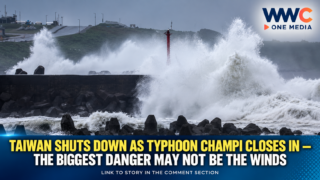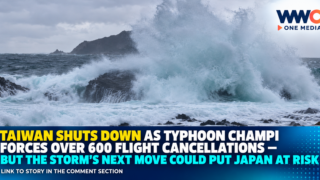
TAIWAN — Typhoon Champi battered Taiwan with powerful winds, torrential rain and towering coastal waves, damaging infrastructure, disrupting transportation and leaving tens of thousands of households without electricity as authorities rushed to restore services and protect vulnerable communities.
The storm’s impact extended beyond power outages. Roads were damaged by coastal erosion, a large crane was swept into the sea, and emergency evacuations were ordered in areas threatened by landslides and flooding.
According to Taiwan’s Central News Agency (CNA), as reported by Focus Taiwan on October 23, 77,498 households had experienced power outages by 2 p.m. Friday. Taiwan Power Co. reported that electricity had been restored to approximately 75% of those affected, while 19,029 households remained without power at that time.
The figures reflected conditions at a specific reporting time, and subsequent updates showed that the number of affected households increased as the storm continued to batter the island.
Powerful Waves Sweep Crane Into the Sea
One of the most dramatic incidents occurred at Fugang Harbor in Taitung County, where waves reaching approximately six meters swept a large crane into the sea at around 9:40 a.m. on Friday, October 23.
Further north, at Changbin Harbor, waves reportedly reached eight meters, sending seawater onto roads and overturning three bamboo rafts.
The powerful surf also raised concerns about coastal infrastructure. Part of the roadbed along Provincial Highway 9 near Duoliang Village in Taitung County was washed away, prompting authorities to impose a lane closure and prepare emergency protective measures.
Two students at National Dong Hwa University in Hualien were also injured after their scooter struck a fallen tree amid heavy rain and reduced visibility. Both sustained minor injuries and were discharged from the hospital after treatment.
These incidents illustrate how Champi’s effects reached inland communities as well as exposed coastal areas.
Power Restoration Efforts Intensify
Taiwan Power Co. worked to reconnect affected households as damaged electrical infrastructure disrupted communities across the island.
The outages were linked to storm damage involving power lines, fallen trees and other infrastructure problems. Restoration crews faced the added challenge of working in dangerous weather and reaching damaged sites.
A later report by Reuters on October 24 said more than 288,000 households had lost electricity during the storm, although most had been reconnected by the time of that report.
The changing figures are important: the earlier total of 77,498 households referred to outages recorded by 2 p.m. Friday, while the Reuters figure reflected the storm’s broader impact as it continued.
Evacuations and Transportation Disruptions
Heavy rainfall prompted precautionary evacuations in communities exposed to landslides and other hazards.
CNA reported that 1,397 people in vulnerable districts of New Taipei City were expected to be evacuated, while preventive evacuations involving 350 people were carried out in Datong and Nan’ao townships in Yilan County.
The storm also disrupted air travel. Taiwan’s aviation authorities reported widespread flight cancellations on Friday, affecting domestic and international connections. Airlines and transportation authorities advised passengers to check service updates before traveling.
The disruption was part of a broader emergency response as officials assessed infrastructure damage, monitored rainfall and prepared rescue resources.
One Death and Hundreds of Injuries Reported
Champi’s effects also resulted in casualties.
Taiwan’s emergency authorities initially reported one death and 94 injuries early Friday. By Friday evening, the reported number of injured had risen substantially.
In an October 24 report, Reuters said one person had died and 527 people had been injured during the storm. The fatality involved a man swept away by powerful waves near Liuqiu Island in Pingtung County.
The updated figures underscore the danger posed not only by destructive winds but also by rough seas, falling objects, damaged trees and hazardous travel conditions.
Storm Weakens, but Heavy Rain Remains a Concern
Although Champi had weakened after reaching super-typhoon strength earlier in its development, its large wind field and unusual movement near Taiwan prolonged the threat.
Taiwan’s Central Weather Administration warned that the storm’s movement could affect how long strong winds and heavy rainfall persisted. Forecasts published on October 23 indicated that mountainous areas of northern and northeastern Taiwan could receive exceptionally heavy accumulated rainfall.
Reuters reported on October 24 that Champi had moved away from Taiwan’s northeastern coast and was heading north toward China’s coast, with the storm expected to continue toward southern Japan.
However, weakening winds did not immediately eliminate the dangers from saturated ground, damaged roads, fallen trees and coastal flooding.
Authorities continued urging residents to follow official weather warnings, avoid dangerous shorelines and stay away from downed power lines.
The bottom line: Typhoon Champi’s impact on Taiwan went far beyond temporary blackouts. The storm damaged roads and coastal infrastructure, disrupted flights, triggered evacuations and caused casualties. Even as the system moved away, the scale of the damage and the continuing risks from heavy rain made recovery and public safety the immediate priorities.