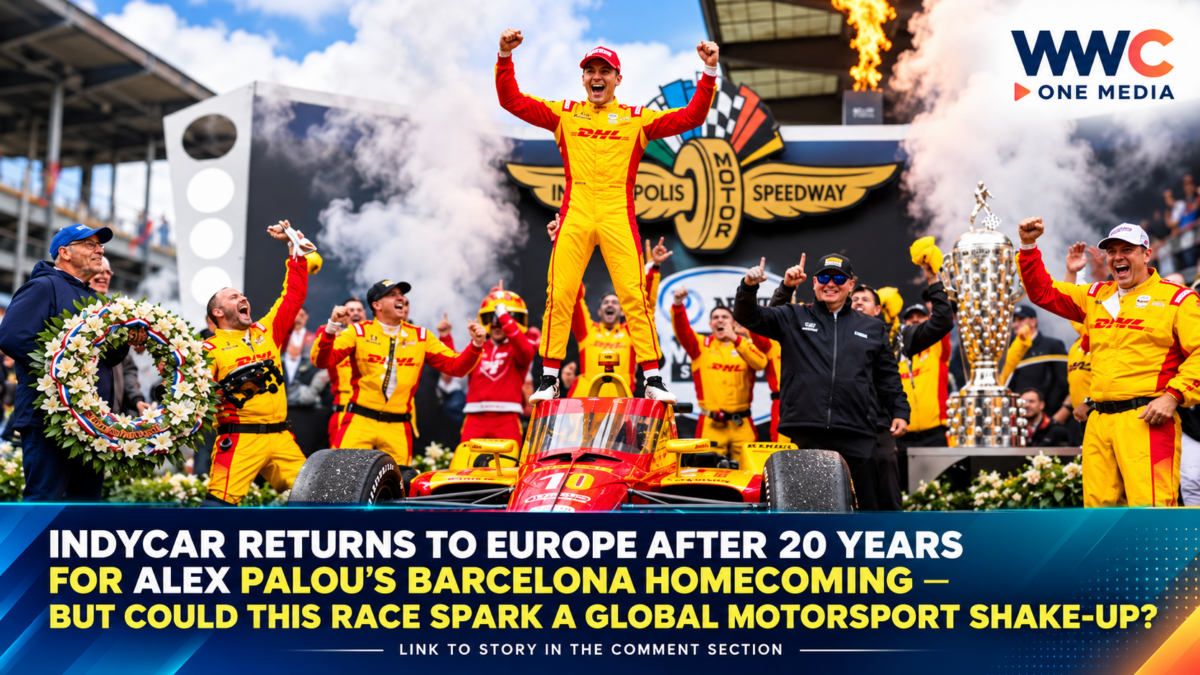
Barcelona, Spain — American motorsport is preparing for a historic return to European soil as the IndyCar Series officially confirms its first race on the continent in two decades, setting the stage for an emotional homecoming for Spanish racing superstar Alex Palou.
In a major announcement on October 23, organizers confirmed that the inaugural IndyCar Grand Prix of Barcelona will take place on July 18, 2027, at the Circuit de Barcelona-Catalunya, marking a breakthrough in the championship’s international expansion.
The landmark event will be held under a multiyear agreement, bringing one of North America’s most competitive racing championships to Spain for the first time.
But beyond the excitement surrounding IndyCar’s European comeback, the announcement raises a bigger question: Could Barcelona become the starting point for IndyCar’s long-awaited global expansion — and challenge Formula 1 for a larger share of international motorsport audiences?
A historic return after two decades
The Barcelona Grand Prix will end a 20-year absence from European racing, with the championship’s last European appearance taking place at the TT Circuit Assen in the Netherlands in 2007 during the Champ Car era.
It will also mark IndyCar’s first championship race outside North America since 2013, when James Hinchcliffe won on the streets of São Paulo, Brazil.
For years, IndyCar has concentrated its racing calendar primarily in the United States and Canada, even as its roster of drivers and worldwide fan base have become increasingly international.
Now, with Barcelona joining its 2027 schedule, the championship is taking a significant step toward reaching new audiences beyond its traditional markets.
The decision could open opportunities for European sponsorships, international broadcasting partnerships and greater commercial exposure.
Alex Palou’s emotional return to home soil
Perhaps no driver has more reason to celebrate the announcement than Alex Palou.
The 29-year-old Spanish racer, who drives for Chip Ganassi Racing, has emerged as one of the most dominant figures in modern IndyCar competition.
Palou secured his fifth IndyCar championship in 2026, extending an extraordinary run that includes four consecutive series titles.
His achievements place him alongside some of the most celebrated names in American open-wheel racing.
Only A.J. Foyt, with seven titles, and Scott Dixon, with six, have won more IndyCar Series championships.
Palou also captured the prestigious Indianapolis 500 in 2025, adding one of motorsport’s biggest prizes to his growing collection of achievements.
For a driver raised near Barcelona, the opportunity to race in front of Spanish supporters offers something that championship trophies alone cannot provide.
It means competing at home as one of the most successful drivers in the sport.
Palou welcomed the announcement and expressed his determination to deliver a victory for the fans when IndyCar arrives in Spain.
With his formidable record and Chip Ganassi Racing’s championship experience, he is likely to be among the leading contenders for the inaugural Barcelona event.
Barcelona’s famous racing circuit takes center stage
The Circuit de Barcelona-Catalunya, located in Montmeló outside Barcelona, is already internationally recognized as a major motorsport venue.
Opened in 1991, the circuit has hosted Formula 1, MotoGP and other prestigious international championships.
Its mixture of high-speed corners, technical sections and demanding braking zones presents a significant challenge for both drivers and engineers.
For IndyCar, the Barcelona race represents an opportunity to showcase its wheel-to-wheel racing at a venue familiar to European motorsport fans.
Unlike Formula 1, IndyCar operates with a more standardized technical framework, helping create tightly contested races where strategy, tire management and driver execution frequently determine the outcome.
That competitive format could appeal to European spectators accustomed to Formula 1 but unfamiliar with the American championship.
Formula 1 calendar changes create a major opportunity
The IndyCar announcement comes during an important transition for Barcelona’s international racing calendar.
Formula 1 raced at the Circuit de Barcelona-Catalunya in 2026, but the venue will not host a Formula 1 Grand Prix in 2027 under the announced rotation arrangements involving Belgium.
The change creates a valuable opportunity for Barcelona to maintain its profile as a destination for elite open-wheel motorsport.
By securing IndyCar, circuit organizers are adding another major international championship to their calendar while diversifying their events and potential audiences.
However, IndyCar’s arrival should not automatically be interpreted as direct competition with Formula 1.
The two championships feature different technical regulations, racing cultures and commercial structures.
Still, Barcelona could provide an important test of whether IndyCar can attract a sustainable European audience.
Why IndyCar’s European comeback matters
Penske Entertainment, which owns IndyCar, has identified international growth as an important opportunity for the championship.
Company president and CEO Mark Miles described the Barcelona announcement as a major milestone and highlighted the excitement surrounding Palou’s long-awaited appearance before his home supporters.
The commercial potential extends beyond a single race weekend.
A successful European event could strengthen the championship’s position with global sponsors, expand its television reach and demonstrate whether additional international destinations are commercially viable.
Yet taking an American-based championship overseas presents substantial challenges.
Transporting race cars, equipment, personnel and technical operations across the Atlantic involves significant logistical coordination and expense.
Race organizers must also ensure sufficient ticket demand, sponsor participation and long-term financial sustainability.
Barcelona’s established racing infrastructure could help address some of these challenges.
Could Spain become IndyCar’s gateway to Europe?
The multiyear agreement suggests IndyCar’s ambitions extend beyond a one-off European appearance.
Barcelona provides a strategically attractive starting point thanks to its motorsport heritage, established facilities and the popularity of Palou.
His championship success gives the event a recognizable homegrown star capable of attracting Spanish media attention and motorsport supporters.
The July 16–18, 2027 race weekend will therefore serve as more than just another addition to the calendar.
It will be an important test of IndyCar’s ability to stage a major international event and develop lasting commercial interest in Europe.
However, organizers have not announced additional European races as part of the Barcelona agreement.
Whether the championship eventually expands to other European countries will depend on future commercial negotiations, logistical considerations and the performance of its international events.
A defining moment for Palou and IndyCar
For Alex Palou, winning the inaugural IndyCar Grand Prix of Barcelona would add another unforgettable chapter to an already remarkable career.
For IndyCar, success in Spain could mark the beginning of a new phase in its international development.
The championship has spent years building its identity around fierce competition, spectacular overtaking and some of the most prestigious races in North American motorsport.
Now, after 20 years away from Europe, it is preparing to return to a continent with a deep passion for racing.
And when the green flag finally waves in Barcelona on July 18, 2027, the biggest question may not be whether Palou can win at home — but whether IndyCar can turn one historic European comeback into a lasting global breakthrough.