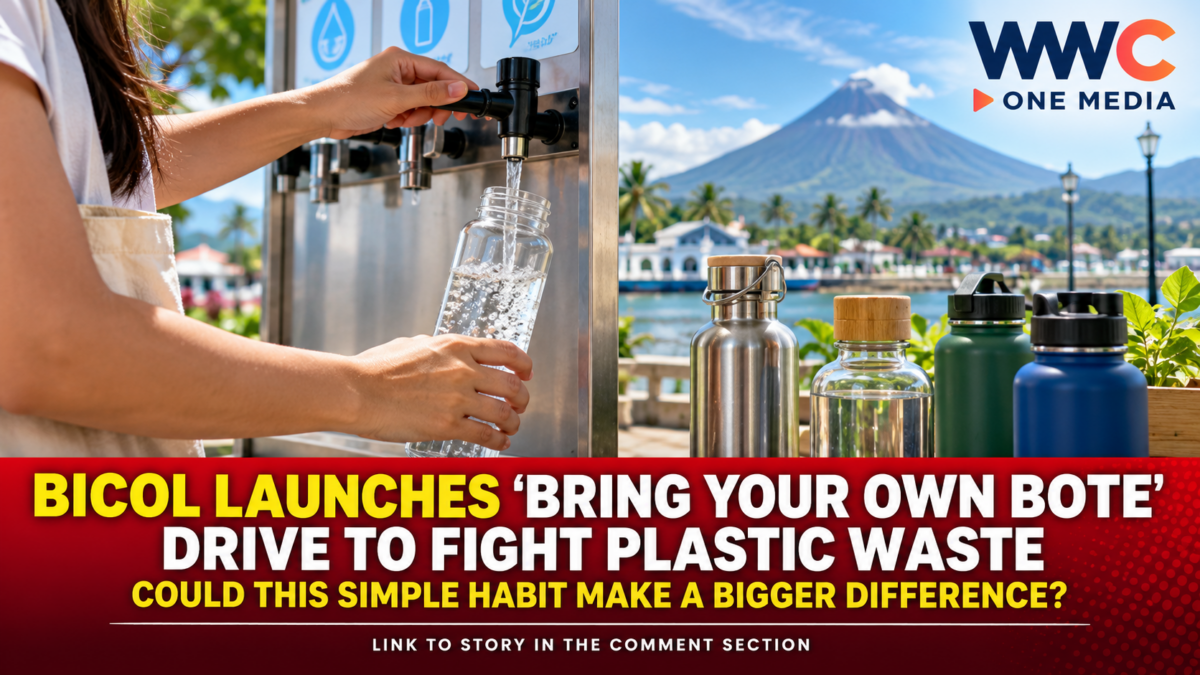
BICOL, Philippines — A campaign encouraging people to bring their own bottles is drawing attention to a practical way of reducing plastic waste, as environmental advocates and government agencies continue to push for stronger waste management and greater use of reusable packaging.
The “Bring Your Own Bote” drive, reported by the Philippine Daily Inquirer, highlights the role that everyday consumer choices can play in addressing the country’s persistent plastic pollution problem.
Although bringing a reusable container may seem like a small step, initiatives built around reuse and refill systems can help reduce demand for disposable packaging when they are supported by accessible refill services, participating businesses and consistent public participation.
Why the “Bring Your Own Bote” concept matters
Plastic waste remains a significant environmental challenge in the Philippines, where inadequate collection systems, limited recycling capacity and the widespread use of disposable packaging contribute to pollution in communities and waterways.
A separate Inquirer investigation, published in 2026, examined how plastic waste escapes the country’s waste management systems. The report cited estimates showing that only a small share of plastic waste is recycled, while substantial quantities are disposed of in landfills or leak into the environment.
These challenges demonstrate why preventing waste before it is generated can be just as important as collecting and recycling discarded materials.
Encouraging people to reuse bottles and refill containers offers one possible way to reduce packaging waste at its source.
However, the impact of a campaign depends on whether residents can conveniently access refill options, whether participating businesses can sustain the service and whether the program reaches people beyond its initial launch.
The Philippines already has laws targeting plastic waste
The Bicol initiative comes against the backdrop of two major national environmental laws.
Republic Act No. 9003, or the Ecological Solid Waste Management Act of 2000, established the country’s framework for waste segregation, recycling, composting and environmentally responsible disposal.
Republic Act No. 11898, or the Extended Producer Responsibility Act of 2022, strengthened the responsibility of large enterprises for recovering and diverting plastic packaging waste.
Despite these measures, implementation remains a challenge. In an earlier report, the Inquirer examined gaps in enforcement, waste collection and recycling infrastructure that continue to undermine the country’s efforts to control plastic pollution.
These problems underscore the need for coordinated action involving local governments, businesses, households and communities.
Refill initiatives show how reuse can work in practice
The idea behind bringing reusable bottles is not limited to Bicol.
In August 2026, the Environmental Management Bureau in Region XI reported that the Department of Environment and Natural Resources had partnered with NutriAsia for a “Bring Your Own Bote” activity at its regional office.
The initiative allowed participating employees to bring empty bottles for discounted refills of selected condiments, including soy sauce, vinegar and oil.
The activity demonstrated how businesses and government agencies can encourage packaging reuse through practical refill arrangements.
Separately, a July 2026 report by The Guardian highlighted the Tingi Tindahan initiative in Malabon City, which promotes refill shopping for household essentials. The project demonstrates how refill systems can also connect with the Filipino tradition of buying products in small, affordable quantities.
These examples illustrate different approaches to reducing packaging waste. They do not, by themselves, establish the results or scale of the Bicol campaign.
Can small actions make a meaningful difference?
Reusable containers can help reduce the need for new packaging, but their effectiveness depends on repeated use and the availability of convenient alternatives.
For a campaign to achieve lasting results, organizers and local partners need to consider several factors:
- Accessibility: Residents need convenient places where containers can be refilled.
- Affordability: Refill options must be practical for households managing tight budgets.
- Public participation: People need clear information about where and how to participate.
- Business support: Retailers and product manufacturers can help establish reliable refill systems.
- Measurable results: Tracking the number of refills and the amount of packaging avoided can show whether the initiative is making a difference.
Reusable bottles alone cannot solve the country’s entire plastic waste problem, particularly when many products are sold in packaging that is difficult to reuse or recycle.
Nevertheless, campaigns that make reuse more convenient can form part of a broader strategy to prevent unnecessary waste.
The bigger challenge goes beyond individual consumers
The Philippines’ plastic pollution problem cannot be addressed through household behavior alone.
Local governments need effective waste collection and segregation systems, while businesses must comply with applicable environmental regulations and develop practical packaging recovery or reuse programs.
The national government’s Philippine National Plastic Action Roadmap 2026–2040 also sets a broader direction for reducing plastic pollution, promoting reuse and improving waste management across the plastics life cycle.
Ultimately, the success of initiatives such as Bicol’s “Bring Your Own Bote” drive will depend on whether the campaign develops into a sustained, accessible program with measurable environmental benefits.
The idea is straightforward: reuse what can be reused and avoid unnecessary packaging whenever practical.
The bigger question is whether a simple habit can become a lasting community practice—and whether similar efforts can be expanded to help the Philippines confront its growing plastic waste challenge.