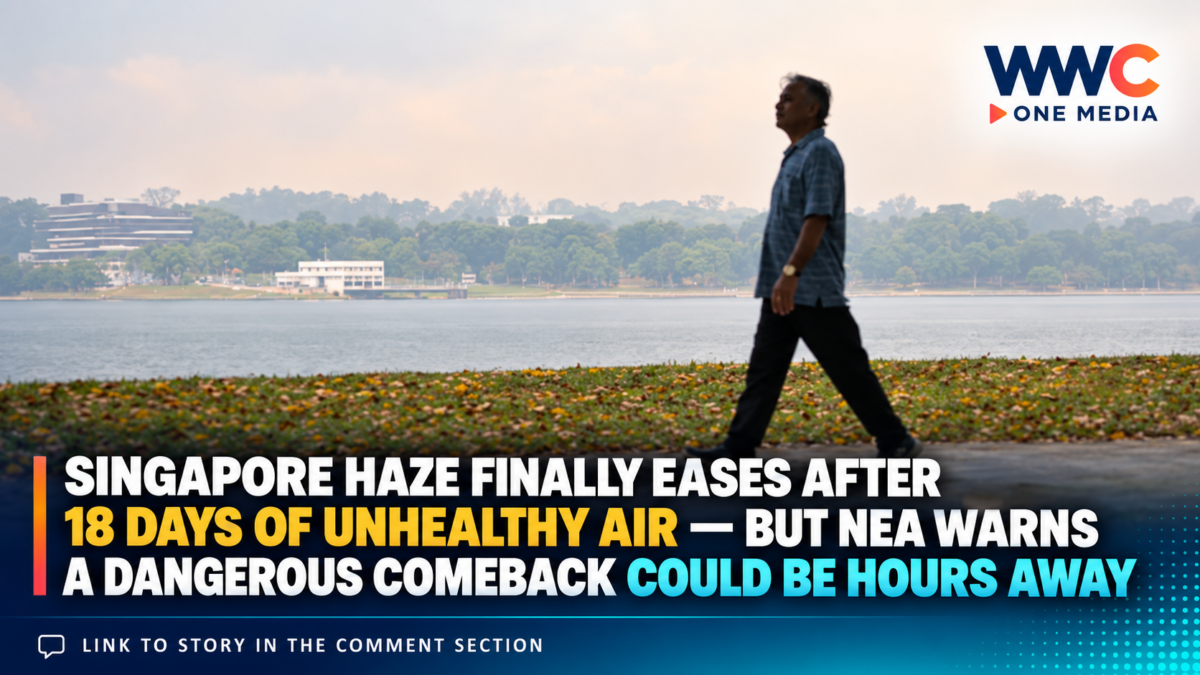
SINGAPORE, October 23, 2026 — Singaporeans are finally breathing easier after nearly three weeks of unhealthy air, but authorities are warning that the relief could be temporary as smoke from forest and land fires in Indonesia threatens to return.
Air quality across all five regions of Singapore remained in the good-to-moderate range on Friday morning, marking a significant improvement after a prolonged haze episode that had raised public health concerns.
According to Channel NewsAsia (CNA), the 24-hour Pollutant Standards Index (PSI) ranged from 67 to 90 as of 10 a.m. on October 23, with no region reporting unhealthy conditions.
However, Singapore’s National Environment Agency (NEA) has forecast that air quality could deteriorate again, with PSI readings potentially reaching 101 to 150 — the unhealthy category.
The improvement is welcome news, but the threat of another wave of transboundary haze has not disappeared.
Air Quality Improves After 18 Days of Haze
Singapore’s latest recovery follows an extended period of poor air quality that began on October 5.
By Thursday afternoon, October 22, the western region — the last area to remain in the unhealthy PSI category — had improved sufficiently for all five regions to return to good-to-moderate conditions.
The Straits Times reported that the improvement ended an 18-day stretch of unhealthy readings in parts of Singapore.
At 10 a.m. Friday, the 24-hour PSI readings reported by The Straits Times were:
- North: 66
- South: 70
- East: 72
- West: 90
- Central: 79
Although the figures indicated significantly improved air quality, the west continued to record the highest pollution level among the five regions.
The hourly PM2.5 reading in western Singapore also reached 56 at 10 a.m., entering the elevated category, while readings elsewhere remained normal.
This highlights an important distinction: improving 24-hour air quality does not necessarily mean short-term particle pollution has disappeared.
Why Singapore’s Haze Could Return
The primary concern is continuing smoke pollution from fires in parts of Indonesia, particularly Sumatra and Kalimantan.
In its October 22 haze advisory, the NEA warned that dry conditions in southern Sumatra and Kalimantan could allow smoke haze to move towards Singapore under prevailing southeasterly winds.
Although easterly and northeasterly winds had previously kept much of the smoke south of Singapore, changes in wind direction could once again expose the island to drifting pollution.
The agency forecast a PSI of between 101 and 150 for October 23, indicating the possibility of unhealthy conditions despite the improvement observed in the morning.
Further smoke haze from Sumatra could also affect Singapore on Saturday, October 24.
But there is a potential source of relief.
NEA expects showers and more favourable winds to improve haze conditions on Sunday, October 25.
Whether that happens will depend on actual weather conditions, regional fire activity and the movement of smoke across the region.
Singapore’s Haze Emergency Raises Health Concerns
The prolonged haze episode has renewed attention to the health risks of fine particulate pollution.
PM2.5 refers to airborne particles measuring 2.5 micrometres or smaller. Because these particles are extremely fine, they can penetrate deeply into the lungs and contribute to respiratory and cardiovascular problems.
For vulnerable populations, even relatively short periods of elevated pollution can be particularly concerning.
Singapore’s health guidance places special emphasis on protecting:
- Children and elderly residents
- Pregnant women
- People with asthma or chronic respiratory conditions
- Individuals with underlying heart or lung disease
When the 24-hour PSI reaches the unhealthy category, vulnerable individuals are advised to minimise or avoid prolonged strenuous outdoor activities, depending on their health circumstances.
Authorities recommend using one-hour PM2.5 readings when deciding whether immediate outdoor activities are appropriate.
Well-fitting N95 masks or equivalent protective masks may help reduce exposure to fine particles when outdoor conditions become severely polluted.
Singapore Expands Protective Mask Distribution
As part of the country’s response, authorities have also expanded their haze protection measures.
The Straits Times reported that a second mask distribution exercise was scheduled to begin on October 23, allowing Singaporeans aged 60 and above to collect two masks each.
The earlier eligibility threshold had been set at 67 years old.
The expanded distribution comes as authorities seek to protect more vulnerable residents against the possibility of renewed air pollution.
Eligible residents can consult official government channels for collection locations and availability.
The Bigger Challenge: Southeast Asia’s Recurring Haze Problem
Singapore’s latest haze episode also exposes a recurring environmental challenge facing Southeast Asia.
Transboundary smoke from Indonesian forest and land fires has repeatedly affected air quality in neighbouring countries, including Singapore and Malaysia.
Dry conditions, land clearing, vegetation fires and weather patterns can combine to create pollution episodes that cross national borders.
The current crisis demonstrates how quickly air quality can deteriorate when regional fires coincide with winds carrying smoke towards densely populated cities.
It also reinforces the importance of regional cooperation, fire prevention, land management and improved monitoring of hotspots.
While changing winds and rainfall can provide immediate relief, these weather developments alone cannot eliminate the underlying sources of smoke pollution.
What Happens Next?
For Singapore, the immediate question is whether the improved air quality recorded on October 23 can be sustained through the weekend.
NEA’s forecast points to a possible deterioration on Friday and Saturday, followed by potentially more favourable conditions on Sunday.
Residents are encouraged to monitor official PSI forecasts and hourly PM2.5 readings through Singapore’s haze information services and the myENV mobile application.
For now, Singapore has gained a much-needed break from unhealthy air.
But with fires still affecting the surrounding region and wind conditions capable of changing rapidly, the latest improvement may prove to be only a temporary reprieve.