TOKYO, Japan | October 23, 2026
Japan may be moving beyond its decades-long battle with falling prices, but the government is refusing to declare victory just yet, raising fresh questions about the country’s economic recovery and the Bank of Japan’s next monetary policy decision.
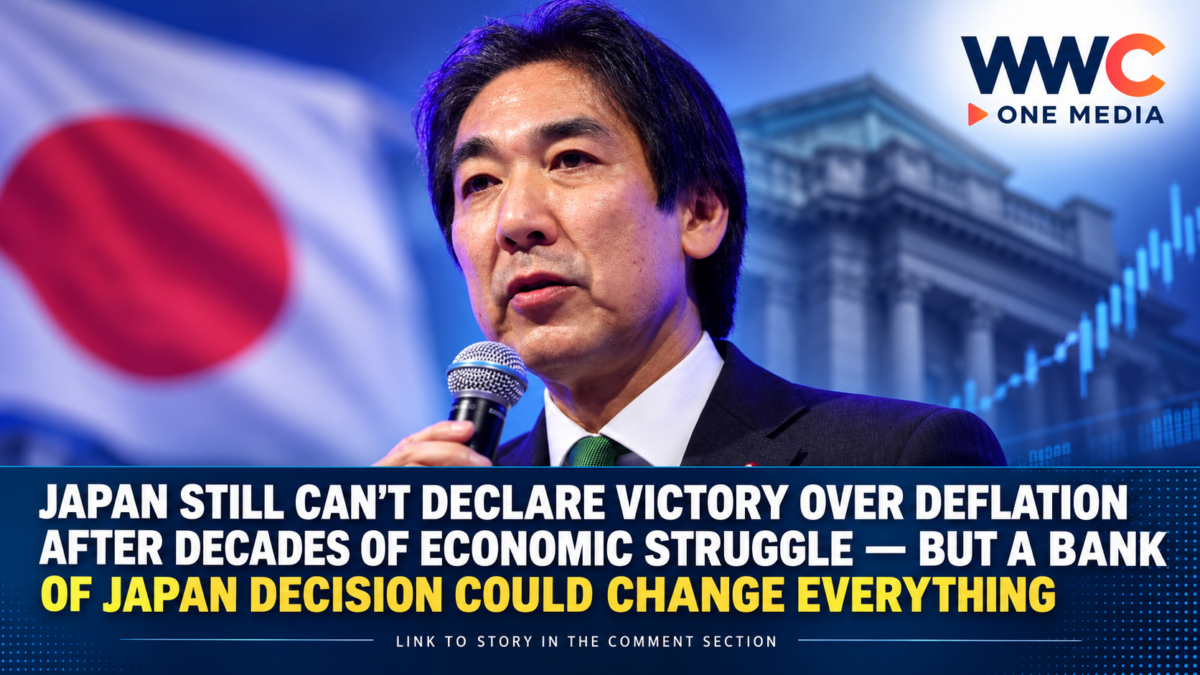
Economy Minister Minoru Kiuchi said Friday that Japan has not yet met the conditions necessary for the government to officially announce an end to deflation, even as expectations grow that underlying inflation could be approaching the central bank’s long-standing 2% target.
The statement highlights a critical distinction in Japan’s economic transformation: prices may be rising, but policymakers still want evidence that the country can sustain healthy inflation without sliding back into prolonged economic weakness.
Japan’s Deflation Battle Is Not Officially Over
Speaking at a news conference on October 23, Kiuchi explained that Japan’s government would assess multiple economic indicators before formally declaring that deflation had ended.
The decision, he said, must reflect confidence that Japan will not return to a pattern of persistently declining prices.
His remarks followed media reports suggesting that the Bank of Japan could indicate at its upcoming monetary policy meeting that underlying inflation had broadly reached its 2% objective.
However, achieving an inflation target and officially ending deflation are not necessarily the same thing.
An economy can experience rising prices because of expensive imports, energy shortages or a weaker currency without establishing the sustained wage growth and domestic demand needed for a durable recovery.
Why Japan’s Economic Recovery Remains Complicated
Japan spent much of the period following the collapse of its asset-price bubble in the early 1990s battling weak consumer demand, stagnant wages and periods of falling prices.
Deflation became one of the country’s most persistent economic challenges because expectations of lower future prices discouraged spending and investment.
To reverse the trend, Japanese policymakers introduced extraordinary stimulus measures, including ultra-low interest rates, large-scale asset purchases and government spending initiatives.
The economic landscape has since changed dramatically.
Instead of worrying exclusively about falling prices, Japanese officials must now manage higher living costs, currency pressures and questions about how quickly monetary policy should return to more conventional settings.
The challenge is ensuring that inflation reflects a genuinely stronger economy rather than simply an increase in the cost of everyday necessities.
Bank of Japan Faces Another Critical Interest Rate Test
Japan’s central bank has already moved away from its historic era of ultra-loose monetary policy.
In September 2026, the Bank of Japan raised its policy interest rate to 1.25%, its highest level in 31 years, amid concerns about persistent inflationary pressures.
Higher energy costs associated with the Iran war, strong global demand linked to artificial intelligence and rising import costs from the weaker yen have contributed to the changing inflation environment.
Now, attention is turning to whether the central bank will strengthen its assessment that underlying inflation is sustainably approaching its 2% target.
Such an assessment could influence expectations for future interest rate increases.
However, no additional rate increase has been confirmed by Kiuchi’s October 23 comments.
For Japanese households and companies, further monetary tightening could affect borrowing costs, corporate financing, mortgage expenses and broader investment decisions.
Government Sees Opportunity for a Wage-Driven Economy
The latest warning comes despite more optimistic comments from senior Japanese officials earlier this month.
On October 15, Kiuchi told investors at a Reuters NEXT event in Tokyo that Japan was moving toward an economy supported by stronger investment, rising wages and expanding consumption.
He urged international investors to look beyond the country’s historical reputation for deflation and recognize its changing economic structure.
Yet he also acknowledged that the cycle of rising investment, wages and consumer spending was not fully established.
Finance Minister Satsuki Katayama reinforced that cautious optimism on October 21, describing Japan as approaching a transition from import-cost-driven inflation toward more sustainable inflation supported by higher wages.
This distinction is crucial.
When consumer prices rise faster than wages, households lose purchasing power. But if wages consistently grow and support stronger spending, businesses may gain the confidence to invest, hire and expand.
For Japan, that would represent a significant shift after decades of economic stagnation.
Prime Minister Takaichi’s Economic Strategy Faces a Delicate Balance
Prime Minister Sanae Takaichi’s administration is also navigating a complicated relationship between fiscal stimulus and monetary tightening.
The government plans a temporary reduction in the consumption tax on food from 8% to zero for two years, beginning in April 2027, alongside other measures intended to ease household financial pressure.
While those policies could support consumer spending, economists have warned that stimulating demand could also complicate the Bank of Japan’s efforts to control inflation.
Katayama has argued that the government’s economic approach will focus on improving productive capacity rather than simply pushing demand higher.
Japan has also outlined a long-term investment strategy targeting more than ¥370 trillion in public and private investment by fiscal 2040, including semiconductors, artificial intelligence, quantum technologies and creative industries.
The broader objective is to transform Japan into an economy capable of generating sustained growth, higher wages and stronger productivity.
What This Means for Asian Markets
Japan’s economic policy direction has implications beyond its borders.
As one of Asia’s largest economies, Japan plays an important role in regional finance, manufacturing, trade and investment.
Any substantial shift in Bank of Japan policy could influence the yen, Japanese government bonds, international capital flows and investor sentiment across Asian markets.
For the Philippines and other Southeast Asian economies, movements in Japanese financing costs and exchange rates could affect business investment, trade competitiveness and borrowing conditions.
However, the direction and magnitude of those effects would depend on future policy decisions and market responses.
The Bigger Question: Is Japan Finally Entering a New Economic Era?
Japan’s latest economic warning reveals a dilemma that policymakers have struggled with for decades.
The country has made meaningful progress in moving away from persistent price declines, but officials remain reluctant to declare the problem permanently solved.
The Bank of Japan’s next policy assessment could provide an important indication of how confidently officials view the inflation outlook.
For investors, businesses and households, the critical question is no longer simply whether prices are increasing.
It is whether rising wages, stronger consumption and sustainable investment can turn Japan’s inflation recovery into lasting economic growth.
Japan may be closer than ever to escaping its deflationary past — but whether its new economic momentum can survive tighter monetary policy remains the question that could shape its next chapter.