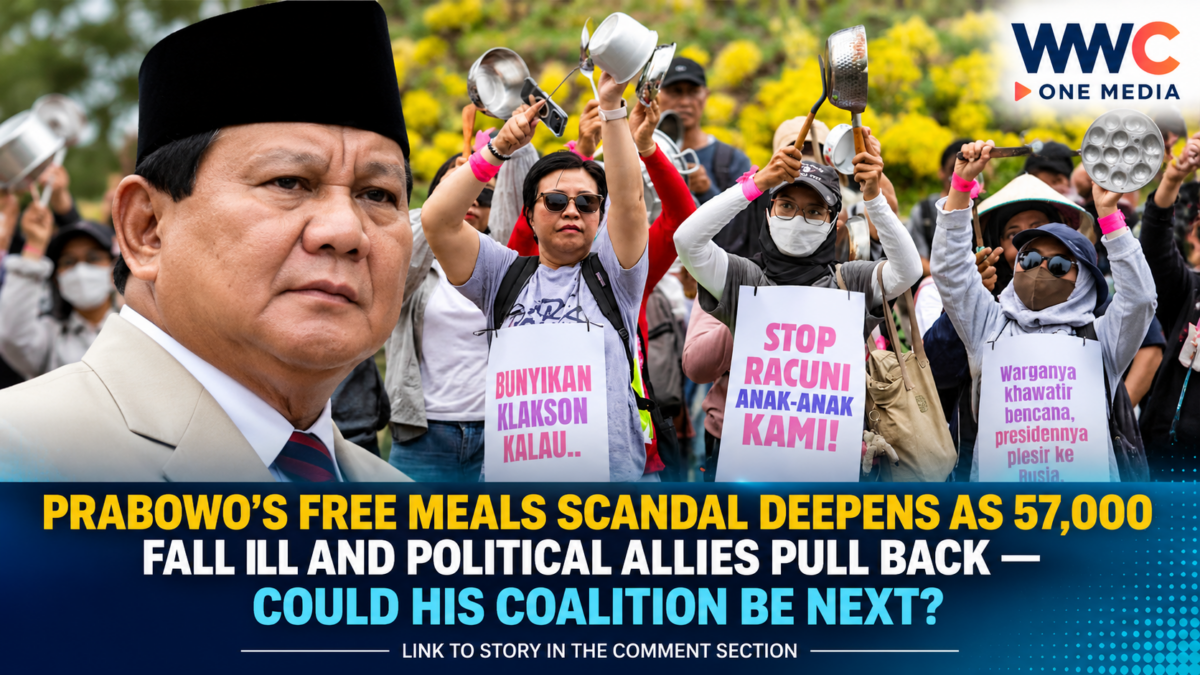
JAKARTA, Indonesia — What began as one of Indonesia’s most ambitious anti-hunger initiatives is turning into a major political challenge for President Prabowo Subianto, as members of his powerful ruling coalition begin distancing themselves from his flagship free nutritious meals programme.
With at least 57,000 reported food poisoning cases, corruption allegations, growing complaints from families, and declining public approval, the multibillion-dollar initiative is now testing the political alliances that have helped Prabowo govern with overwhelming parliamentary support.
According to a Reuters investigation published by Channel News Asia on October 22, senior figures from two coalition parties said their parties had decided internally to distance themselves from the programme. A representative of a third party expressed concerns that the controversy could damage its electoral prospects.
The development is particularly significant because Prabowo’s governing alliance commands approximately 80% of Indonesia’s parliament, giving his administration considerable legislative influence since he assumed office in October 2024.
Although the three parties were not identified publicly, they collectively represent more than one-quarter of that coalition’s parliamentary strength.
The reported distancing does not amount to a formal coalition breakup. However, it signals growing political discomfort with a programme that was supposed to become one of Prabowo’s defining achievements.
From Campaign Promise to Political Liability
Launched in January 2025, Indonesia’s free nutritious meals programme was designed to combat malnutrition, improve children’s health, and provide nutritional support for millions of vulnerable families.
The initiative originally sought to reach approximately 83 million beneficiaries, including schoolchildren and pregnant women.
Its scale made it one of Southeast Asia’s most ambitious government-funded nutrition programmes.
But implementing such a vast operation has proved difficult.
Food safety incidents, logistical challenges, questions about kitchen management, and alleged corruption have damaged confidence in the programme.
According to Reuters, at least 57,000 cases of food poisoning have been reported since the programme began.
In early September 2026, approximately 1,700 people reportedly became ill in four separate incidents involving meals supplied through the initiative.
For families expecting safer and healthier food for their children, these incidents have raised urgent questions about sanitation, accountability, and the supervision of meal providers.
Public Opposition Reaches 62% as Prabowo’s Approval Falls
Political pressure has intensified alongside a sharp deterioration in public sentiment.
An early-October survey conducted by Saiful Mujani Research and Consulting (SMRC) found that approximately 62% of respondents opposed the free meals programme.
Positive sentiment toward the initiative had fallen from 62% in November 2025 to just over one-third in October 2026.
The same polling organisation reported a substantial decline in Prabowo’s presidential approval ratings:
- November 2025: 81%
- March 2026: 66.4%
- July 2026: 51%
- October 2026: 44.5%
The decline does not establish that the free meals controversy alone caused the president’s falling approval. Nevertheless, it illustrates the difficult political environment confronting his administration.
With Indonesia’s next general elections expected in early 2029, coalition parties are increasingly weighing the political consequences of remaining closely associated with the troubled programme.
Corruption Arrests and Families’ Complaints Increase Pressure
The crisis has also moved beyond public dissatisfaction.
In June 2026, Indonesian authorities arrested a former head of the programme and two other officials in connection with corruption allegations.
The arrests added another dimension to concerns over the use of government funds and oversight of the massive food distribution network.
The allegations remain subject to legal proceedings and should not be treated as proof of guilt.
Meanwhile, dozens of families filed a police complaint against the government on August 31, marking a significant legal challenge linked to the programme’s implementation.
Vice President Gibran Rakabuming Raka has publicly apologised for the food poisoning incidents and visited affected children.
The apology underscored the seriousness of the safety concerns, even as the administration maintained its commitment to the initiative.
Billions Still Committed Despite Budget Cuts
Financial pressures present another challenge.
The programme’s 2026 budget was reduced substantially, with Reuters reporting in July that the allocation had been cut from an original 335 trillion rupiah to a provisional 229 trillion rupiah.
Officials said the adjustments were intended to improve efficiency, with increased emphasis on food quality and operational oversight.
Nevertheless, the government has budgeted approximately 240 trillion rupiah for 2027, demonstrating that the programme remains a major national spending priority.
Indonesia is also managing competing demands for education, public infrastructure, social protection, and broader economic development.
The challenge is especially sensitive because the country maintains a legal fiscal deficit ceiling of 3% of gross domestic product.
Large-scale welfare spending must therefore be balanced against revenue constraints and concerns about long-term fiscal sustainability.
Prabowo’s Coalition Faces Its First Serious Internal Test
Prabowo’s ruling alliance has remained remarkably cohesive throughout much of his presidency.
But the free meals controversy is beginning to expose disagreements over political responsibility and the risks associated with defending an increasingly unpopular policy.
According to Reuters, one coalition party has instructed its lawmakers to begin offering constructive public criticism while maintaining a measured tone.
Another party source warned that continued problems could weaken coalition unity by mid-2027.
However, support for the president has not disappeared.
Gerindra spokesperson Sugiat Santoso maintained that the coalition remained strong and said improvements were being pursued.
The National Mandate Party also reaffirmed its commitment to the programme, while acknowledging the need to address shortcomings.
These contrasting positions suggest that the immediate political debate is not simply about whether the programme should survive, but how extensively it must change.
Could Indonesia Scale Back the Free Meals Programme?
Policy analysts have suggested that a more targeted approach could help reduce costs and improve implementation.
Instead of attempting to provide meals across an enormous beneficiary population simultaneously, the government could place greater emphasis on children and families facing the highest nutritional risks.
Such a shift could also allow authorities to strengthen kitchen inspections, food handling standards, supplier accountability, and monitoring systems.
Reuters cited political analyst Burhanuddin Muhtadi, a senior visiting fellow at Singapore’s ISEAS–Yusof Ishak Institute, who warned that failure of the programme could represent a major political setback for Prabowo.
The president has defended the initiative and pledged improvements in quality and efficiency.
His administration now faces a difficult choice: maintain the programme’s enormous ambitions or make substantial changes to restore public confidence.
What Happens Next?
The coming months could determine whether Indonesia’s free meals initiative becomes a lasting social welfare achievement or a major liability for the government.
Three questions will be central to its future: Can authorities prevent further mass food poisoning incidents? Can financial oversight and public accountability improve? And will coalition parties continue supporting the programme if voter dissatisfaction persists?
For Prabowo, the political stakes extend beyond the national budget.
The programme is closely associated with his promises to improve nutrition and living standards for millions of Indonesians.
Its success could help define his administration’s legacy. Continued problems, however, risk deepening public frustration and weakening the political unity that has sustained his presidency.
For now, Indonesia’s free meals programme remains in operation — but the growing concerns inside Prabowo’s own coalition suggest its political future may be becoming increasingly uncertain.