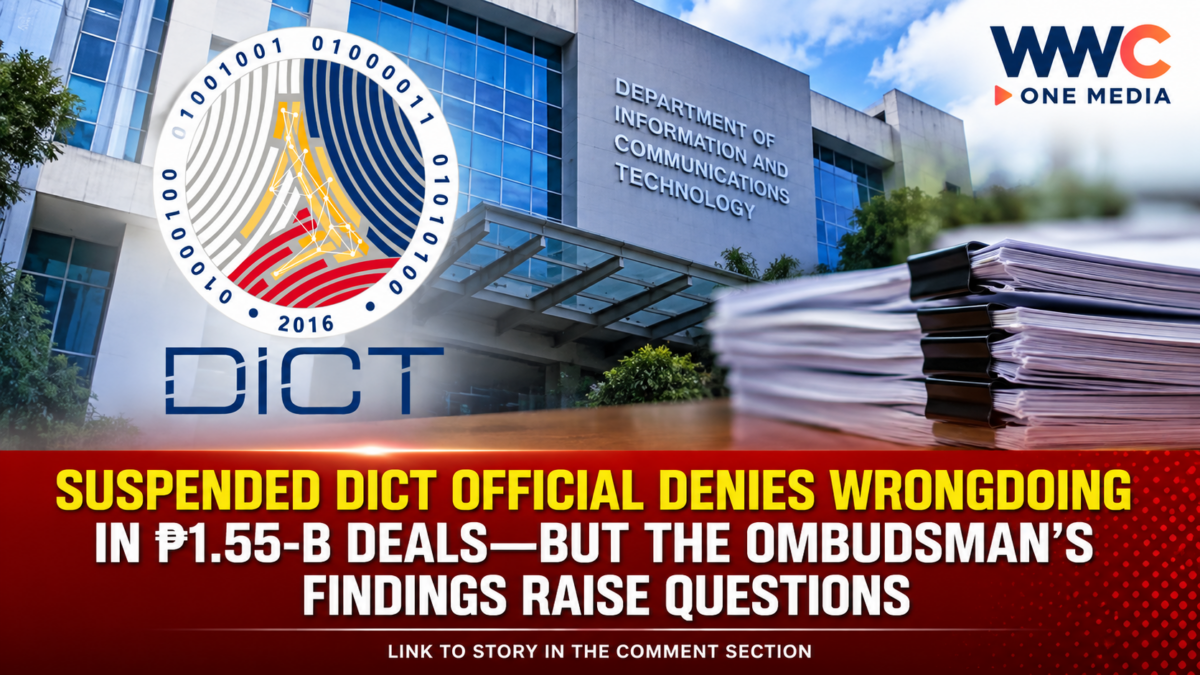
MANILA, Philippines — Suspended Department of Information and Communications Technology (DICT) Undersecretary David Almirol Jr. has denied wrongdoing in connection with government contracts worth approximately ₱1.55 billion, as an investigation by the Office of the Ombudsman raises questions about possible conflicts of interest involving companies linked to his former technology business.
The controversy centers on at least eight DICT contracts awarded between November 2023 and May 2025 to companies that the Ombudsman said had financial relationships with Multisys Technologies Corp., a software and digital solutions company founded by Almirol.
The Ombudsman has ordered Almirol’s preventive suspension for six months without pay while administrative complaints against him are being resolved. The allegations have not yet resulted in a final determination of administrative liability.
Why the ₱1.55-Billion Contracts Are Under Scrutiny
According to reports by the Philippine Daily Inquirer, Philstar.com, Newsbytes and the Daily Tribune, the Ombudsman’s seven-page order cited contracts covering information and communications technology consultancy, e-government application deployment, web-based messaging services, cloud infrastructure, data center colocation and software subscriptions.
These services are associated with the government’s digitalization efforts, including the rollout of the eGovPH Super App, which aims to make government services more accessible through a digital platform.
Almirol founded Multisys in 2010 and served as its president and chief executive officer for more than a decade before joining the DICT as undersecretary for e-government in August 2022.
The Ombudsman’s investigation examined whether his previous business interests and the financial relationships between Multisys and companies receiving DICT contracts created a conflict of interest.
The Shareholding Issue That Became a Key Part of the Case
One of the central issues concerns Almirol’s reported ownership stake in Multisys after his appointment to government.
The Ombudsman cited company records showing that Multisys’ general information sheet, notarized on October 27, 2022, and received by the Securities and Exchange Commission on November 2, 2022, still listed Almirol as holding 49.21 percent of the company’s shares.
Under Section 9 of Republic Act No. 6713, or the Code of Conduct and Ethical Standards for Public Officials and Employees, public officials must divest business interests that could create a conflict of interest within the prescribed 60-day period after assuming office.
A subsequent corporate filing, notarized on November 18, 2022, and received by the SEC on November 21, removed Almirol from the list of Multisys stockholders, according to reports detailing the Ombudsman’s findings.
The timing of that divestment is among the issues being examined in the administrative proceedings.
Financial Records Also Drew Attention
The Ombudsman also cited Multisys’ audited financial statements, which reportedly showed revenue from related companies for managed services amounting to ₱110.8 million in 2023 and ₱514.6 million in 2024.
These figures form part of the financial background of the case. They should not, by themselves, be interpreted as proof that the government contracts were improperly awarded or that Almirol personally received those amounts.
The investigation must establish whether the relationships, transactions and relevant official decisions violated applicable laws or ethical standards.
In earlier reporting on the audit findings, Rappler also discussed concerns raised by a DICT internal audit report dated June 5, 2025. The report flagged possible conflicts of interest involving the hiring of former Multisys personnel and the awarding of contracts to other companies with business relationships connected to the technology firm.
Almirol disputed aspects of the audit findings in earlier coverage, arguing that other major service providers had also received comparable government contracts.
Why the Ombudsman Ordered a Six-Month Suspension
The Ombudsman said there were sufficient grounds to place Almirol under preventive suspension while the administrative complaints are being resolved.
The complaints involve alleged grave misconduct, conduct prejudicial to the best interest of the service, and violations of Republic Act No. 6713.
The anti-graft office also said Almirol’s continued stay in office could prejudice the investigation, particularly because of his access to documents and other evidence relevant to the case.
DICT Secretary Robert Joseph de Claro was furnished a copy of the order and directed to implement it and submit proof of compliance.
The suspension is immediately executory and is intended to protect the integrity of the proceedings.
Importantly, the Ombudsman has emphasized that preventive suspension is not a penalty or a final finding of administrative liability. It is a precautionary measure intended to allow the investigation to proceed impartially and without interference.
What Happens Next?
The case now places renewed attention on transparency, procurement safeguards and conflict-of-interest rules in government technology projects.
As the proceedings continue, the central questions are whether the business relationships identified by investigators created prohibited conflicts, whether the applicable divestment requirements were followed, and whether the evidence supports the administrative charges.
Almirol’s denial of wrongdoing and the Ombudsman’s allegations must both be considered in the context of the ongoing proceedings. A final determination will depend on the evidence and the outcome of the administrative case.
For the public, the stakes extend beyond one official. Government digitalization projects involve public funds and services that Filipinos increasingly rely on. Ensuring that contracts are awarded and administered in accordance with the law is essential to maintaining public trust.
The next crucial development will be the outcome of the administrative proceedings—and whether the evidence ultimately establishes a violation of public-service rules.