AMSTERDAM, Netherlands | October 22, 2026 — The global artificial intelligence boom is generating another wave of demand for semiconductor manufacturing equipment, and Dutch chipmaking technology company BE Semiconductor Industries (Besi) is emerging as a major beneficiary.
But behind a dramatic surge in orders lies a growing question for investors: Can the company turn AI-driven demand into sustained revenue growth while concerns over competition, memory-chip technology and delayed equipment deliveries continue to mount?
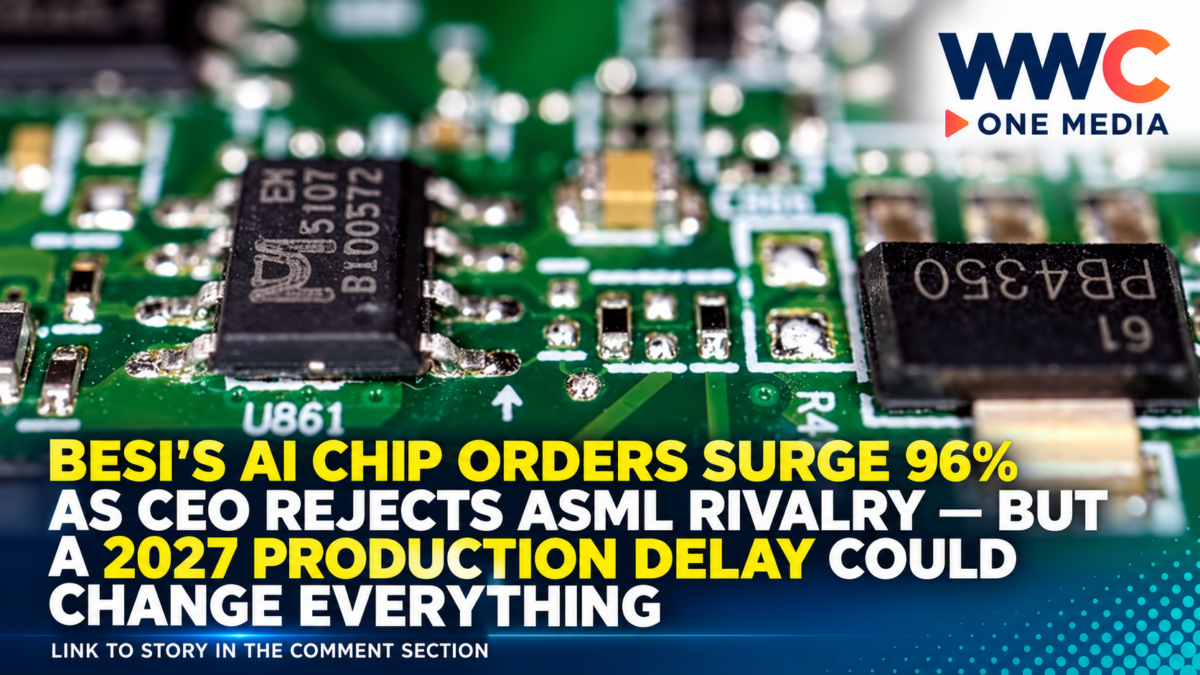
Besi reported €342.6 million (approximately US$385.2 million) in third-quarter orders, representing a 96% increase from the same period last year and a 17% rise from the previous quarter.
The result comfortably surpassed the €298 million expected by analysts surveyed by Visible Alpha, offering fresh evidence that investment in AI data centers and advanced semiconductor packaging remains strong.
However, the financial results came amid speculation that Dutch semiconductor equipment giant ASML could eventually challenge Besi in one of its most promising technologies.
ASML vs. Besi: Is a New Semiconductor Rivalry Emerging?
Besi CEO Richard Blickman moved to address concerns over potential competition from ASML, one of the world’s most important manufacturers of advanced semiconductor production equipment.
The speculation intensified after semiconductor research firm SemiAnalysis examined 27 ASML patent filings and suggested that the company appeared to be developing technology that could compete with Besi’s hybrid bonding systems.
The report contributed to a roughly 3% decline in Besi shares on October 16.
But Blickman rejected the suggestion that ASML was positioning itself as a direct rival in hybrid bonding.
According to the chief executive, the two Dutch companies are collaborating to improve the precision with which Besi’s equipment positions semiconductor chips.
He also indicated that ASML’s longer-term interest lies in three-dimensional transistor stacking within chips, rather than directly competing with Besi’s existing bonding equipment.
Importantly, ASML has not confirmed that it is developing a competing hybrid bonding machine.
That leaves investors facing a critical distinction: Patent research may signal a possible future direction, but it does not establish that a competing commercial product exists.
Why Hybrid Bonding Could Become a Major AI Battleground
At the center of Besi’s growth strategy is hybrid bonding, an advanced semiconductor packaging technology that allows chips to be stacked and directly connected with extremely fine electrical connections.
The technology is increasingly important as chipmakers search for ways to improve computing performance without relying exclusively on shrinking transistor sizes.
For artificial intelligence systems, this matters enormously.
AI accelerators must process vast amounts of information while reducing energy consumption, managing heat and maintaining high data-transfer speeds.
Hybrid bonding can help manufacturers create densely interconnected chip structures, potentially improving performance and power efficiency.
The technology is relevant to advanced logic chips, high-bandwidth memory, chiplet architectures and future semiconductor packages.
Besi disclosed that its hybrid bonding equipment orders during 2026 have already more than doubled compared with the entire previous year.
This expanding order book suggests that chipmakers increasingly view advanced packaging as an essential part of future AI computing infrastructure.
AI Demand Surges, But Memory Makers Remain a Concern
Despite the impressive growth, Besi faces an important challenge involving the timing of hybrid bonding adoption.
Investors have been monitoring whether major memory-chip manufacturers, including Micron and SK Hynix, will adopt the technology quickly enough for upcoming generations of high-bandwidth memory.
High-bandwidth memory, commonly called HBM, is crucial to the operation of powerful AI accelerators because it allows processors to access large volumes of data at high speeds.
Any delays in adopting new bonding technologies could affect how quickly Besi converts its technological advantage into equipment sales.
These concerns have contributed to considerable volatility in the company’s share price.
Besi shares have fallen roughly 50% from their June 2026 peak, reflecting worries about competitive threats, technology adoption and future growth expectations.
Still, the latest order figures offer a counterargument: AI-related equipment demand remains substantial even as uncertainty surrounds the timetable for some next-generation applications.
€100 Million Share Buyback Signals Confidence
Alongside its stronger-than-expected orders, Besi announced plans to launch a new €100 million share repurchase program beginning October 27, 2026.
Such programs can reduce the number of shares outstanding and may support earnings per share, depending on execution and other financial factors.
They can also signal management’s confidence in a company’s financial position.
However, a buyback does not eliminate the risks associated with changing semiconductor demand, technological competition or customer spending decisions.
The 2027 Warning Hidden Behind Strong Orders
While orders exceeded expectations, Besi’s short-term revenue forecast was less encouraging.
The company expects fourth-quarter revenue to remain broadly unchanged from its third-quarter level of €283.4 million, with a possible variation of 5% in either direction.
Analysts surveyed by LSEG had expected fourth-quarter revenue of approximately €291.5 million.
Besi explained that some customers requested equipment deliveries aligned with production schedules for the first half of 2027.
This creates a timing gap between receiving equipment orders and recognizing the associated revenue.
For investors, the distinction is crucial.
Strong orders demonstrate customer demand, but future financial performance will depend on equipment delivery schedules, customer investment decisions and the company’s ability to execute.
ING analyst Marc Hesselink nevertheless viewed the overall results favorably, pointing to robust order growth, progress in hybrid bonding, clarification of the ASML competition issue and the announced share buyback.
Why This Matters to the Global Semiconductor Industry
Besi’s results illustrate an important shift in the semiconductor industry.
The AI race is no longer centered only on companies developing the most powerful processors.
It increasingly involves the businesses providing sophisticated equipment and technologies needed to assemble, connect and package those processors efficiently.
The investment boom is creating opportunities throughout the semiconductor supply chain, including equipment manufacturers, foundries, memory producers and advanced packaging specialists.
For Asian semiconductor manufacturers and technology investors, this evolution is particularly significant because major parts of the global chip manufacturing and memory ecosystem are concentrated in Taiwan, South Korea and other Asian markets.
However, rising demand for AI-related equipment does not guarantee uninterrupted growth. High capital costs, adoption schedules, competitive innovation and changing customer requirements remain significant risks.
What’s Next for Besi and ASML?
Three major developments will determine how the story unfolds: whether Besi continues winning hybrid bonding orders, whether memory manufacturers accelerate adoption, and whether ASML eventually confirms a commercial product that directly competes with Besi’s technology.
For now, Besi’s leadership says the two companies are collaborators rather than rivals.
The latest figures support the view that demand for advanced AI chip packaging equipment remains strong.
But as customers move toward their 2027 production schedules, the bigger question is whether Besi’s surging order book will translate into sustained revenue growth — or whether new technologies and shifting delivery timelines will reshape the industry’s competitive landscape.