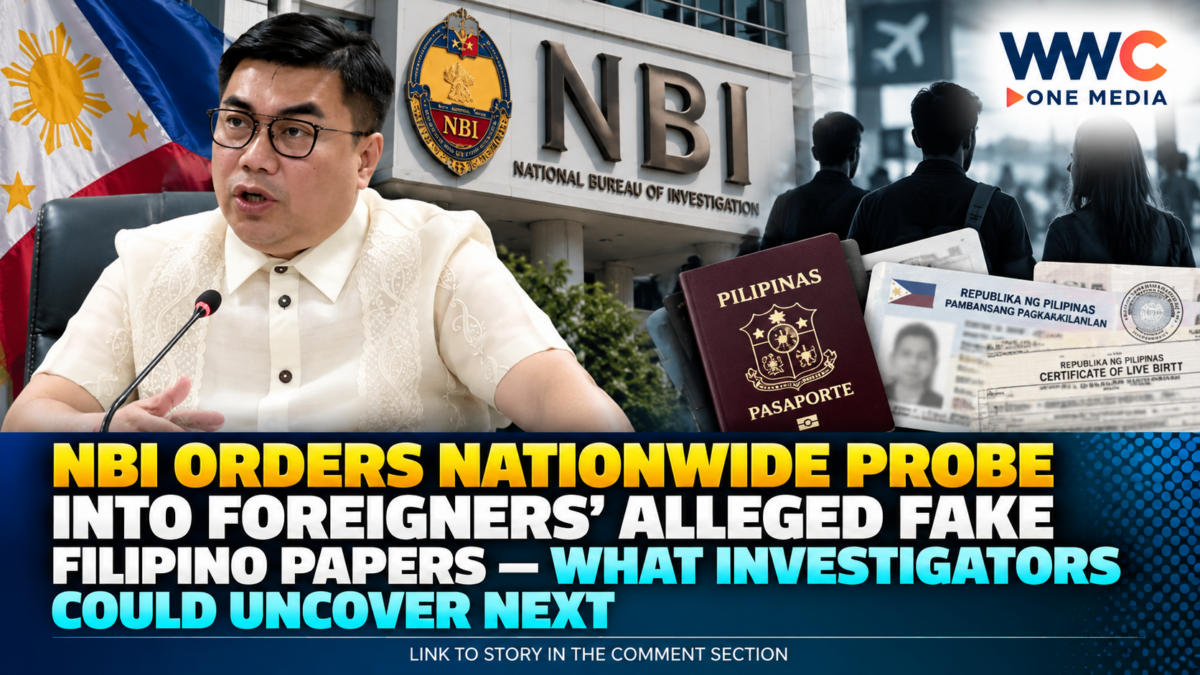
MANILA, Philippines — The National Bureau of Investigation (NBI) is preparing a nationwide investigation into allegations that foreign nationals obtained Philippine citizenship documents through fraudulent birth registrations, raising concerns about identity fraud, government recordkeeping and the possible unlawful acquisition or control of property.
NBI Director Melvin Matibag announced the planned investigation on October 20, 2026, saying he would issue a memorandum directing regional directors and assistant directors to investigate suspected fraudulent citizenship documents, related identity fraud and alleged unlawful property arrangements involving foreign nationals.
According to GMA News, Matibag acknowledged that initial reports involved many Chinese nationals, while emphasizing that other nationalities were also implicated in the reports under review.
The planned probe comes as authorities continue examining questionable birth registrations and allegations that individuals within local civil registry offices helped facilitate the issuance of documents that foreign nationals could use to claim Filipino identity.
Why the NBI is expanding the investigation
The investigation is intended to determine how foreign nationals may have obtained Philippine birth records and other government-issued documents through allegedly fraudulent means.
A genuine-looking birth certificate can become the starting point for obtaining other identity documents if its underlying registration is not properly verified. Investigators are therefore expected to examine the authenticity of records, the supporting documents used during registration and whether government personnel or private intermediaries helped facilitate irregular transactions.
The inquiry also covers allegations involving the unlawful acquisition or control of property by foreign nationals. Authorities will need to establish the facts of individual cases rather than assume that every foreign national with questionable documents has committed an offense.
Matibag said the NBI would direct its regional offices to investigate the suspected irregularities. Initial reports identified North Cotabato and Davao del Sur as areas of concern, particularly in Mindanao.
The nationwide scope is significant because it could help investigators determine whether the suspected cases are isolated incidents or part of a broader pattern involving civil registration, identity documents and possible property-related violations.
Nearly 50,000 potentially fraudulent birth records flagged
The investigation builds on concerns raised by the Philippine Statistics Authority (PSA) and the NBI over potentially fraudulent birth registrations.
In March 2026, the NBI reported that the PSA had flagged more than 50,000 potentially fraudulent birth records across more than 1,600 civil registry offices nationwide.
In a separate report published on October 21, 2026, Bilyonaryo News Channel said the PSA and NBI were examining nearly 50,000 suspected records, with 1,471 already flagged. The report said most of those flagged records involved Chinese nationals, while some involved Vietnamese nationals.
These figures require an important distinction: records flagged for examination are not automatically proven to be fraudulent, and the figures should not be interpreted as the number of foreigners who have conclusively obtained citizenship illegally.
The investigation must establish which registrations are false, whether any were used to obtain passports or other government identification, and who may have participated in the alleged schemes.
Earlier NBI cases point to alleged irregularities in North Cotabato
The planned nationwide probe follows an earlier investigation involving the local civil registry offices of Pikit and Aleosan in North Cotabato.
In March 2026, the NBI announced that it had recommended criminal charges against public officials and private individuals allegedly involved in fraudulent birth registrations.
According to the NBI, investigators found indications that local civil registry personnel, their staff and a retired municipal civil registrar acting as a private facilitator had allegedly bypassed required procedures for late registration of Certificates of Live Birth.
Investigators alleged that some registrations were processed using fabricated or falsified supporting documents, including records described as “ready-made” because they had allegedly been issued without mandatory verification.
The NBI said it recommended charges under the Civil Register Law, the Anti-Graft and Corrupt Practices Act, the Code of Conduct and Ethical Standards for Public Officials and Employees, and provisions of the Revised Penal Code covering falsification of public documents and perjury.
These are allegations and recommended charges; criminal responsibility must be determined through the appropriate legal proceedings.
The case illustrates why investigators are examining not only the foreign nationals who allegedly benefited from questionable documents, but also the people who may have facilitated their issuance.
How fake birth certificates can become a national security concern
A birth certificate is a foundational civil record used to establish identity and support applications for other government documents.
If a fraudulent registration passes through the verification process, it may potentially be used to support applications for a Philippine passport or other identification documents. Authorities have previously raised concerns that such schemes could allow foreign nationals to misrepresent their citizenship or evade immigration requirements.
A 2024 Senate legislative research briefing documented earlier concerns raised by government agencies about foreign nationals allegedly using spurious birth certificates to obtain Philippine passports. During a Senate budget discussion, lawmakers were also informed that at least 308 questionable birth certificates had been used in passport applications between January and September 2023, including six cases involving foreign nationals who received Philippine passports.
The earlier findings demonstrate that concerns about fraudulent identity documents predate the latest nationwide investigation. They do not, however, establish that every case now under investigation is connected to the same network.
The potential consequences extend beyond identity fraud. Authorities have raised concerns that falsely obtained citizenship documents could be used to circumvent restrictions or requirements affecting immigration, business activities and property ownership.
The property issue: What investigators still need to establish
The NBI’s planned investigation also covers allegations involving the unlawful acquisition or control of property by foreign nationals.
Philippine law generally restricts foreign ownership of private land, subject to constitutional provisions and specific legal exceptions. Foreign nationals may, however, hold certain other property interests under applicable laws.
Investigators will need to determine whether any individuals used allegedly fraudulent citizenship documents to acquire interests they would not otherwise have been legally permitted to hold, whether the relevant transactions violated specific laws, and whether public officials or other intermediaries were involved.
The existence of a suspicious birth record alone does not prove unlawful property ownership. Each alleged transaction must be examined on its own facts and under the relevant legal provisions.
What happens next?
The NBI’s planned memorandum is expected to direct regional offices to investigate suspicious citizenship documents, possible identity fraud and the alleged unlawful acquisition or control of property.
Key questions remain: How many of the flagged records will be confirmed as fraudulent? Were the documents used to secure Philippine passports or other official identification? Did public officials knowingly facilitate improper registrations? And can investigators establish connections between questionable civil records and property-related transactions?
The answers will depend on record verification, documentary evidence, interviews and the results of individual investigations.
For now, the nationwide probe represents an effort to strengthen the integrity of Philippine civil registration and determine whether existing safeguards were exploited.
The central issue is not simply how many suspicious documents have been identified. It is whether investigators can establish who produced or processed them, how they were used and whether anyone should face criminal or administrative accountability.