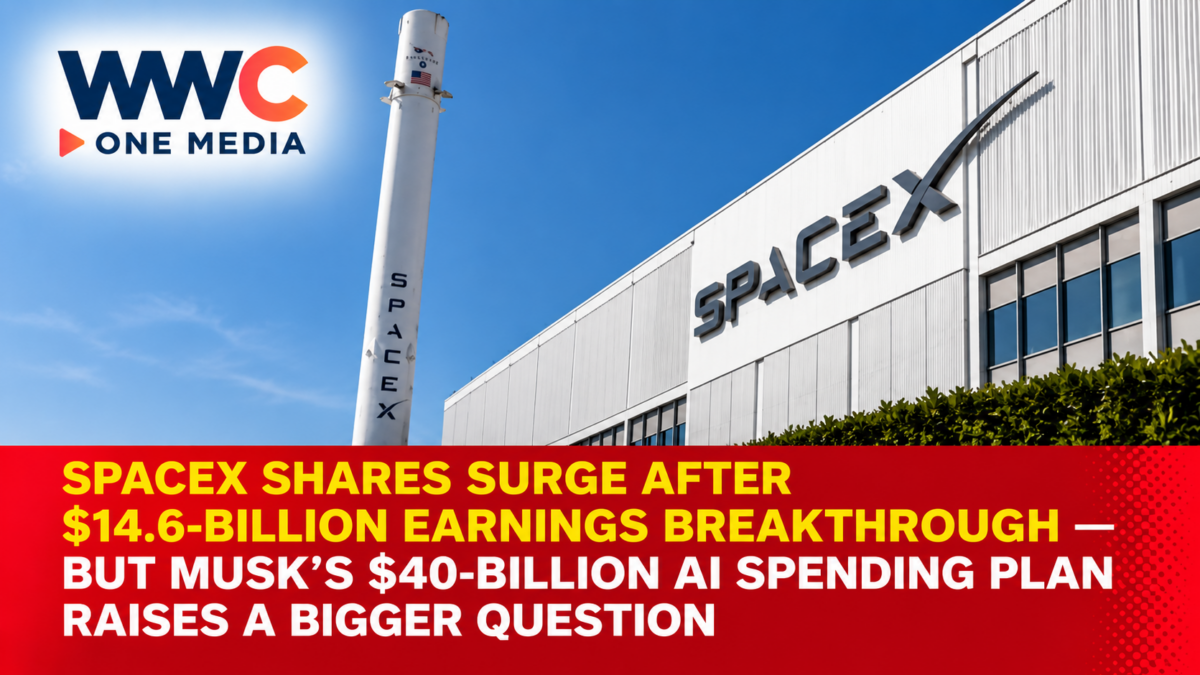
NEW YORK — Elon Musk’s SpaceX is rewriting its investment story after reporting its first quarterly profit as a publicly traded company, sending its shares sharply higher and shifting Wall Street’s attention from rockets and satellites toward a rapidly expanding artificial intelligence business.
The company reported third-quarter revenue of approximately $14.6 billion, an extraordinary 161% increase from the same period last year.
Net income reached $4.4 billion, reversing a $1.1-billion loss a year earlier, while adjusted earnings before interest, taxes, depreciation and amortization climbed to $8.8 billion.
The results surpassed analysts’ expectations and helped lift SpaceX shares by approximately 8% in extended trading, with gains continuing in Wednesday’s premarket session.
But the earnings announcement delivered another major surprise.
SpaceX’s Super Intelligence business generated approximately $7.6 billion in quarterly revenue, surpassing the company’s satellite connectivity division for the first time.
As investors celebrate the growth, they are also confronting an increasingly important question: Can SpaceX sustain its AI expansion without allowing enormous infrastructure spending to undermine its long-term financial position?
SPACEX DELIVERS STRONGER-THAN-EXPECTED THIRD-QUARTER RESULTS
According to SpaceX’s October 20 earnings release filed with the U.S. Securities and Exchange Commission, third-quarter revenue jumped from approximately $5.6 billion in 2025 to $14.6 billion in 2026.
The company recorded operating income of $2.8 billion and net income of $4.4 billion.
Adjusted EBITDA increased 306% year over year to $8.8 billion.
MarketWatch reported that analysts had expected approximately $12.9 billion in revenue.
SpaceX also reported quarterly earnings that exceeded Wall Street’s consensus estimates.
The results demonstrate a sharp improvement in the company’s overall financial performance following its public stock market debut earlier in 2026.
The company trades on Nasdaq under the ticker SPCX.
However, strong quarterly earnings do not eliminate the risks associated with the company’s expansion strategy.
SpaceX continues investing heavily in artificial intelligence infrastructure, satellite connectivity and next-generation launch systems.
AI BUSINESS OVERTAKES STARLINK IN REVENUE
The most significant development was the rapid growth of SpaceX’s Super Intelligence division.
The segment recorded approximately $7.6 billion in quarterly revenue, compared with $5.2 billion from the company’s Connectivity division, which includes Starlink.
The AI business now represents slightly more than half of consolidated quarterly revenue.
According to Reuters and The Verge, the expansion was supported by cloud computing agreements, the acquisition of AI coding company Cursor and increased demand for products including Grok.
The Super Intelligence division combines computing infrastructure and software services designed to serve businesses developing and operating artificial intelligence systems.
The company has benefited from a surge in demand for specialized computing resources.
Technology companies require substantial processing capacity to train and operate increasingly advanced AI models.
SpaceX is attempting to capture that demand by expanding infrastructure and leasing computing capacity to outside customers.
However, revenue growth alone does not establish that the AI division has become the company’s most profitable operation.
The financial performance of Starlink remains an important source of operating earnings.
STARLINK REACHES 13.6 MILLION SUBSCRIBERS
SpaceX’s satellite internet business continued expanding during the quarter.
Starlink reported approximately 13.6 million consumer subscribers worldwide, following the addition of around 1.6 million customers during the period.
The Connectivity division generated approximately $5.2 billion in revenue, representing 69% annual growth.
Its operating income reached about $2.4 billion.
These figures demonstrate the importance of Starlink as a recurring-revenue business.
The service provides internet connectivity through a large constellation of low-Earth-orbit satellites.
Customers include households, businesses, aviation operators and government organizations.
However, subscriber growth did not meet every analyst expectation.
Business Insider reported that Starlink’s consumer subscriber count fell short of a Bloomberg consensus estimate of approximately 14.2 million.
This illustrates why investors are examining both growth rates and the quality of that growth.
New customers can expand revenue, but maintaining network quality and managing equipment costs are equally important.
SPACEX’S ARTIFICIAL INTELLIGENCE INVESTMENT REACHES $19.6 BILLION
The company’s expansion has come at an extraordinary cost.
SpaceX reported capital expenditures of approximately $19.6 billion in the third quarter.
According to MarketWatch, about $16.4 billion was allocated to its Super Intelligence division.
That spending included computing infrastructure intended to support AI services and related applications.
Capital expenditure differs from operating expenses.
It generally involves investment in assets expected to provide benefits over multiple years, such as equipment and facilities.
Nevertheless, it requires substantial cash resources.
The latest figure suggests that AI infrastructure has become one of the largest investment priorities within SpaceX.
And the company is preparing to spend even more.
FOURTH-QUARTER SPENDING COULD HIT $40 BILLION
SpaceX Chief Financial Officer Bret Johnsen said fourth-quarter capital expenditure could reach between $35 billion and $40 billion.
That would represent a substantial increase from the already elevated third-quarter spending level.
The company is expanding computing capacity while continuing to fund its rocket and satellite operations.
Management believes demand for AI processing remains sufficiently strong to justify the investment.
However, the outlook raises questions about financing requirements.
Large-scale data centers require expensive processors, networking equipment, electrical infrastructure and cooling systems.
The facilities also depend on reliable electricity supplies and long-term customer demand.
While SpaceX has reported strong quarterly earnings, its future cash generation will depend on the timing of investments, operating profitability and payments received from customers.
Analysts will be closely watching whether the company can maintain financial flexibility while carrying out its ambitious development plans.
SPACEX REACHES 1.7 GIGAWATTS OF COMPUTING CAPACITY
The company reported that its installed nameplate computing capacity reached approximately 1.7 gigawatts by September 30.
This represents the scale of the electricity infrastructure associated with its computing operations.
The capacity is becoming increasingly important as SpaceX expands its AI cloud services.
According to Reuters and additional industry reporting, major technology companies are among the customers purchasing computing capacity.
These relationships could provide substantial recurring revenue.
However, computing capacity should not be confused with actual average electricity consumption.
Nor does installed capacity guarantee that every system is operating at full utilization.
Revenue depends on customer contracts, utilization, pricing and operational reliability.
TESLA MERGER DISCUSSIONS ADD ANOTHER SURPRISE
Perhaps the most unexpected development came during SpaceX’s earnings call.
Elon Musk confirmed that SpaceX and Tesla have established special committees to explore a potential merger.
The announcement followed growing speculation about closer cooperation between Musk’s companies.
A combination could potentially link Tesla’s vehicle, robotics and energy businesses with SpaceX’s satellite connectivity, computing infrastructure and AI operations.
Musk described the possibility positively but said he could not personally participate in negotiations because of potential conflicts of interest.
Independent directors and shareholders would need to evaluate any proposed transaction.
Importantly, the discussions do not mean a merger has been agreed upon.
Neither company has announced a finalized transaction.
Any proposed combination could face complex valuation, governance, financing and shareholder approval requirements.
WALL STREET REACTS TO STRONG RESULTS AND MERGER SPECULATION
SpaceX shares advanced sharply following the earnings announcement.
Reuters reported that the stock rose approximately 8% in extended trading.
By Wednesday’s premarket session, gains had reached approximately 9.4%.
Tesla shares also gained as investors considered the possibility of closer cooperation between the two companies.
MarketWatch reported that SpaceX’s strong results helped improve sentiment toward other AI-related businesses.
Companies involved in chips, servers and specialized cloud infrastructure also attracted attention.
However, market reactions can change rapidly.
Extended-hours and premarket prices are not the same as official regular-session closing prices.
The gains reflect investor responses to the reported results and announcements at specific points in time.
ANALYSTS SEE MAJOR UPSIDE — BUT VALUATION REMAINS A CHALLENGE
Before the earnings release, analysts were already divided over how to value SpaceX.
Some analysts see substantial growth opportunities in AI computing, satellite internet and next-generation launch technology.
Others are concerned that enthusiasm for artificial intelligence may be pushing valuations ahead of the company’s ability to generate consistent returns.
Investopedia reported that options traders had anticipated a stock move of approximately 7.5% in either direction following the earnings announcement.
Such estimates represent expectations implied by options prices, not predictions that the stock must move by a particular amount.
The eventual positive reaction reflected the strength of the earnings results and additional merger speculation.
But the longer-term outlook will depend on whether SpaceX can deliver against ambitious revenue and investment targets.
SPACEX’S ROCKET BUSINESS REMAINS ESSENTIAL
Despite the growing focus on artificial intelligence, launch services remain central to the company’s long-term strategy.
SpaceX continued developing Starship, its next-generation launch system.
The company said it completed its first revenue-generating Starship mission during the quarter, deploying 26 Starlink V3 satellites.
SpaceX stated that the mission provided substantially more downlink capacity than a typical Falcon 9 Starlink launch.
Its longer-term goal is to improve launch economics through reusable rocket technology.
Successful advances could support the deployment of larger satellite constellations and additional commercial missions.
However, launch development remains technically demanding.
Testing delays, engineering failures, regulatory requirements and safety considerations may affect development schedules.
WHAT SPACEX’S RESULTS MEAN FOR THE AI INDUSTRY
SpaceX’s earnings are significant beyond the aerospace sector.
The company is increasingly competing in markets traditionally associated with cloud computing and AI infrastructure providers.
Its strong AI revenue growth suggests that demand for computing resources remains substantial.
However, its capital spending also demonstrates the immense financial commitments required to participate in the industry.
Other companies, including specialized AI cloud providers and major technology platforms, face similar challenges.
Investors are increasingly examining whether these businesses can convert infrastructure investment into sustainable cash flow.
The broader question is whether demand will continue growing quickly enough to support the expansion underway.
SpaceX’s latest results provide evidence of strong demand, but they do not guarantee that every planned investment will achieve its expected return.
WHAT THIS MEANS FOR ASIA AND THE PHILIPPINES
SpaceX’s growth has implications for global technology supply chains.
Its AI infrastructure expansion creates demand for semiconductors, servers, networking systems, energy equipment and advanced manufacturing services.
Asian economies play major roles in these industries.
For the Philippines, Starlink’s regional presence and growing interest in satellite connectivity are particularly relevant.
Satellite internet services may provide additional options for remote and underserved locations, subject to local availability, pricing and regulatory requirements.
The AI infrastructure boom could also influence the wider electronics and technology services sectors.
However, SpaceX’s financial performance does not automatically translate into investment gains or direct economic benefits for Philippine companies.
Any impact will depend on specific commercial relationships and market conditions.
THE BIGGER QUESTION: CAN SPACEX TURN THE AI BOOM INTO LASTING PROFITS?
SpaceX’s third-quarter results demonstrate a remarkable transformation.
The company is no longer being assessed solely as a rocket manufacturer or satellite internet provider.
Artificial intelligence has become its largest revenue segment.
Starlink continues generating substantial operating income.
And the company is preparing another enormous round of computing infrastructure investment.
The potential merger with Tesla introduces an additional source of uncertainty and opportunity.
But the combination of rapid growth and accelerating capital expenditure creates a demanding test for management.
Investors may be impressed by SpaceX’s $14.6-billion quarterly revenue and $4.4-billion profit, but the company’s future will depend on whether its investments produce sustainable financial returns.
As Musk pushes deeper into artificial intelligence and explores a possible combination with Tesla, one critical question remains:
Will SpaceX’s explosive AI growth justify tens of billions of dollars in new spending — or could the scale of its ambitions become the biggest risk to Wall Street’s latest technology favorite?