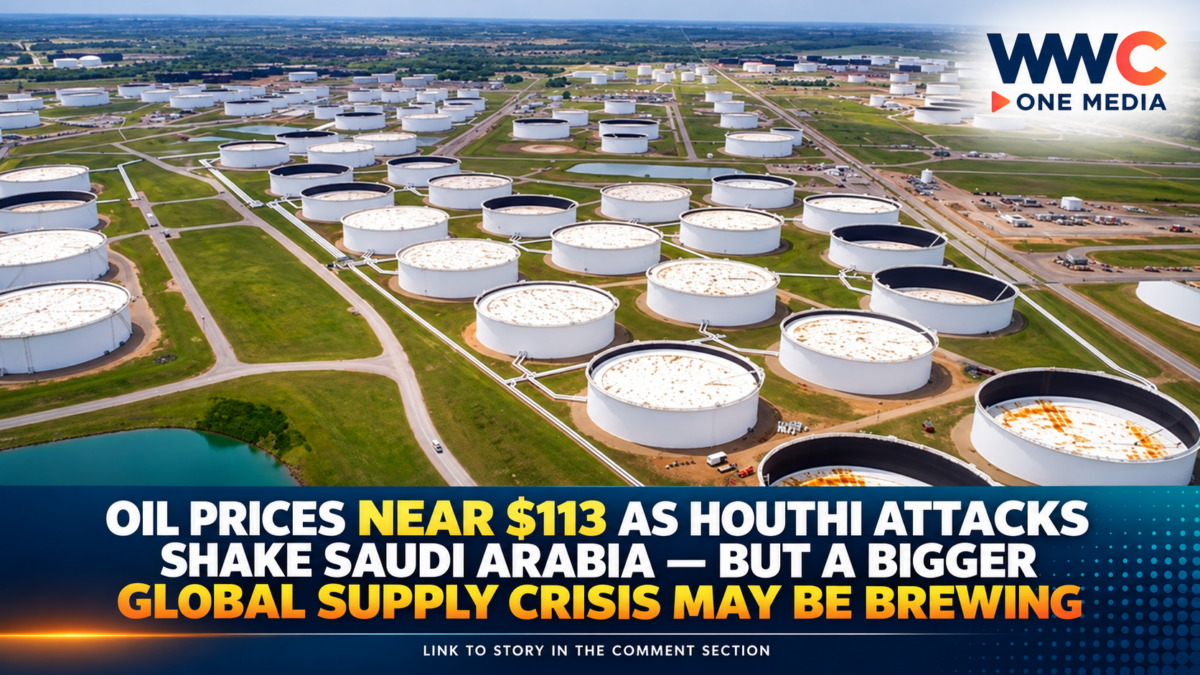
SINGAPORE — Global oil markets remained on edge Friday as crude prices hovered near five-month highs following intensified Houthi attacks on Saudi Arabia, raising fresh concerns that escalating Middle East tensions could threaten international energy supplies and push fuel costs higher.
Oil prices showed little movement during early Asian trading after surging approximately 4% in the previous session, a sharp rally driven by fears of further disruption to production facilities, transportation routes and energy infrastructure across the region.
As of 0030 GMT on Friday, benchmark Brent crude futures slipped 21 cents, or 0.2%, to $112.96 per barrel, while US West Texas Intermediate (WTI) crude declined 27 cents, or 0.3%, to $98.12.
Despite the modest retreat, Brent remained near its highest level in five months, highlighting growing anxiety among energy traders over the security of supplies from one of the world’s most important oil-producing regions.
Saudi Aramco Evacuation Raises Alarm
The latest escalation took a troubling turn Thursday when Saudi Aramco, the Saudi state-controlled oil giant, ordered personnel to evacuate its headquarters in Dhahran, near Bahrain.
The precautionary move came amid intensified fighting between Saudi forces and Yemen’s Iran-aligned Houthi movement, which has repeatedly targeted Saudi infrastructure.
Saudi Arabia is among the world’s largest oil producers and exporters, making any sustained disruption to its energy operations a potentially significant threat to international markets.
The evacuation underscored the severity of the security situation, although it did not, by itself, establish that Saudi oil production had been halted.
Recent attacks have heightened concerns about the vulnerability of critical energy infrastructure, including oilfields, refineries and transportation networks.
Why the World’s Oil Markets Are Worried
The confrontation extends beyond Saudi Arabia’s borders.
The Houthis have been engaged in a prolonged conflict involving Yemen’s internationally recognized government and a Saudi-led coalition. Recent hostilities have also placed renewed attention on the Bab el-Mandeb Strait, a strategically important passage connecting the Red Sea with the Gulf of Aden.
The waterway is vital for international commercial shipping, including energy cargoes moving between the Middle East, Europe and other markets.
Any serious disruption could force vessels to change routes, raise insurance premiums and increase transportation expenses.
Those additional costs can affect the price of crude oil and refined petroleum products even when some physical supplies remain available.
For energy-importing countries, the danger is not limited to an outright supply shortage. Prolonged instability can keep prices elevated through uncertainty, transportation costs and the risk that further attacks may occur.
Libya Adds Another Threat to Global Supply
Adding to concerns, Libya reported an interruption affecting oil production after a pipeline valve connecting the Hamada and Tahara oilfields to the Zawiya export port was shut.
The head of Libya’s National Oil Corporation confirmed Thursday that production at both fields had been reduced.
The development added another source of supply uncertainty as traders assessed the possible consequences of Middle East hostilities.
Although the scale and duration of Libya’s production losses were not specified in the initial report, simultaneous disruptions across producing countries could tighten global supply conditions if they persist.
Russia-Ukraine Diplomacy Could Influence Prices
Energy markets are also watching developments involving Russia and Ukraine.
Russia said Wednesday that it was prepared to resume US-mediated negotiations with Ukraine in November following discussions between Russian President Vladimir Putin and US envoy Steve Witkoff in St Petersburg.
Ukrainian President Volodymyr Zelenskyy also expressed hope that negotiations could begin early next month.
The possibility of renewed diplomacy has implications beyond the conflict itself.
Russia remains one of the world’s largest crude oil producers, and sanctions imposed following its full-scale invasion of Ukraine in 2022 have significantly affected international energy trade.
A diplomatic breakthrough could eventually change expectations for Russian oil exports and trade restrictions. However, negotiations alone would not guarantee immediate sanctions relief or additional supply.
Could Oil Prices Rise Even Further?
Brent crude was on course for a third consecutive weekly gain, while WTI was positioned to finish the week lower following two weeks of increases.
That divergence illustrates how regional supply concerns, trading conditions and geopolitical developments can affect the world’s two major crude benchmarks differently.
Energy markets are particularly sensitive to uncertainty involving Saudi Arabia because of the country’s substantial production and export capacity.
Further attacks on major facilities, sustained restrictions on shipping or prolonged production interruptions could add upward pressure to oil prices.
Conversely, improved regional security, stable export flows or meaningful diplomatic progress could help ease the market’s geopolitical risk premium.
For now, traders are balancing actual supply disruptions against the possibility of more serious interruptions.
What This Means for the Philippines and Asia
Higher international crude prices could create renewed pressure on oil-importing economies across Asia, including the Philippines.
If elevated crude and refined fuel prices persist, Philippine motorists and businesses could face more expensive gasoline and diesel, depending on international product prices, foreign exchange movements and local pricing adjustments.
Higher fuel expenses can also increase transportation and logistics costs, potentially affecting food distribution, electricity generation costs in oil-dependent systems and broader inflation.
For the Philippines, where imported petroleum products play a major role in meeting domestic demand, sustained volatility in global energy markets remains an important economic risk.
However, higher Brent prices do not automatically translate into immediate or equivalent increases at local fuel stations. Actual pump prices depend on regional fuel markets, currency movements, taxes and other factors.
The Bigger Question: Is the Market Facing Another Energy Shock?
What makes the current situation particularly concerning is the combination of overlapping geopolitical and operational risks.
Saudi Arabia faces renewed attacks, Libya has reported reduced production, major shipping routes remain exposed to security threats, and Russia’s future trading relationship with global energy markets remains uncertain.
Yet the possibility of disruption is not the same as an established worldwide oil shortage.
Recent evidence that Gulf exports have continued flowing also suggests that producers and shipping operators have found ways to maintain substantial volumes despite the conflict.
The market’s next direction may therefore depend less on individual headlines and more on whether attacks cause sustained losses in actual oil production and deliveries.
With Brent trading near $113 per barrel, the central question is no longer simply whether oil prices can rise again — but whether the world’s energy supply network can withstand another major escalation without a lasting economic shock.