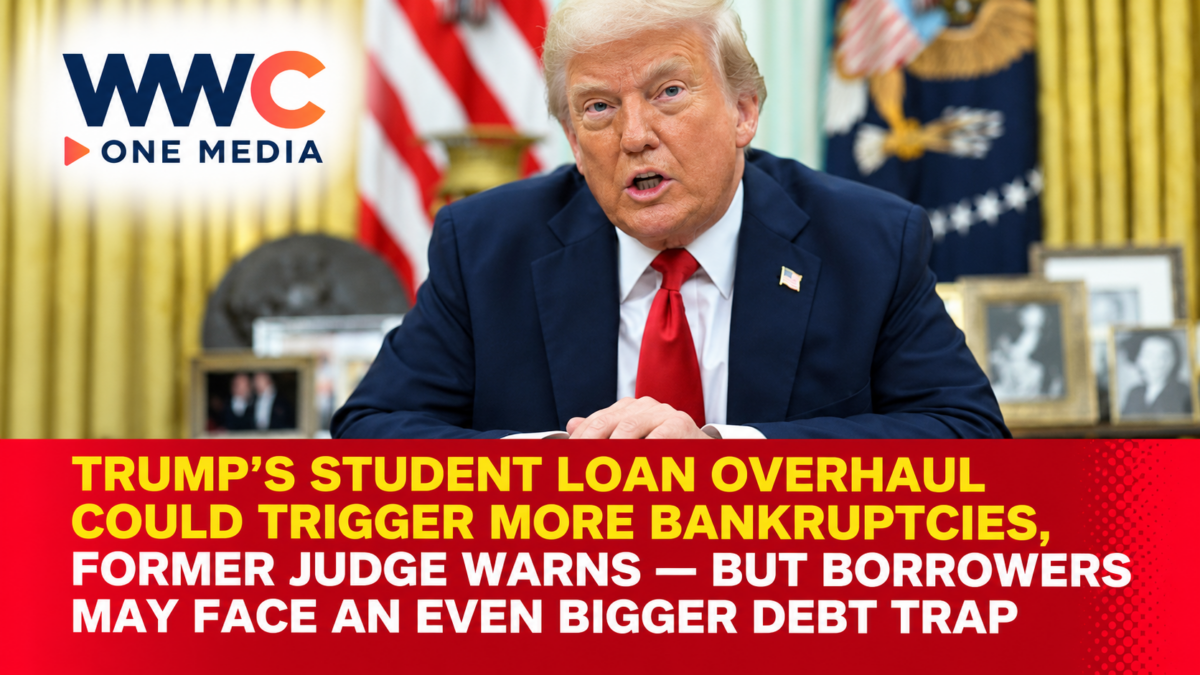
WASHINGTON, D.C. — A sweeping overhaul of America’s federal student loan system is raising concerns that more borrowers could face financial distress, with a former federal bankruptcy judge warning that new borrowing restrictions may push students toward higher-cost private loans and increase the risk of bankruptcy.
Sarah Sharer Curley, who served on the U.S. Bankruptcy Court for the District of Arizona for nearly three decades, raised the warning in an interview with CNBC published on October 17.
Curley, who retired from the bench in 2014, argues that the country’s bankruptcy system already makes it unusually difficult for struggling borrowers to escape certain education debts.
Now, changes introduced under President Donald Trump’s student loan legislation could add to the pressure.
The warning comes as the United States grapples with a growing student debt burden, rising repayment costs and an increase in personal bankruptcy filings.
But the most troubling issue may be what happens after borrowers become unable to repay.
Unlike many other forms of consumer debt, qualifying student loans generally cannot be eliminated through bankruptcy unless borrowers establish that repayment would create an undue hardship.
FORMER JUDGE WARNS MORE AMERICANS COULD FILE FOR BANKRUPTCY
Curley discussed the issue in an interview about her book, “The Price of Forgiveness: Debt, Bankruptcy, and the Future of Fairness in America.”
Drawing on her experience presiding over bankruptcy proceedings, she criticized a legal framework that can leave financially distressed borrowers carrying education debts for decades.
Her warning centers on the possibility that tighter federal borrowing limits will force some graduate and professional students to turn to private lenders.
Private loans may carry higher interest rates and offer fewer repayment protections than federal student loans.
That could leave certain borrowers vulnerable if their expected earnings fail to materialize or if they experience unemployment, illness or other financial setbacks.
Curley believes the changes could contribute to additional bankruptcy filings.
However, the prediction is an expert assessment, not an established outcome of the new legislation.
The full effects of the borrowing changes will become clearer only as affected students enter repayment and their financial performance can be measured.
TRUMP’S 2025 LAW INTRODUCES STRICTER BORROWING LIMITS
The changes stem from the federal tax and spending law signed by President Donald Trump on July 4, 2025.
Major student loan provisions began taking effect in July 2026.
Under the revised system, federal graduate borrowing is generally subject to tighter limits.
Eligible graduate students outside designated professional programs face an annual Direct Unsubsidized Loan limit of $20,500 and an aggregate limit of $100,000.
Students in designated professional programs face an annual limit of $50,000 and an aggregate limit of $200,000.
The law also ends new graduate and professional PLUS borrowing under the revised framework, subject to transitional protections for qualifying existing borrowers.
Previously, Graduate PLUS loans allowed eligible borrowers to obtain additional federal funding up to the approved cost of attendance, subject to applicable requirements.
Supporters of the new limits argue that restricting federal borrowing could discourage excessive education debt and put pressure on universities to control tuition costs.
Critics contend that the caps may not reflect the actual cost of certain graduate programs, potentially pushing students into more expensive private financing.
MEDICAL STUDENTS COULD FACE PARTICULAR PRESSURE
Graduate and professional education can require substantial financial investment.
Medical, dental and other advanced programs may involve several years of tuition, living expenses and limited opportunities for full-time employment.
For students whose expenses exceed the new federal borrowing limits, private loans may become an alternative.
However, private financing is not necessarily available on favorable terms.
Interest rates may depend on credit history, income, cosigners and broader market conditions.
Curley illustrated the potential danger with a hypothetical medical student borrowing $300,000 at a 16% annual interest rate.
Over a conventional 10-year repayment period, such borrowing could require monthly payments of approximately $5,000 and generate more than $300,000 in interest.
The illustration demonstrates how high interest rates can dramatically increase the total cost of education.
It is not a prediction that all medical students will borrow $300,000 or face a 16% interest rate.
Actual borrowing costs vary by lender, loan terms and individual circumstances.
ONE RETIREE’S $584,000 DEBT SHOWS THE HUMAN COST
During her CNBC interview, Curley recalled a particularly troubling case from her years on the bench.
A 73-year-old woman appeared before her court in 2012 carrying more than $584,000 in student loan debt.
According to Curley’s account, the debt originated decades earlier and had continued accumulating during the woman’s working life.
The borrower had worked in public service but had never earned substantial income.
By the time she sought relief, she was living in poverty and relying on Social Security.
The case illustrated the potentially devastating long-term consequences of education debt that grows beyond a borrower’s capacity to repay.
It also reinforced Curley’s argument that bankruptcy law can fail to provide a meaningful financial fresh start to people facing extraordinary hardship.
However, the case occurred well before the Trump administration’s latest student loan changes.
It should be understood as historical evidence of the challenges surrounding student debt, not as an example caused by the 2025 legislation.
BANKRUPTCY FILINGS ALREADY RISING ACROSS THE UNITED STATES
Federal court statistics show that nonbusiness bankruptcy filings have increased significantly in recent years.
For the 12 months ending December 2025, approximately 549,577 nonbusiness bankruptcy cases were filed nationwide.
That compared with around 374,240 cases in 2022.
The increase was approximately 47% over three years.
The figures demonstrate a broader rise in household financial distress and the use of bankruptcy proceedings.
However, the increase cannot be attributed to the student loan overhaul.
The statistics cover periods before the major new borrowing limits took effect in July 2026.
They also include bankruptcies arising from many different financial difficulties, not just education debt.
Factors may include medical expenses, credit card borrowing, employment problems, business failures and other financial pressures.
Nevertheless, the trend provides context for concerns about additional debt burdens entering an already challenging financial environment.
WHY STUDENT LOANS ARE DIFFICULT TO ERASE IN BANKRUPTCY
One of Curley’s central arguments concerns the special legal treatment of student loans.
In the United States, filing for bankruptcy does not automatically eliminate qualifying federal or private education loans.
Under federal bankruptcy law, borrowers generally must demonstrate that continuing repayment would impose an undue hardship on themselves and their dependents.
This requirement is different from the process used for many ordinary unsecured consumer debts.
Borrowers typically must file a separate legal proceeding within their bankruptcy case, known as an adversary proceeding.
The bankruptcy court then determines whether the applicable legal standard has been met.
Depending on the jurisdiction, courts may consider a borrower’s income, necessary living expenses, long-term financial circumstances and repayment history.
The process can be costly, time-consuming and legally complicated.
For people already experiencing serious financial distress, the additional legal burden can discourage them from seeking relief.
BANKRUPTCY RELIEF HAS BECOME MORE ACCESSIBLE FOR SOME BORROWERS
There is, however, an important development that complicates the picture.
In November 2022, the U.S. Department of Justice and Department of Education introduced a standardized process to make it easier for eligible federal student loan borrowers to seek discharge in bankruptcy.
The process allows borrowers to provide financial information through an attestation form.
Government attorneys can then evaluate whether the borrower’s circumstances support an undue-hardship discharge.
According to a CNBC Select report updated in August 2026, research published in the American Bankruptcy Law Journal found that borrowers who pursued federal student loan discharge in 2023 were successful approximately 87% of the time.
That was higher than the success rates reported in earlier comparison years.
The statistic is important but must be interpreted carefully.
It describes borrowers who actually pursued discharge proceedings, not all Americans carrying student debt.
Many financially distressed borrowers never file the necessary legal action.
Furthermore, a favorable government recommendation does not automatically eliminate a loan.
A bankruptcy court must still approve the discharge.
FEDERAL GUIDANCE REMAINS AVAILABLE
As of an update published in March 2026, the U.S. Department of Justice continued to provide the standardized guidance for student loan bankruptcy cases.
The official guidance explains how federal attorneys evaluate discharge requests and how borrowers can submit supporting financial information.
The Department of Education’s Federal Student Aid website also confirms that borrowers may seek discharge through bankruptcy if they demonstrate undue hardship.
This distinction matters because the new borrowing caps do not mean every existing bankruptcy relief mechanism has disappeared.
However, the applicable process depends on the type of loan and the circumstances of the borrower.
Private student loans do not generally qualify for the same federal attestation process.
Some private education loans may also fall outside the statutory categories normally protected from discharge, depending on the loan’s characteristics.
Borrowers therefore need individual legal advice rather than assuming that all student loans are treated identically.
DEPARTMENT OF EDUCATION DEFENDS REPAYMENT REFORMS
The Trump administration has presented its student loan overhaul as an effort to simplify repayment and reduce complexity.
In a June 2026 fact sheet, the U.S. Department of Education said the new framework was intended to replace a fragmented system of repayment options with clearer alternatives.
The revised arrangements include the Repayment Assistance Plan and a tiered standard repayment structure.
The administration argues that these changes can make repayment more predictable and discourage borrowing beyond students’ ability to repay.
Some supporters also believe federal lending restrictions could eventually encourage educational institutions to offer programs at more sustainable prices.
However, critics question whether universities will reduce costs quickly enough to offset the borrowing restrictions.
They also warn that some students may turn to private loans without the same borrower protections.
The competing arguments reflect a broader policy debate about how to finance higher education while protecting taxpayers and students from unsustainable debt.
REUTERS: COURT CHALLENGE EXPOSES DISPUTE OVER PROFESSIONAL DEGREES
The administration’s implementation of graduate borrowing restrictions has also faced legal challenges.
Reuters reported on June 25 that a federal judge blocked aspects of a Department of Education rule that narrowed which academic programs could qualify under the higher professional-student borrowing limits.
Organizations representing healthcare professionals challenged the classification system, arguing that it unfairly excluded certain programs.
The judge concluded that the department’s interpretation conflicted with applicable legal requirements.
However, the ruling did not eliminate the underlying borrowing limits enacted by Congress.
Instead, it addressed the administration’s implementation and classification of eligible professional degree programs.
The distinction is important because changes to administrative rules and changes to federal law have different legal consequences.
Students considering expensive professional degrees must therefore verify the rules applicable to their programs.
BUSINESS INSIDER: REPAYMENT CHANGES MAY INCREASE MONTHLY BILLS
The latest warning also comes as borrowers face changes to federal repayment programs.
Business Insider reported in October that a Center for American Progress analysis found certain borrowers could see substantial increases in their monthly payments under the revised repayment framework.
One example involved a borrower earning $68,615 annually whose monthly payment could rise from $136 to $343.
The figures represent a modeled scenario rather than an increase applying to every borrower.
Actual monthly payments depend on the loan balance, income, household circumstances, repayment plan and eligibility rules.
Still, the research demonstrates why financial advocates are concerned about affordability.
An increase in required payments can reduce the money households have available for rent, food, healthcare and other necessities.
Borrowers who cannot maintain payments may face delinquency, default and additional collection consequences.
ANOTHER STUDENT LOAN DISPUTE REACHES FEDERAL COURT
Separate concerns have emerged involving student loan relief promised to borrowers who were allegedly defrauded by educational institutions.
Business Insider reported on October 20 that the Project on Predatory Student Lending filed a motion seeking enforcement of the Sweet v. McMahon settlement.
The advocacy organization alleged that more than 1,000 qualifying borrowers were still waiting for discharges or refunds they should already have received.
The Department of Education disputed the accusations, describing the motion as baseless and saying some accounts required additional review.
The case concerns borrower-defense relief, which is legally distinct from bankruptcy discharge.
It nevertheless highlights the broader challenges facing the administration of federal student loan relief.
A hearing was scheduled for November 5.
WHAT THIS MEANS FOR STUDENTS AND FAMILIES
The financial risks associated with higher education are becoming increasingly important for families planning graduate and professional studies.
Prospective borrowers need to consider the total cost of a program, expected income after graduation and the amount of debt required.
Students should also compare federal and private lending terms.
Federal loans generally provide borrower protections that may not be available with private loans.
These can include certain repayment arrangements and possible eligibility for federal relief programs.
Private lenders may offer competitive rates to some borrowers, but loan terms and hardship protections vary.
Students should also consider scholarships, grants, employer assistance and lower-cost educational alternatives where appropriate.
For borrowers already experiencing financial difficulties, seeking reputable financial or legal guidance early can help clarify available options.
Bankruptcy should not be treated as an automatic or risk-free solution.
WHAT THIS MEANS FOR FILIPINO STUDENTS IN THE UNITED STATES
The student loan changes may also be relevant to Filipino families with children studying in the United States.
However, federal student loan eligibility depends on citizenship or qualifying immigration status and other program requirements.
International students generally do not qualify for ordinary U.S. federal student loans solely because they are enrolled in an American institution.
Some may instead rely on scholarships, family financing or eligible private education loans.
Filipino families considering study in the United States should therefore verify the funding options available to the individual student.
The U.S. bankruptcy rules discussed in this report should not be confused with Philippine insolvency law.
The legal protections and obligations differ between countries.
THE BIGGER QUESTION: WILL STUDENT LOAN REFORM CREATE MORE DEBT DISTRESS?
The debate over Trump’s student loan overhaul reflects a difficult policy choice.
Supporters argue that borrowing limits and repayment reforms could reduce excessive education debt and encourage institutions to become more financially accountable.
Critics warn that the limits may shift borrowing from federal programs into private markets, where interest rates and repayment protections can be less favorable.
Former bankruptcy judge Sarah Sharer Curley believes the consequences could include more borrowers seeking financial relief through the courts.
But the long-term effect remains uncertain.
The new borrowing framework has not been operating long enough to establish its full impact on student defaults or bankruptcy filings.
Meanwhile, the existing bankruptcy system continues to offer limited relief to borrowers who can demonstrate undue hardship.
The central challenge is whether the United States can control rising education borrowing without making advanced degrees unaffordable or forcing students into more expensive private debt.
And as policymakers debate the future of student financing, one question remains:
Could stricter federal loan limits protect future students from excessive debt — or will they push more Americans toward private loans that become even harder to escape when financial hardship strikes?