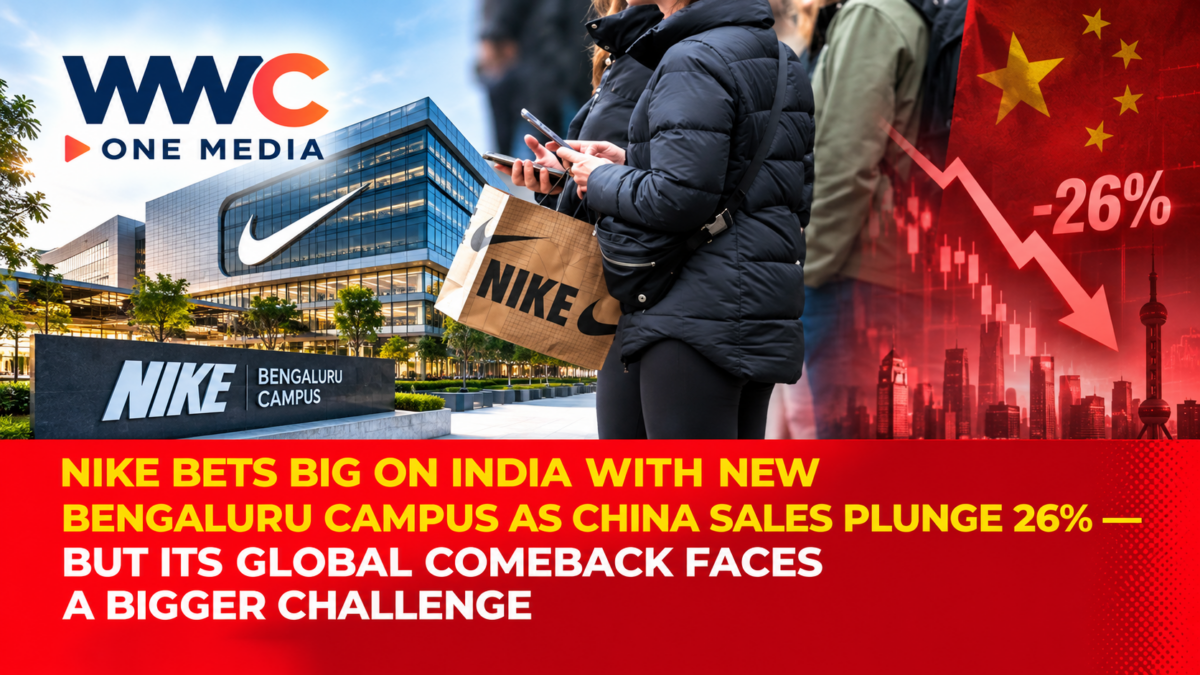
BENGALURU, India — Nike is making a major long-term bet on India as the American sportswear giant searches for new growth opportunities while confronting a deepening sales slump in China and mounting pressure to revive its global business.
The company has announced plans to establish a new global corporate campus in Bengaluru, India’s technology capital, bringing together employees and capabilities supporting its Nike, Jordan Brand and Converse businesses.
The investment forms part of a sweeping restructuring strategy called Pace, designed to simplify Nike’s operations, strengthen its supply chain and generate approximately $2.5 billion in cumulative savings through fiscal 2031.
But the expansion comes at a difficult time.
Nike’s Greater China revenue fell 26% on a currency-neutral basis during its fiscal first quarter ended August 31, 2026. Worldwide quarterly revenue declined 4% to approximately $11.2 billion.
Under chief executive Elliott Hill, Nike is attempting to restore its reputation for product innovation, strengthen relationships with retailers and recover from years of disappointing sales.
India offers an attractive opportunity because of its expanding consumer market, growing sporting culture and large pool of professional talent.
However, the planned Bengaluru campus is not a guarantee of immediate sales growth.
The bigger question is whether Nike can turn India into a meaningful long-term growth engine while fixing the problems undermining its once-dominant position in China.
Nike Announces Major New Campus in Bengaluru
Nike unveiled its Bengaluru campus plans on October 1, 2026, alongside its first-quarter fiscal 2027 financial results.
The company described the project as a long-term investment in talent, innovation and global business capabilities.
Bengaluru is one of India’s principal technology and corporate services centers, making it an attractive location for multinational companies seeking specialized expertise.
According to Nike’s operating model announcement, the new campus will support employees working across Nike, Jordan Brand and Converse.
The facility is expected to bring together functions that serve both India’s market and the company’s international business.
Employees already based in India are expected to move to the campus in phases beginning in fiscal 2028, with further development over subsequent years.
Indian business reporting indicated that Nike expects to disclose the campus’s location during calendar year 2027.
However, the company has not publicly confirmed a total investment amount, completed campus design, precise construction timetable or final employee headcount.
Those details should not be treated as established facts until Nike provides official confirmation.
CEO Elliott Hill Sees India as a Long-Term Growth Opportunity
Nike chief executive Elliott Hill has emphasized India’s strategic importance as both a growth market and a manufacturing hub.
In a message to employees, Hill highlighted the country’s capabilities and access to talent as reasons for making the investment.
Nike believes its presence in India can support stronger consumer insights, product innovation and global operations.
The company has also pointed to increased participation in running, football, basketball, fitness and other sports as creating opportunities to reach more athletes.
For Nike, expanding its corporate capabilities in India could help the business respond more effectively to local consumer preferences.
India’s market differs from the United States and China in pricing, retail distribution, purchasing power and participation across sports.
Success will therefore require more than simply introducing global marketing campaigns or opening additional facilities.
Nike must develop products, distribution strategies and brand experiences that resonate with Indian consumers.
The company has indicated that it plans to provide more information about its strategy at its investor event in November.
China Sales Plunge 26%, Deepening Nike’s Turnaround Crisis
The India expansion comes as Nike faces substantial difficulties in what has historically been one of its most important international markets.
During the fiscal quarter ended August 31, 2026, Greater China revenue fell 26% on a currency-neutral basis.
Nike’s wholesale revenue in the region declined 31%, while its direct-to-consumer revenue decreased 18%.
Digital sales fell 28%, and sales from company-operated stores declined 14%.
The downturn affected multiple product categories.
Footwear revenue in Greater China dropped 26%, while apparel revenue declined 27%, both on a currency-neutral basis.
These figures indicate that the problem extends beyond a single product line or sales channel.
Nike’s China business has also faced growing competition from domestic sportswear companies and changing consumer preferences.
Local brands have strengthened their positions by investing in product development, retail distribution, marketing and connections with Chinese consumers.
The competitive environment is forcing Nike to reconsider how it presents its products and operates its stores.
However, the fall in Greater China revenue should not be described as a 26% decline in Nike’s total worldwide sales.
The company’s overall quarterly revenue decreased by a much smaller 4%.
Nike’s Global Revenue Falls to $11.2 Billion
Nike reported first-quarter fiscal 2027 revenue of approximately $11.2 billion, compared with roughly $11.7 billion a year earlier.
That represents a 4% decrease on a reported basis and a 5% decrease after adjusting for currency movements.
The company’s gross profit margin improved by 60 basis points to 42.8%, supported partly by lower logistics and warehousing expenses.
Diluted earnings per share reached $0.48.
The margin improvement provided some evidence of progress in operational efficiency.
Nevertheless, the overall results showed that cost discipline has not yet restored broad-based sales growth.
The Nike brand’s wholesale revenue totaled approximately $6.8 billion, down slightly year over year.
Nike Direct revenue fell to approximately $4.1 billion, reflecting weakness in the company’s digital and store businesses.
That presents an important challenge.
Nike previously invested heavily in direct-to-consumer distribution, but the strategy contributed to tensions with some wholesale partners and exposed the company to changes in shopping behavior.
Under Hill, management has been rebuilding retailer relationships while strengthening its performance footwear and apparel businesses.
The goal is to return Nike to sustainable growth rather than relying heavily on promotions and inventory reductions.
Nike Launches $2.5 Billion Restructuring Program
The Bengaluru campus is one component of a broader operating transformation called Pace.
Nike intends to reorganize its global structure, simplify internal processes and improve supply-chain efficiency.
The company expects the initiative to generate approximately $2.5 billion in cumulative cost savings through fiscal 2031.
The restructuring also involves additional workforce reductions.
Nike has not disclosed a complete final headcount for the planned cuts.
The program is expected to involve restructuring expenses before the full savings are realized.
For investors, that means the announced $2.5 billion figure should not be described as an immediate profit increase or cash injection.
It represents a multiyear cost-saving target.
The financial outcome will depend on implementation expenses, operating performance and Nike’s ability to improve sales.
Cost reductions can help protect profit margins, but they cannot fully compensate for declining demand if consumers continue choosing competing brands.
Nike Reorganizes Into Three Global Regions
As part of the Pace transformation, Nike is restructuring its geographical organization into three principal regions.
The first will combine North America and Latin America into an Americas division.
The second will bring together Asia Pacific and Greater China.
The third will retain Europe, the Middle East and Africa as a consolidated operating region.
Nike said its Asia Pacific and Greater China regional leadership will be based in Singapore, with some functions moving closer to the markets they support.
The restructuring is intended to simplify decision-making and improve responsiveness to regional conditions.
This is particularly significant for Asia.
Rather than managing Greater China and the rest of Asia Pacific through separate regional structures, Nike will place them within a combined geographical grouping.
However, the new organizational structure does not mean China and India will be managed as one consumer market.
The two countries have different competitive conditions, retail systems and growth opportunities.
The challenge for Nike will be achieving operational efficiency while maintaining the local insight necessary for successful product development and marketing.
India Could Become a Major Retail Growth Engine
Nike’s investment is partly driven by expectations of long-term expansion in India’s consumer economy.
According to market projections cited by CNBC, India could become the world’s third-largest retail market by 2030.
The India Brand Equity Foundation estimated the country’s e-commerce market at approximately $159 billion in 2026, with the potential to exceed $330 billion by 2031.
Those estimates highlight the scale of the opportunity for international consumer brands.
A growing retail market can increase demand for footwear, sports apparel and lifestyle products.
But Nike will face competition from both international and domestic businesses.
The Indian market includes consumers with widely different purchasing power, and many shoppers remain sensitive to pricing.
Premium athletic shoes and apparel may be attractive to urban and affluent consumers but less accessible to the wider population.
For Nike, a successful India strategy will require thoughtful pricing, distribution and product positioning.
The company will also need to navigate the complexity of India’s retail system, which includes modern shopping centers, independent stores and online marketplaces.
The projected expansion of India’s retail market does not automatically translate into a specific revenue forecast for Nike.
India Is More Than a Consumer Market for Nike
The planned campus also highlights India’s role in global corporate operations.
Nike already recognizes the country as an important manufacturing location and source of professional talent.
The Bengaluru investment is intended to strengthen capabilities that serve the company’s international business.
Corporate campuses can support activities such as technology, business operations, analytics, product development and other centralized functions.
Nike has confirmed that the campus will support work across its major brands, although it has not disclosed a complete department-by-department breakdown of the planned activities.
That distinction matters.
The investment should not automatically be described as a new footwear factory or as proof that Nike is moving manufacturing operations out of China.
A corporate campus and a manufacturing plant serve different purposes.
Nike’s strategy appears designed to improve global capabilities while expanding its long-term presence in India’s economy.
Nike Says China Remains a Long-Term Priority
Despite the attention surrounding India, Nike has emphasized that it is not abandoning China.
The company continues to regard Greater China as a strategically important market.
Management intends to improve product availability, refresh its retail stores and strengthen its digital business.
Nike has acknowledged that these changes will take time.
The company’s difficulties in China reflect more than short-term consumer spending pressure.
They also involve brand relevance, product selection, competition and retail execution.
Rebuilding the business will likely require stronger innovation and a more compelling shopping experience.
India’s long-term opportunities may help diversify Nike’s growth prospects, but the company cannot simply replace China’s existing revenue base overnight.
For investors, the most convincing turnaround would involve measurable recovery in China alongside sustainable expansion elsewhere.
Adidas and Local Sportswear Brands Intensify Competition
Nike’s turnaround is unfolding in an increasingly competitive global sportswear industry.
Adidas remains a major international competitor, while specialized running brands and domestic Asian manufacturers continue gaining attention.
Consumers are increasingly willing to compare performance, comfort, design and price rather than relying entirely on historical brand recognition.
This puts pressure on Nike to refresh its product offerings and regain momentum in categories where competitors have attracted customers.
In China, domestic brands have strengthened their positions by aligning products and marketing with local preferences.
In India, Nike must build loyalty in a market where consumers have access to a wide variety of sportswear options at different price points.
The ability to compete effectively in both markets will require consistent investment in product development and strong relationships with retailers.
A new corporate campus may strengthen the company’s operational capabilities, but product performance and consumer demand will ultimately determine commercial success.
Wall Street Remains Skeptical of Nike’s Recovery
Nike’s restructuring has not immediately restored investor confidence.
Following its October 1 earnings announcement, the company’s shares fell sharply as investors reacted to weak sales and a difficult outlook.
Reuters reported that Nike’s turnaround under Elliott Hill was facing increasing scrutiny amid persistent problems in Greater China, Jordan Brand and its sportswear business.
The company has also experienced a prolonged decline in market valuation.
Investors will want to see improvement in revenue, profitability and brand momentum before concluding that the turnaround is working.
Management’s November investor event may provide a more detailed explanation of the India investment, the Pace restructuring and the company’s broader growth strategy.
Until then, several important financial and operational details remain unknown.
What Nike’s India Strategy Means for Asia and the Philippines
Nike’s restructuring has implications beyond India and China.
The company’s decision to place Asia Pacific and Greater China under a combined regional organization, with leadership based in Singapore, reflects the growing importance of managing Asian operations close to local markets.
For Southeast Asia, including the Philippines, the move could influence how Nike coordinates regional distribution, marketing and business operations over time.
However, the company has not announced a specific Philippine store expansion, employment program or retail investment as a direct consequence of the Bengaluru campus.
Any claim about immediate changes to Nike Philippines would require separate confirmation.
The broader industry lesson is clear: global consumer brands increasingly need to combine operational efficiency with locally relevant products and marketing.
The Bigger Question: Can India Help Nike Restore Its Global Dominance?
Nike’s decision to develop a new Bengaluru campus represents an important long-term commitment to India.
The investment could strengthen the company’s global capabilities, deepen its access to talent and improve its understanding of a rapidly developing consumer market.
But the move comes during one of Nike’s more challenging business periods.
Revenue has declined, competition in China remains intense and investors are demanding stronger evidence that the company’s turnaround strategy will succeed.
The Pace program may create significant savings, but sustainable recovery will ultimately depend on whether consumers return to Nike’s products.
India provides an opportunity for future growth.
China remains an urgent challenge.
Nike is betting that Bengaluru can help build the capabilities needed for its next era of expansion. But with Greater China sales down 26% and billions of dollars in restructuring savings still years away, the bigger question is whether India can become a powerful new growth engine before Nike loses more ground in the markets that once fueled its global success.