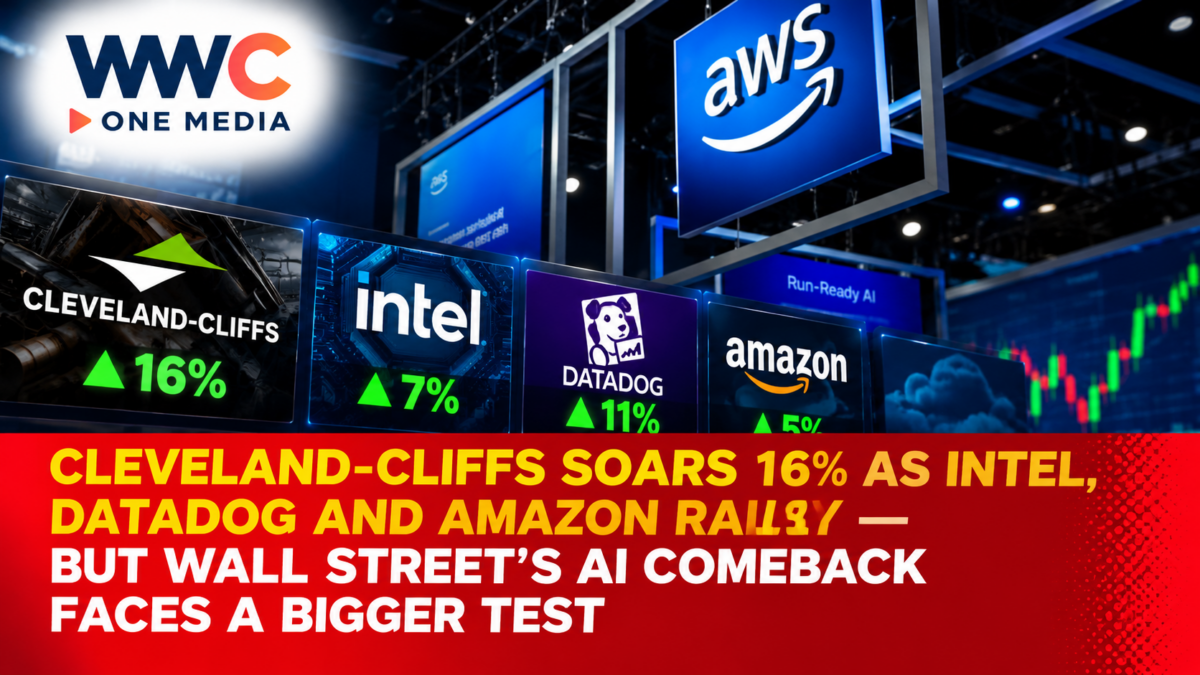
NEW YORK — Wall Street witnessed a dramatic shift in investor sentiment on Monday, October 19, as Cleveland-Cliffs surged more than 16% while technology giants Intel, Amazon and cloud software company Datadog rallied following positive analyst calls and renewed interest in artificial intelligence investments.
The gains helped U.S. technology shares recover from a difficult week, although concerns about the enormous cost of AI infrastructure and the sustainability of corporate spending continued to influence financial markets.
Cleveland-Cliffs emerged as one of the day’s biggest winners after reporting stronger-than-expected quarterly earnings and presenting an ambitious profit outlook for 2027.
Meanwhile, Intel received a rating upgrade from JPMorgan, Datadog attracted renewed optimism from Bernstein, and Amazon benefited from a bullish assessment by Morgan Stanley.
The simultaneous rallies highlighted a broader market trend: Investors remain interested in companies with credible growth opportunities, but they are becoming increasingly selective about the financial risks behind those opportunities.
CLEVELAND-CLIFFS SURGES AS STEELMAKER FORECASTS MAJOR PROFIT GROWTH
American steel producer Cleveland-Cliffs delivered one of the biggest stock market surprises of the trading session.
Its shares rose more than 10% in premarket trading and ended the day over 16% higher after the company reported stronger-than-expected third-quarter adjusted earnings.
Cleveland-Cliffs posted adjusted earnings of 28 cents per share, exceeding the 21 cents forecast by analysts surveyed by FactSet.
Quarterly revenue reached approximately $5.61 billion, up from $4.73 billion a year earlier, although it remained slightly below market expectations.
The company also reported a net profit of approximately $152 million, reversing a loss of $251 million during the corresponding period a year earlier.
However, the biggest catalyst was management’s outlook for the coming year.
Cleveland-Cliffs forecast more than $4 billion in adjusted earnings before interest, taxes, depreciation and amortization for 2027, substantially above the approximately $2.54 billion expected by analysts.
The company also projected fourth-quarter 2026 adjusted EBITDA of approximately $715 million, compared with consensus expectations of roughly $684 million.
The upbeat guidance suggested that improving domestic steel demand, higher selling prices and favorable trade policies could support a substantial improvement in profitability.
Chief Executive Lourenco Goncalves has emphasized opportunities arising from customers’ increasing preference for domestically produced steel.
However, the company continues to face challenges involving its Canadian operations.
The Canadian government has raised concerns over potential job cuts at the company’s Stelco facilities, including the possibility of legal action tied to previously negotiated commitments.
The controversy adds political and operational uncertainty to an otherwise encouraging financial outlook.
Despite those concerns, the market’s reaction demonstrated that investors were placing significant weight on Cleveland-Cliffs’ projected earnings recovery.
INTEL RALLIES AFTER JPMORGAN SIGNALS GROWING CONFIDENCE
Intel attracted renewed investor attention after JPMorgan upgraded the semiconductor manufacturer to neutral from underweight.
The upgrade helped push Intel shares nearly 4% higher in premarket trading, while the stock finished the regular session approximately 2.4% higher.
JPMorgan analyst Harlan Sur acknowledged that Intel’s turnaround remains a long-term process but expressed greater confidence in the company’s execution.
The reassessment comes as Intel continues working to improve manufacturing performance, regain competitiveness and strengthen its position in the semiconductor industry.
The company has faced intense competition from Advanced Micro Devices, Nvidia and other chipmakers benefiting from demand for advanced computing systems.
Intel is also attempting to build its foundry business, which manufactures chips for external customers.
The strategy requires substantial investment in factories, manufacturing technologies and research.
While the JPMorgan upgrade does not guarantee that Intel’s turnaround will succeed, it signals improving confidence among some analysts.
The stock’s gains also coincided with a broader rebound in semiconductor shares following a difficult period for AI-related investments.
For investors, the key question remains whether Intel can turn operational progress into sustainable earnings growth.
DATADOG JUMPS AS AI DEMAND ATTRACTS WALL STREET ATTENTION
Cloud monitoring company Datadog became another beneficiary of improving technology-sector sentiment.
Shares advanced approximately 3% in premarket trading and finished the session about 5.4% higher after Bernstein upgraded the company to outperform from market perform.
Bernstein analyst Peter Weed pointed to artificial intelligence as a potential driver of future demand for Datadog’s services.
The company develops software that helps businesses monitor cloud infrastructure, applications, databases and digital systems.
As organizations adopt increasingly complex AI technologies, they may require more sophisticated monitoring tools to identify system problems, manage performance and control computing costs.
This trend could create new commercial opportunities for Datadog.
Companies deploying AI-powered applications need to understand how those systems behave in real-world operations.
Datadog’s monitoring and observability services may become increasingly valuable as organizations expand their AI workloads.
However, growing demand does not automatically guarantee higher profits.
The company must continue competing with other enterprise software providers and demonstrate that customers are willing to spend more on monitoring services.
The Bernstein upgrade nevertheless suggested confidence that AI adoption could strengthen Datadog’s long-term growth opportunities.
AMAZON CLIMBS AS MORGAN STANLEY BACKS ITS AI OPPORTUNITY
Amazon also emerged as one of the strongest large-cap performers of the day.
The company’s shares rose more than 1% during premarket trading before advancing approximately 5% during the regular session.
The rally followed a positive assessment from Morgan Stanley, which named Amazon a top investment pick and raised its price target.
Morgan Stanley analyst Brian Nowak highlighted several potential growth drivers, including Amazon Web Services, the company’s Bedrock artificial intelligence platform and the increasing use of robotics to improve operational efficiency.
Amazon Web Services remains a central part of the company’s profitability and long-term investment strategy.
The cloud computing division provides infrastructure used by businesses developing applications, managing data and deploying AI systems.
Bedrock, meanwhile, allows enterprise customers to access and develop applications using different foundation models.
Morgan Stanley’s optimistic assessment reflects expectations that businesses will continue spending on cloud infrastructure and AI services.
Amazon’s extensive logistics operations also create opportunities to use automation and robotics to manage costs.
However, investors are closely watching whether substantial AI-related capital expenditure will translate into sustained revenue growth and attractive returns.
The stock’s strong performance indicated renewed confidence in Amazon’s position as a major participant in the AI infrastructure race.
BLUE OWL CAPITAL RISES ON POTENTIAL SALE REPORT
Alternative asset manager Blue Owl Capital also attracted attention after reports emerged that investment bankers had approached the company regarding a potential transaction.
According to CNBC’s October 19 premarket report, which cited The Wall Street Journal, the discussions involved the possibility of a full or partial sale.
Blue Owl shares edged approximately 1% higher in premarket trading following the report.
The company operates in alternative investments, including private credit and other financing strategies.
Private credit has become an increasingly important source of capital for companies seeking financing outside traditional bank lending arrangements.
However, preliminary approaches do not mean that a formal transaction has been agreed upon.
There was no confirmed sale announcement in the reporting.
For investors, the development illustrates how potential corporate transactions can influence share prices even before negotiations produce a definitive outcome.
SEMICONDUCTOR STOCKS REBOUND AFTER HEAVY SELLING
The rallies involving Intel and other technology companies were part of a broader recovery in semiconductor shares.
According to Reuters, the Philadelphia Semiconductor Index gained approximately 1.6% on October 19, ending an eight-session losing streak.
The decline had reflected growing concerns over the cost of building AI infrastructure and uncertainty surrounding the financial returns expected from enormous data center investments.
The latest rebound lifted confidence in several technology names, including Advanced Micro Devices and other semiconductor-related businesses.
However, the recovery did not eliminate investors’ broader concerns.
Some AI infrastructure companies have accumulated substantial debt to finance the development of data centers and computing systems.
Rising interest rates and high borrowing requirements could make those investments more expensive.
That creates a potential divide between technology companies with strong established cash flows and businesses relying heavily on external financing.
For investors, the issue is no longer simply whether demand for AI computing is growing.
It is whether the companies supplying that computing capacity can earn enough to justify the cost of building it.
COREWEAVE SHOWS WHY AI DEBT REMAINS A CONCERN
The financial pressures surrounding Nvidia-backed CoreWeave remain an important part of the broader AI investment debate.
CoreWeave provides specialized computing infrastructure to companies developing artificial intelligence systems.
The business has attracted significant customer demand, but its aggressive expansion has also required substantial borrowing.
Investors have recently become more cautious about the company’s financing costs and long-term cash-flow prospects.
Goldman Sachs upgraded CoreWeave to buy ahead of the October 19 trading session, offering a more positive interpretation of its valuation and growth opportunities.
Nevertheless, the company’s shares finished the regular session slightly lower, according to Reuters.
The contrast between CoreWeave’s performance and the gains recorded by Amazon highlights an important difference in investor sentiment.
Both companies participate in the AI infrastructure market, but their financial structures and ability to fund expansion are not identical.
While Amazon benefits from established businesses and substantial cash generation, specialized infrastructure providers may face greater pressure when financing conditions become difficult.
The market’s reaction suggests that investors are becoming more discriminating about which companies will benefit most from continued AI investment.
WALL STREET REBOUNDS, BUT INVESTORS REMAIN CAUTIOUS
The broader U.S. stock market delivered a mixed performance on October 19.
The Nasdaq Composite advanced approximately 1.11%, supported by gains in technology and semiconductor shares.
The S&P 500 increased around 0.41%.
However, the Dow Jones Industrial Average slipped approximately 0.07%.
The divergence reflected renewed enthusiasm for selected technology companies rather than a uniform rally across all major sectors.
Reuters reported that the rebound came after a difficult period for technology stocks, with investors preparing for a busy week of corporate earnings.
Major companies were scheduled to report results, potentially providing fresh evidence about consumer demand, enterprise technology spending and the economics of artificial intelligence.
Strong earnings could strengthen investor confidence.
Disappointing forecasts, however, could revive concerns about expensive valuations and the scale of AI-related investment.
WHY THIS MATTERS TO ASIAN INVESTORS
Developments involving Intel, Amazon and other major U.S. technology companies have implications beyond American financial markets.
Asian economies play important roles in the global semiconductor supply chain, electronics manufacturing, cloud infrastructure development and digital services.
Changes in demand for AI chips and computing infrastructure can influence businesses involved in advanced manufacturing, semiconductor equipment, memory chips and data center construction.
For Southeast Asian economies, including the Philippines, the wider AI investment cycle could also affect expectations for digital infrastructure development, telecommunications investment and cloud-service adoption.
However, these opportunities remain dependent on commercial demand, financing conditions and the ability of companies to deliver profitable projects.
A recovery in U.S. technology shares does not guarantee that Asian technology stocks will follow the same direction.
THE BIGGER QUESTION: IS THE TECHNOLOGY RALLY SUSTAINABLE?
The October 19 trading session demonstrated how quickly investor sentiment can shift when companies report strong earnings or receive favorable analyst assessments.
Cleveland-Cliffs benefited from a surprisingly strong earnings outlook.
Intel attracted renewed confidence in its turnaround strategy.
Datadog gained attention as analysts recognized potential opportunities tied to AI adoption.
Amazon rallied as investors reassessed the growth potential of its cloud computing and artificial intelligence businesses.
But the gains also came against a backdrop of persistent uncertainty.
AI infrastructure spending remains extraordinarily expensive, competition among technology companies is intense, and investors are increasingly demanding evidence of sustainable profitability.
The companies that succeed may not simply be those investing the most money in artificial intelligence, but those capable of translating that investment into reliable revenue and cash flow.
For Wall Street, the next challenge will be determining which recent rallies represent the beginning of lasting business improvements and which may prove temporary.
As Cleveland-Cliffs, Intel, Datadog and Amazon attract renewed investor enthusiasm, one question remains: Can stronger earnings and optimism about AI sustain the market rebound, or will the enormous cost of the technology eventually test investor confidence again?