MANILA, PHILIPPINES — The future of the country’s largest coal-producing operation is under scrutiny as the Department of Energy (DOE) prepares to reassess the rules governing the award of coal mining contracts, including the strategically important Semirara coal reserves in Antique.
At stake is more than the right to operate a coal mine.
The outcome could influence domestic fuel supply, government revenues, investment commitments and the cost pressures faced by electricity consumers across the Philippines.
With the existing Semirara coal operating contract scheduled to expire in July 2027, the government must determine how the resource will be developed under a new contractual arrangement.
The issue has generated competing positions involving the DOE, Semirara Mining and Power Corporation (SMPC), and consumer advocates calling for clearer protections against supply disruptions and rising power costs.
An October 21 opinion column published by InsiderPH argued that competitive bidding could help the government secure stronger commitments from companies seeking control of the strategic resource.
But questions remain about how the bidding process will be structured, whether legal disagreements can be resolved and how any eventual contract would translate into tangible benefits for ordinary Filipinos.
SEMIRARA’S COAL RESERVES ARE A STRATEGIC ENERGY ASSET
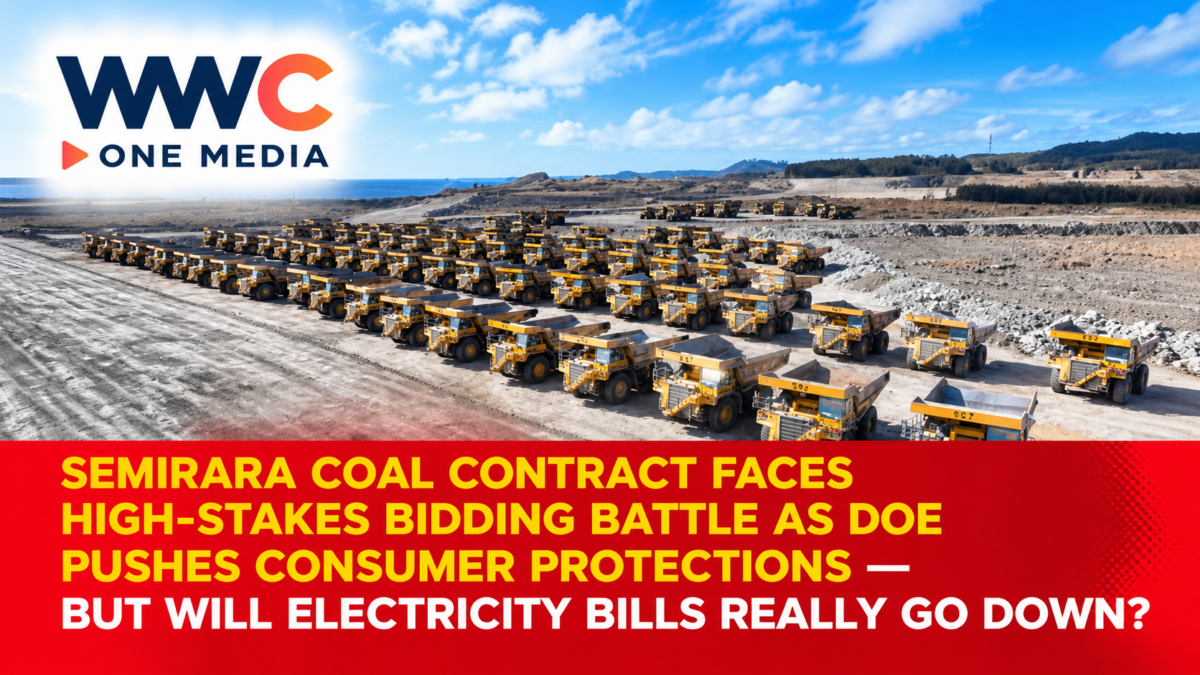
Semirara Island, located in Caluya, Antique, is home to the country’s largest coal mining operation.
The National Association of Electricity Consumers for Reforms (NASECORE) describes the island as accounting for approximately 97% of Philippine domestic coal production.
That figure refers to locally produced coal, not 97% of all coal consumed in the Philippines.
The country also depends on imported coal, making domestic production an important component of energy security.
Coal remains a major fuel source for Philippine electricity generation.
Consequently, disruptions affecting domestic coal production may influence the sourcing decisions and fuel costs of certain power producers.
However, the relationship between local coal production and electricity prices is not automatic.
The final impact on consumers depends on fuel purchase agreements, market prices, generation costs, regulatory mechanisms and other components of electricity bills.
Nevertheless, the scale of Semirara’s production makes the future of its coal operating contract a matter of considerable national importance.
DOE INITIALLY OFFERED 18 COAL BLOCKS FOR COMPETITIVE BIDDING
On February 27, 2026, the DOE opened a bidding round under the Philippine Conventional Energy Contracting Program.
The initiative covered three predetermined areas comprising 18 coal blocks across approximately 18,000 hectares.
Ten blocks covering 10,000 hectares were located on Semirara Island in Antique.
Three blocks covering 3,000 hectares were offered in parts of Cagayan, while five blocks covering 5,000 hectares were located in Isabela.
The process was intended to provide qualified companies with opportunities to develop coal resources under new Coal Operating Contracts.
Interested companies were expected to satisfy legal, financial, technical and work-program requirements.
For Semirara, the bidding was particularly significant because SMPC’s existing Coal Operating Contract No. 5 is scheduled to reach the end of its 50-year term in July 2027.
The process represented an opportunity to review the financial and operational conditions that would apply to future extraction.
DOE TERMINATES THE BIDDING ROUND OVER CONTRACT CONCERNS
The initial bidding process did not proceed as originally planned.
In September 2026, the DOE terminated the coal bidding round covering the three predetermined areas, saying the evaluation framework needed reassessment.
The department identified several concerns affecting the proposed award of operating contracts.
These included questions raised by prospective bidders, continuing water seepage affecting Semirara’s mining operations and legal uncertainties surrounding operational assets.
The DOE explained that the areas contained established commercially mineable reserves and that future awards should reflect the economic value of these state-owned resources.
Rather than treating the termination as an abandonment of domestic coal development, the agency characterized the decision as an opportunity to strengthen the terms under which the resources would be offered again.
The department said a revised process should provide clearer economic benefits to the government and stronger commitments to domestic energy requirements.
As of the reporting reviewed for this article, a new completed award for the affected Semirara blocks had not been verified.
CONSUMER GROUP RAISES ALARM OVER FALLING COAL PRODUCTION
NASECORE has called attention to developments involving Semirara’s recent operating performance.
In an October 19 statement discussed by InsiderPH, the consumer organization cited figures indicating a significant decline in SMPC’s coal output.
Second-quarter 2026 production reportedly fell approximately 55% year over year, from 5.6 million metric tons to 2.5 million metric tons.
The organization also pointed to lower planned capital spending.
According to figures cited in the report, SMPC’s 2026 capital expenditure budget was reduced to approximately ₱1.9 billion, compared with ₱5.9 billion in 2025.
Capital spending allocated to the coal business reportedly declined to around ₱800 million from ₱4.8 billion.
These figures have prompted questions about production capacity, investment priorities and the future management of the mining operation.
However, lower production or capital spending during a particular reporting period does not, by itself, establish that the operator has violated its contractual obligations.
Operational conditions, investment schedules, mine development plans and other circumstances must be considered.
The consumer group’s central concern is that any future operating contract should contain measurable requirements designed to protect domestic supply and prevent unnecessary disruptions.
COULD COMPETITIVE BIDDING HELP LOWER ELECTRICITY COSTS?
Supporters of competitive bidding believe a properly designed auction could encourage companies to offer more favorable contractual terms.
These could include higher government revenue shares, stronger capital investment commitments, minimum production targets and obligations involving domestic coal supply.
The DOE has specifically identified domestic utilization commitments that could support lower electricity costs as a consideration in revising its bidding parameters.
However, there is an important distinction between negotiating better contractual terms and guaranteeing lower monthly power bills.
Coal prices are only one factor influencing electricity charges.
Other factors include generation contracts, transmission costs, distribution charges, taxes, system losses and adjustments associated with wholesale electricity markets.
A new mining operator may offer better supply commitments without necessarily causing an immediate decline in consumers’ bills.
The effectiveness of the future bidding framework would therefore depend on the specific terms, their enforceability and how benefits are transmitted through the energy sector.
SEMIRARA OPERATOR CHALLENGES PROPOSED ASSET RULES
The dispute also involves questions about equipment and other assets used in the mining operation.
SMPC, which is controlled by the Consunji group, has criticized aspects of the DOE’s proposed bidding rules.
In reporting published by BusinessMirror on October 7, the company argued that requirements concerning the disclosure and potential surrender of operational assets were unfairly directed at the incumbent operator.
SMPC maintained that the disputed provisions could effectively prevent it from competing on equal terms.
The company also cited Presidential Decree No. 972, the Coal Development Act of 1976, in arguing that its rights over certain operational assets must be respected.
These arguments are contested issues, not settled legal findings.
The DOE, meanwhile, has emphasized the importance of protecting state resources and ensuring that any eventual operating arrangement can be implemented without unnecessary disruption.
The disagreement highlights an important challenge for policymakers.
A future contract must protect the public interest while establishing clear, lawful and commercially workable rules for all qualified participants.
THE CURRENT OPERATOR’S EXPERIENCE REMAINS AN IMPORTANT FACTOR
SMPC has operated the Semirara mining complex for decades.
Its experience includes mine development, production logistics, specialized equipment, workforce management and coal delivery arrangements.
These capabilities may offer advantages when compared with companies that have not previously operated the site.
However, experience alone does not determine whether an operator should receive a new contract.
A competitive evaluation could consider the incumbent’s track record alongside future commitments from other qualified bidders.
Important considerations include investment capacity, technical competence, production continuity, environmental responsibilities and financial benefits to the government.
The central challenge is developing a transparent framework that treats qualified participants fairly while reflecting the strategic value of the resource.
INSIDERPH POINTS TO NAIA AS AN EXAMPLE OF COMPETITIVE BIDDING
The InsiderPH opinion column compared the potential Semirara coal auction with the competitive bidding process used for the Ninoy Aquino International Airport public-private partnership.
The NAIA contract was awarded after the winning consortium offered a government revenue share of 82.16% of specified future gross revenues.
The agreement also included an upfront payment of ₱30 billion and a fixed annual payment of ₱2 billion.
The comparison illustrates how competitive bidding can produce substantial financial commitments to the government.
However, airport concessions and coal operating contracts involve different legal structures, investment requirements and market risks.
Their bidding formulas cannot simply be treated as interchangeable.
For Semirara, the appropriate evaluation method would need to reflect mineable reserves, operating costs, environmental obligations, asset ownership issues and domestic energy requirements.
A stronger government revenue share would also need to be assessed alongside the potential effects on project viability and fuel costs.
ENVIRONMENTAL AND COMMUNITY RESPONSIBILITIES MUST ALSO BE CONSIDERED
The future of Semirara cannot be evaluated solely through production volumes and government revenues.
Mining operations also involve environmental responsibilities, rehabilitation requirements and impacts on local communities.
The DOE has acknowledged continuing water seepage issues that could affect the volume of economically recoverable coal.
Such operational conditions may influence the technical and financial assumptions used by prospective bidders.
Any future operating agreement would need to account for the safe and responsible development of the resource.
This includes appropriate mine rehabilitation, environmental compliance, worker safety and clear responsibilities for infrastructure and equipment.
The transition to a new contract may also affect workers and communities whose livelihoods depend on mining-related activity.
A credible framework should therefore address continuity of employment, community obligations and the long-term environmental consequences of extraction.
WHAT IS AT STAKE FOR ANTIQUE AND THE REST OF THE PHILIPPINES?
For Antique, the Semirara contract is closely connected to employment, local economic activity and the future of a major industrial operation.
For the rest of the country, the issue centers on domestic energy supply and the cost of producing electricity.
A competitive process that attracts financially and technically capable operators could improve investment commitments and strengthen safeguards.
However, poorly designed rules, prolonged litigation or uncertainty over essential mining assets could delay the transition and complicate production planning.
The government must therefore consider both competition and operational continuity.
The interests of consumers, taxpayers, workers, local communities and qualified investors will all need to be weighed.
THE BIGGER QUESTION: WILL A NEW CONTRACT DELIVER REAL BENEFITS?
The debate surrounding Semirara reflects a larger challenge in Philippine resource management.
Natural resources belong to the State, but their development often requires substantial private investment, specialized technology and long-term operational commitments.
The government must design contracts that attract capable companies while securing appropriate public benefits.
The DOE’s decision to terminate and reassess the initial coal bidding round creates an opportunity to strengthen those terms.
But the effectiveness of the revised framework will ultimately depend on what it requires, how those obligations are enforced and whether the public receives measurable benefits.
Supporters of competitive bidding argue that the process can create stronger incentives for transparency and better contractual offers.
The incumbent operator, meanwhile, has raised concerns about legal protections and the fairness of particular asset-related requirements.
Both issues must be addressed through lawful, transparent and evidence-based decision-making.
For Filipino consumers, the most important result will not simply be which company receives the next Semirara coal operating contract.
It will be whether the future arrangement strengthens energy security, protects supply continuity, delivers appropriate returns to the government and creates credible safeguards against avoidable electricity cost pressures.
And as the government prepares its next move, one crucial question remains: Will the Semirara bidding battle deliver a better deal for the Filipino public — or will unresolved disputes and operating risks leave consumers facing the same electricity cost pressures?