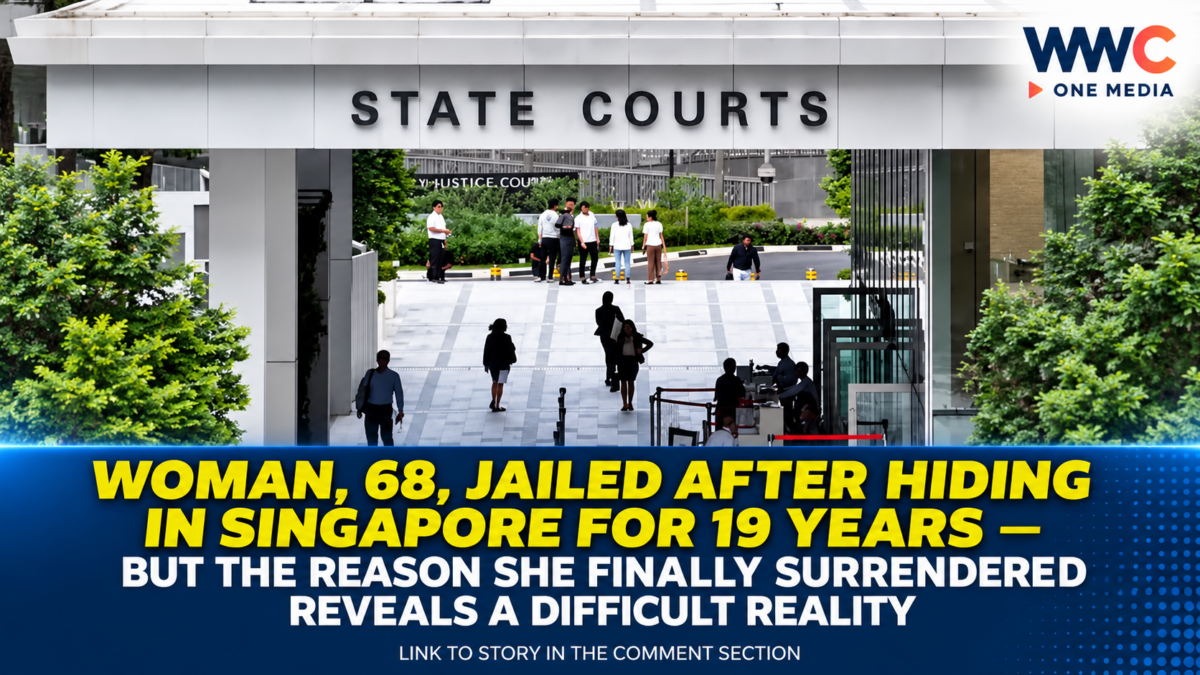
SINGAPORE — A 68-year-old Chinese woman who managed to remain in Singapore illegally for more than 19 years has been sentenced to six months in prison and fined S$2,000 after voluntarily surrendering to immigration authorities alongside her husband.
The woman, identified as Ding Hui Yun, had stayed in the country without valid immigration permission for 19 years, two months and 23 days, surviving through odd jobs after failing to report for repatriation in 2007.
Her extraordinary case came to light after she turned herself in to Singapore’s Immigration and Checkpoints Authority (ICA) on October 6, 2026.
But the reason behind her surrender was not simply a sudden decision to comply with the law.
According to court proceedings reported by Channel NewsAsia on Wednesday, October 21, Ding finally approached immigration authorities because she no longer had the financial means to support herself in Singapore.
The court also heard that her husband, who faces a separate immigration charge after allegedly overstaying for more than 18 years and 10 months, surrendered alongside her.
How a 2007 Immigration Case Became a 19-Year Overstay
Ding’s immigration problems began almost two decades ago.
In May 2007, she was convicted of an immigration offence involving unlawful entry or presence in Singapore. The court sentenced her to four weeks in prison and imposed a S$1,500 fine in lieu of caning.
After serving that sentence, Ding was permitted to remain temporarily in Singapore because authorities needed her as a prosecution witness in another case.
She received a special pass in June 2007, allowing her to stay legally for a limited period. The pass was subsequently extended until mid-July that year.
However, when she was required to report for repatriation, she failed to appear.
Instead of departing, she continued living in Singapore without valid immigration status.
By the time she surrendered in October 2026, her unlawful stay had stretched across more than 19 years.
CNA
Why She Refused to Return to China
According to the prosecution, Ding had a personal reason for avoiding repatriation.
Her family in China was facing financial debts, and she wanted to avoid creditors.
Rather than returning home, she remained in Singapore, supporting herself through occasional work despite lacking the legal authorization to stay.
The court was not told that she had obtained permanent residency, citizenship or another long-term immigration pass during those years.
Her circumstances illustrate how financial difficulties can contribute to prolonged immigration violations, although such difficulties do not automatically provide a legal defense to overstaying.
Husband Also Faces Immigration Charges
One of the most significant details to emerge from the case concerns Ding’s husband.
He surrendered with her on October 6 and is accused of illegally remaining in Singapore for more than 18 years and 10 months.
During Wednesday’s proceedings, the prosecution said the husband had been scheduled to plead guilty to a similar offence that day but was unwell.
Court records indicated that he was expected to enter his plea the following week.
Importantly, the husband’s case had not yet reached the same outcome as Ding’s at the time of the October 21 report.
His sentence, if any, should therefore not be assumed.
Ding also told the court that neither she nor her husband had a passport.
An Emotional Plea to Be Sent Home Together
Ding asked the judge for leniency, citing her health and the fact that she had surrendered voluntarily.
She told the court that she had diabetes and that her husband had hypertension.
Beyond seeking a lighter sentence, she expressed a wish that they be allowed to return home together after completing their respective sentences.
The prosecution acknowledged her request.
However, the court did not announce a confirmed joint repatriation arrangement during the reported proceedings.
The couple’s hope of traveling home together remains dependent on their legal cases and the necessary immigration and travel arrangements.
Court Hands Down Maximum Six-Month Jail Term
District Judge Janet Wang sentenced Ding to six months’ imprisonment and a S$2,000 fine, following her guilty plea to one charge of remaining unlawfully in Singapore after her special pass expired.
If she cannot pay the fine, Ding must serve an additional 12 days in jail.
A separate charge relating to her failure to comply with the conditions of her special pass was taken into consideration during sentencing.
The judge noted that Ding had previously been convicted of a similar immigration offence and that her latest overstay was exceptionally long.
The court also emphasized the need for deterrence because immigration violations of this nature can be difficult for enforcement agencies to detect.
Ding’s voluntary surrender and personal circumstances were placed before the court, but they did not prevent the maximum six-month custodial sentence from being imposed.
What Singapore Law Says About Overstaying
Singapore maintains strict penalties for foreigners who remain in the country beyond the permitted duration of their immigration passes.
According to the ICA, offenders in relevant overstaying cases may face imprisonment of up to six months, together with caning or a fine imposed in lieu of caning.
For Ding, the court imposed a fine instead of corporal punishment.
Singapore’s immigration authority also warns that overstayers may be deported and prohibited from re-entering the country after their cases are resolved.
This Is Not the First Extraordinary Overstaying Case in Singapore
Ding’s case follows other lengthy immigration violations that have attracted public attention.
In September 2025, Singapore’s Ministry of Home Affairs addressed parliamentary questions concerning Yu Zefang, a woman who managed to remain in Singapore unlawfully for more than 28 years.
Authorities explained that Yu had maintained an unusually low profile, avoided formal employment, lacked a local bank account and did not use government services that would have required identity verification.
The government said such circumstances had made her difficult to detect, despite enforcement operations targeting overstayers.
That case was separate from Ding’s and involved different circumstances.
Nevertheless, both cases raise questions about how immigration authorities identify individuals who remain in Singapore for extended periods without legal status.
Ministry of Home Affairs
Other Immigration Cases Show Singapore’s Strict Enforcement
Official ICA statements provide additional examples of how the country deals with prolonged overstaying.
In June 2026, the authority reported a case involving a Filipina who had remained illegally in Singapore after her visit pass expired in April 2003.
She was subsequently sentenced to six months’ imprisonment and fined S$2,000 before being deported and barred from returning.
Another ICA statement published in October 2026 described charges against a Singaporean man accused of helping an Indonesian woman overstay and providing accommodation despite knowing her immigration status.
These cases demonstrate that enforcement can extend beyond overstayers to individuals suspected of knowingly helping them remain in the country unlawfully.
Why This Case Matters for Foreign Workers and Visitors
Ding’s conviction underscores the importance of understanding immigration pass conditions.
A special pass is not automatically equivalent to long-term permission to live or work in Singapore.
According to ICA guidance, a person whose special pass has expired and who remains in Singapore may be considered an overstayer.
For foreign nationals — including Filipinos who travel to Singapore for work, family visits or other purposes — ensuring that a visa or immigration pass remains valid is essential.
Visitors facing difficulties with departure arrangements should contact the relevant authorities before their permission to stay expires.
This case also highlights the potential personal consequences of prolonged undocumented residence: unstable employment, difficulties obtaining services and increasing vulnerability as individuals grow older.
The Bigger Question: What Happens to the Couple After Prison?
The immediate legal outcome is clear for Ding: six months in jail and a S$2,000 fine, with additional imprisonment if the fine is unpaid.
What remains unresolved is whether she and her husband will eventually be able to return home together.
Her husband’s case is still pending, while the couple’s lack of passports creates another practical issue for repatriation arrangements.
The authorities have not publicly confirmed a date for their departure or a coordinated return to China.
The bottom line: After 19 years of living unlawfully in Singapore, Ding Hui Yun surrendered when she could no longer support herself. Her conviction illustrates the country’s strict immigration laws, but her request to return home with her husband gives the case a deeply personal dimension.