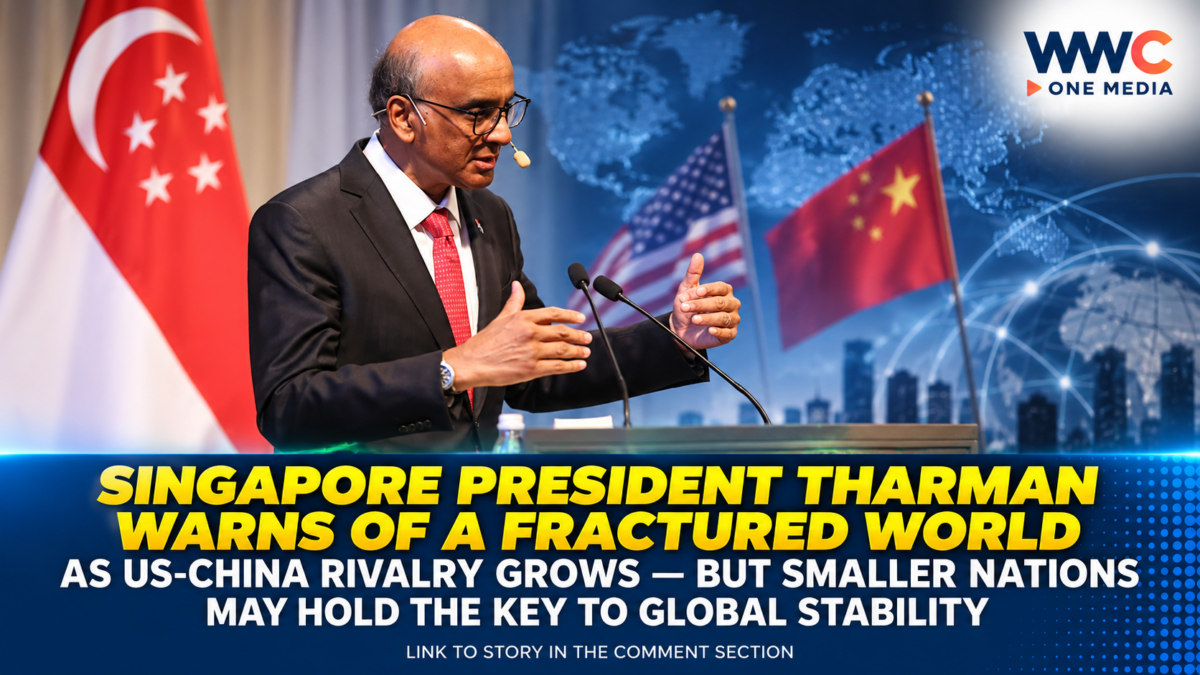
STOCKHOLM, SWEDEN — Singapore President Tharman Shanmugaratnam has issued a warning about the future of global stability, cautioning that the world could become increasingly divided as the United States and China compete for economic, technological and geopolitical influence.
Speaking at the Stockholm School of Economics on October 20, Tharman argued that the US-led international order is receding, but a stable multipolar system has yet to take its place.
Without countries willing to connect rival powers and regions, he warned, international cooperation could weaken while trade disputes, geopolitical confrontation and competition over critical technologies intensify.
His proposed answer: countries such as Singapore and Sweden must help build bridges across the growing global divide.
The remarks were delivered during a historic visit to Sweden, where Singapore’s president also advanced cooperation in emerging technologies, research, energy and trade.
The address was covered by Channel NewsAsia and AsiaOne, while official Singaporean and Swedish government statements provide additional details about the visit and bilateral agreements.
A World With More Powers — But Less Global Leadership
Tharman’s central concern is that the decline of a single dominant global power does not automatically produce a more balanced or peaceful international system.
For decades, the United States played a leading role in shaping trade rules, security arrangements and international institutions.
Now, competing centers of economic and political influence are emerging.
Yet Tharman cautioned that a world with several powerful countries could still lack the collective leadership needed to confront problems affecting everyone.
His warning extended beyond military rivalry to the possible fragmentation of trade, investment, financial infrastructure and technological supply chains.
Such fragmentation could be especially damaging to internationally connected economies that depend on predictable trade rules and access to major markets.
For Singapore, whose economic model relies heavily on global connectivity, the concern is particularly relevant.
Why Singapore and Sweden Could Become Important Bridge-Builders
Tharman argued that diplomatic influence does not necessarily depend on a country’s population, territorial size or military strength.
Instead, countries capable of working across political divides can help preserve cooperation when relations between major powers become more confrontational.
He pointed to Singapore’s efforts to strengthen connections between the European Union and Asia-Pacific trade groupings, including ASEAN and the Comprehensive and Progressive Agreement for Trans-Pacific Partnership.
Sweden, meanwhile, has a longstanding history of international mediation, diplomacy and cooperation on environmental challenges.
Tharman cited former United Nations Secretary-General Dag Hammarskjöld, a Swedish diplomat, as an example of the country’s contribution to international peacekeeping.
He also identified Australia, Canada, Ghana, Japan and the European Union as potential contributors to cross-regional cooperation.
The broader message was that a functioning international order cannot depend exclusively on Washington and Beijing. Other countries must help maintain the networks connecting them.
US-China Competition: The Biggest Test for Global Stability
The most consequential part of Tharman’s address concerned the relationship between the United States and China.
He stressed that both powers remain indispensable to international stability because of their enormous markets, research capabilities, technological influence and roles in global emissions.
Rather than attempting to eliminate economic interdependence, he argued that Washington and Beijing must learn to manage their competition.
He outlined three broad priorities:
- Preserve economic connections. Avoid unnecessary separation of technology systems, supply chains and financial networks.
- Recognize the long-term nature of AI competition. Neither country should assume that technological dominance can be permanently secured.
- Address domestic economic imbalances. US fiscal deficits and China’s reliance on production and exports have consequences beyond their national borders.
He cautioned that the complete separation of artificial intelligence ecosystems and other critical networks could produce a more dangerous international environment.
These were recommendations for managing strategic rivalry, not a prediction that the two powers are about to enter an armed conflict.
Artificial Intelligence Could Create a New Global Security Threat
Tharman also highlighted artificial intelligence as a major source of uncertainty.
While AI can create enormous opportunities for productivity, scientific discovery and economic development, its misuse could generate new risks that national governments cannot contain individually.
He raised concerns about malicious uses of advanced AI, including cyberattacks and the development of dangerous technologies by individuals or smaller groups.
His argument was that technological competition must be accompanied by cooperation on safety rules and safeguards.
That creates a difficult challenge: the United States and China are major competitors in AI, but they also share an interest in preventing harmful uses of the technology.
For countries such as Singapore and Sweden, cooperation on trusted technological systems could provide a practical area for bridge-building.
Singapore and Sweden Strengthen Ties During Historic State Visit
Tharman’s lecture was part of the first state visit to Sweden by a sitting Singapore president.
The two nations are marking 60 years of diplomatic relations in 2026.
During the visit, President Tharman met Sweden’s King Carl XVI Gustaf, Prime Minister Ulf Kristersson and parliamentary representatives.
A major development was the signing of a joint declaration on strategic cooperation involving trusted and innovative technologies.
The agreement reflects both countries’ interest in strengthening secure technology supply chains, innovation and critical infrastructure.
Singapore and Sweden also discussed closer cooperation involving ASEAN and the European Union, with Singapore preparing to chair ASEAN in 2027.
Clean Energy, Research and Education Also Take Center Stage
Beyond geopolitical concerns, the visit produced additional commitments to economic and academic cooperation.
The Straits Times reported that Singapore and Sweden agreed to deepen collaboration on clean energy technologies, including hydrogen, ammonia and power-grid connections.
They also advanced academic cooperation involving the Lee Kuan Yew School of Public Policy, Sweden’s Royal Institute of Technology and the Stockholm School of Economics.
These initiatives could support research exchanges, public policy development and emerging technology projects.
They also provide practical examples of the cooperation Tharman advocated in his lecture: countries working together on shared challenges despite an uncertain international environment.
Why This Matters for ASEAN and the Philippines
Although Tharman’s remarks were delivered in Europe, their implications extend across Southeast Asia.
ASEAN economies maintain substantial relationships with both the United States and China, making regional governments especially sensitive to changes in trade policy, investment flows and technology access.
For the Philippines, a more fragmented global economy could complicate decisions involving exports, infrastructure investment, digital technology and regional economic cooperation.
These are potential implications rather than specific consequences announced by Tharman.
His broader argument suggests that regional institutions such as ASEAN could become increasingly important in keeping cooperation alive between countries with competing strategic interests.
The question is whether smaller and middle-sized countries can coordinate effectively enough to influence decisions by larger powers.
Global Cooperation Must Also Begin at Home
Tharman concluded with a warning that international institutions cannot function effectively when public confidence in domestic political and economic systems is deteriorating.
He argued that governments must renew their social commitments to citizens, including investment in education, healthcare, transport and other shared public services.
The implication is that stronger public institutions and greater confidence at home can make international cooperation more politically sustainable.
This adds another dimension to his argument: restoring global stability requires more than diplomacy among governments. It also requires societies to believe that international cooperation benefits ordinary people.
The Bigger Question: Can Smaller Nations Prevent a Divided World?
Tharman’s message comes at a time when countries are increasingly reassessing their economic dependencies, technological partnerships and security relationships.
His proposed approach does not require smaller countries to replace the United States or China as global leaders.
Instead, it calls on them to create opportunities for cooperation where major powers cannot easily reach agreement.
Whether this approach succeeds will depend on how willing governments are to protect shared economic interests while managing genuine differences over security, technology and trade.
The bottom line: President Tharman believes that a more fragmented global order is a serious risk, but not an inevitable outcome. By strengthening international partnerships and keeping major powers connected, countries such as Singapore and Sweden could help build a more resilient world.