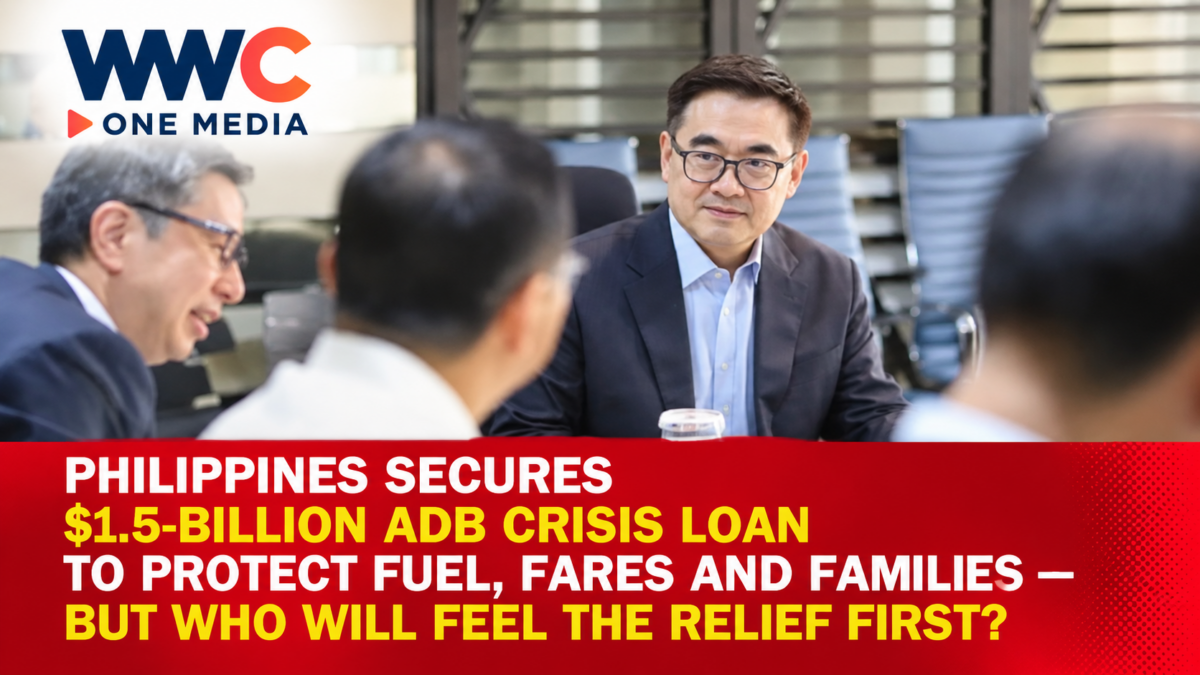
MANILA, Philippines — The Philippine government has secured approximately $1.5 billion in financing from the Asian Development Bank to help protect Filipino families, commuters, workers and vulnerable businesses from economic disruptions caused by the continuing Middle East conflict.
Finance Secretary Frederick D. Go signed the ¥236.64-billion financing agreement on October 6, 2026, under the Assistance for Greater Resilience and Alleviation of Poverty (AGAPAY) program.
The Department of Finance publicly announced the agreement on October 20, nearly a month after the ADB approved the financing on September 24.
The loan will support the government’s Unified Package for Livelihoods, Industry, Food, and Transport (UPLIFT), an initiative aimed at reducing the pressure of rising energy costs, supply disruptions and economic uncertainty.
Priority interventions include measures to maintain fuel and electricity supplies, keep transportation reasonably affordable, support farmers and fisherfolk, provide assistance to vulnerable households and help overseas Filipino workers affected by the conflict return home.
The financing represents an important source of budgetary support at a time when volatile international energy markets are putting pressure on government finances and household spending.
But it also creates a major test of implementation.
Will the $1.5-billion agreement result in faster assistance and more affordable essential services—or will families continue struggling while the government converts its financing commitments into actual support?
ADB Approved the Loan in September, But the Philippines Signed in October
The financing arrangement has three important dates.
On September 24, 2026, the Asian Development Bank formally approved the $1.5-billion package.
On October 6, Finance Secretary Frederick Go signed the agreement for the Philippines.
On October 20, the Department of Finance announced the signing and explained how the financing would support government programs.
This timeline is important because an approved loan and a signed loan agreement are not identical to money already received and spent.
The available official announcements establish that the financing was approved and signed.
They do not provide a confirmed date when the entire amount was disbursed to the Treasury or a complete breakdown of expenditures already made using the facility.
For taxpayers and prospective beneficiaries, actual disbursements and government program releases will be the next important indicators.
The Financing Agreement Is Worth ¥236.64 Billion
The contractual amount is denominated in Japanese yen.
The Department of Finance identifies the facility as ¥236.64 billion, equivalent to approximately $1.5 billion.
GMA News reported an indicative peso equivalent of roughly ₱94 billion.
Such peso estimates can vary depending on the exchange rate and the date of conversion.
The government has not presented the package as a direct ₱94-billion cash giveaway to households.
It is external financing for the government’s budgetary response to the crisis.
A loan of this nature must eventually be repaid according to its contractual terms.
The public announcements reviewed do not disclose the complete interest or financing charges, maturity schedule, grace period or currency-risk arrangements.
Those details are important for assessing the long-term borrowing cost.
They should not be assumed or invented.
AGAPAY Will Help Finance the Government’s UPLIFT Program
The funding is linked to the Unified Package for Livelihoods, Industry, Food, and Transport.
UPLIFT combines government measures intended to soften the effects of the Middle East conflict on Filipino households and economic activity.
The program covers several overlapping challenges.
Higher fuel costs can increase transportation expenses.
More expensive transport can influence the cost of delivering food and other goods.
Energy market disruptions can affect electricity generation and utility costs.
Businesses facing higher operating expenses may struggle to preserve jobs and maintain normal operations.
UPLIFT seeks to address these pressures through targeted interventions rather than relying on a single nationwide subsidy.
The ADB financing will support the government’s ability to sustain these measures while managing broader fiscal demands.
Commuters and Transport Operators Among the Intended Beneficiaries
Transportation is one of the clearest areas where Middle East instability can affect everyday Filipino life.
Public utility vehicles, delivery services and commercial transport operators depend heavily on fuel.
When diesel and gasoline prices increase, operating expenses rise.
These costs can create pressure for fare adjustments and affect the movement of goods.
The government says the financing will support measures to help keep public and commercial transportation reasonably priced.
ADB’s original approval announcement refers to fare discounts and assistance for public transport operators and drivers.
The objective is to ease the cost burden while helping transport services continue operating.
However, the loan announcement does not establish a new universal fare discount or identify a specific amount that every commuter will receive.
Eligibility and the actual value of assistance depend on the relevant government programs.
A signed financing agreement does not automatically reduce every jeepney, bus or railway fare.
Fuel Supply Security Is a Major Concern
The Philippines is particularly exposed to international fuel market disruptions because it imports nearly all the petroleum products and crude oil it uses.
ADB noted in September that oil accounts for approximately one-third of the country’s primary energy supply.
A substantial portion of its energy exposure is linked to the Middle East.
Conflict affecting oil production, shipping or international trade can increase the cost of imported fuel.
Even when physical supplies remain available, higher prices can put pressure on transport companies, power producers, manufacturers and households.
The AGAPAY program is intended to help the government respond to such disruptions.
But the loan cannot guarantee that global oil prices will decline.
International energy prices are determined by a much broader set of factors, including production, demand, trade routes and geopolitical developments.
The financing is designed to improve the government’s ability to manage the effects of the shock, not eliminate the external shock itself.
Electricity Support Could Help Vulnerable Communities
Electricity is another area covered by the crisis response.
ADB’s September announcement specifically mentioned subsidies for provincial and small electric cooperatives as part of the government’s planned measures.
These cooperatives provide electricity services to communities outside some major urban distribution networks.
Higher generation and fuel costs can place pressure on operating budgets and consumers.
Targeted support may help cushion the impact of those pressures.
But the availability of ADB financing should not be interpreted as an announcement that electricity bills nationwide will automatically decrease.
Retail electricity rates depend on generation costs, contractual arrangements, distribution charges, regulatory requirements and other factors.
Any actual subsidy effect will depend on the program design, the participating entities and how financial support reaches consumers.
The government will need to demonstrate whether its measures produce meaningful reductions in costs or prevent larger increases.
Farmers and Fisherfolk Could Receive Targeted Assistance
The Middle East conflict affects more than oil.
ADB has warned that the Philippines also relies on imported fertilizer supplies that may be affected directly or indirectly by instability in the region.
Higher fertilizer prices can raise production expenses for farmers.
Fuel costs can also affect fishing operations, irrigation, farm equipment and transport of agricultural products.
These expenses may eventually influence food prices.
Under UPLIFT, the government plans assistance that includes fuel and fertilizer subsidies for eligible agricultural workers.
Small-scale farmers and fisherfolk are among the groups identified by ADB as intended beneficiaries.
But the announcements do not specify an automatic cash payment for every farmer or fisher.
Individual programs have separate eligibility rules, budgets and delivery arrangements.
The actual benefits will depend on how these schemes are funded and implemented.
Healthcare and Essential Goods Form Part of the Response
The crisis assistance also covers measures intended to keep essential services and products accessible.
ADB identified healthcare, food and medicines as important areas of support.
Its September approval announcement referred to medical relief packages and cash assistance for poor and vulnerable households.
Higher transportation and operating costs can affect the delivery of healthcare services and essential supplies.
Families with limited income may be especially vulnerable because basic necessities account for a large share of their spending.
Budgetary support can help the government maintain social protection and essential public services during economic pressure.
But it does not guarantee that medicines and groceries will become cheaper immediately.
The effect will depend on government procurement, distribution, market conditions and the specific assistance programs implemented.
OFWs in the Middle East Are Another Priority
The financing will also support the repatriation and reintegration of overseas Filipino workers affected by the conflict.
The Middle East remains a major destination for Filipino workers.
According to ADB, approximately 1.1 million Filipino workers were deployed to the region in 2025.
The bank also reported that workers in the Middle East accounted for around 18% of the Philippines’ $35.6 billion in total remittances during that year.
This exposure matters because conflict can disrupt employment, travel and the ability of workers to send money home.
Returning OFWs may need emergency travel arrangements, temporary financial assistance, employment support or other services to restart their lives.
The government’s plans include assistance for both repatriation and reintegration.
However, the October 20 announcement does not publish a confirmed number of workers who will be repatriated using AGAPAY financing.
Nor does it establish a guaranteed payment for every returning OFW.
Actual benefits will depend on the relevant government agencies and eligibility requirements.
Finance Secretary Frederick Go Says Assistance Must Protect Livelihoods
Finance Secretary Go said AGAPAY will help sustain the government’s response to the economic consequences of the Middle East crisis.
He emphasized the importance of supporting vulnerable sectors and protecting livelihoods while families face higher costs.
The Finance Department describes the arrangement as part of the country’s 2026 external financing program.
That distinction matters.
The Philippines is not receiving a donation that can be spent without future financial obligations.
It is securing a loan to help finance government responses to extraordinary economic pressures.
The central policy question is whether the public benefits justify the cost of additional borrowing.
If support is delivered quickly and effectively, it may help reduce the economic damage associated with the crisis.
But poorly targeted or delayed assistance could weaken the intended impact while the government’s repayment obligation remains.
ADB Is Using Its Countercyclical Support Facility
The financing is provided through ADB’s Countercyclical Support Facility.
This mechanism is designed to help countries manage significant economic shocks while protecting critical spending and public services.
In July 2026, ADB updated several crisis response financing tools to address energy supply and food price shocks more effectively.
The changes recognized that international disruptions can create serious economic pressures even when a country is not directly involved in a conflict.
Such pressures can include higher import bills, inflation, tighter fiscal conditions and interruptions to essential goods.
Countercyclical budget support is different from a conventional loan earmarked to construct one specific bridge, hospital or railway.
The financing helps support an identified government policy response and associated public spending.
That means accountability requires tracking the related programs, their expenditures and their results.
The $1.5 Billion Follows an Earlier $1.75-Billion Support Offer
The ADB’s support did not begin with the September loan approval.
On May 15, 2026, ADB President Masato Kanda met President Ferdinand Marcos Jr. and expressed readiness to provide up to $1.75 billion in additional crisis financing.
That announcement described the bank’s willingness to help the Philippines manage pressures on vulnerable communities and public finances.
The September $1.5-billion approval and October signing are subsequent concrete financing milestones.
However, the earlier $1.75-billion offer should not automatically be added to the $1.5-billion loan as though both were separate, fully disbursed funds.
The financing packages must be reconciled using official project and disbursement records before calculating a combined total.
A general offer of support and a signed financing agreement are different categories of financial commitment.
ADB Also Approved Separate Philippine Healthcare Financing
In August 2026, ADB announced a $750-million loan for the third subprogram of the Philippines’ Build Universal Health Care Program.
The bank said it had increased that financing by $250 million as the Middle East conflict raised the government’s needs.
This is a separately announced healthcare financing operation.
It provides additional context for the development bank’s wider response to the crisis.
But it should not be presented as another component of the ¥236.64-billion AGAPAY agreement without evidence that the two facilities form one transaction.
Maintaining that distinction is essential to avoid double-counting development assistance.
The Philippines has several ongoing ADB-supported programs with different objectives, approvals and repayment arrangements.
Why More Borrowing Brings Questions About Accountability
External financing can help governments continue essential spending when revenues and budgets are under pressure.
Development bank lending may provide access to resources under terms that differ from commercial market borrowing.
But the Philippines must still manage its debt sustainably.
The AGAPAY arrangement raises several questions that deserve continuing public scrutiny.
When will the approved financing be disbursed?
How much will go toward transport, energy, food, health and OFW support?
Which government agencies will administer the programs?
How many households and workers will receive assistance?
What are the financing costs and repayment obligations?
How will authorities measure whether assistance prevented deeper economic hardship?
The current public announcements establish the agreement and its intended purposes, but they do not answer all these implementation questions.
Detailed fiscal reporting will be necessary to evaluate the program.
Targeted Aid Matters More Than Broad Announcements
The Middle East crisis does not affect every Filipino household in the same way.
Public transport drivers face direct fuel cost pressures.
Farmers and fisherfolk may deal with rising production costs.
Low-income households may struggle with food, electricity and transport expenses.
Overseas workers and their families may face employment uncertainty and interrupted remittances.
Because the challenges differ, assistance must be designed around the needs of each group.
A large financing package can support multiple responses.
But effectiveness depends on accurate beneficiary identification, efficient distribution and safeguards against waste.
A program may announce millions of intended beneficiaries while still facing implementation problems that delay assistance.
The true measure of success will be how many eligible Filipinos receive useful support when they need it.
Will the Loan Bring Prices Down?
For ordinary consumers, this may be the most immediate question.
The government’s stated objective is to cushion the impact of economic shocks.
That does not necessarily mean reducing prices to their previous levels.
In some cases, assistance could take the form of fare discounts or subsidies.
In others, it could support fuel availability, preserve public services or provide cash relief.
The outcome may be lower costs for eligible recipients, smaller price increases or reduced hardship during a difficult period.
But the $1.5-billion loan cannot independently determine the price of oil, electricity, fertilizer or imported goods.
Global energy conditions and domestic market factors will continue to influence inflation.
The financing can help soften the consequences, but claiming that it will automatically end the country’s cost-of-living pressures would be misleading.
What Happens Next?
The next stage is implementation.
The government must ensure that the loan becomes available according to the financing agreement and applicable conditions.
Agencies responsible for UPLIFT must then carry out their programs, maintain records and report results.
The public will need clear information on actual disbursements and the distribution of benefits.
Commuters will want to know whether transport costs are being contained.
Farmers and fisherfolk will look for assistance with fuel and production expenses.
Vulnerable families will need accessible social protection.
Affected OFWs will require timely and practical support.
These outcomes will provide a more meaningful evaluation than the financing amount alone.
The Bigger Test: Will the $1.5 Billion Reach the People Who Need It?
The Philippines has taken an important step in strengthening its response to the Middle East crisis by securing a ¥236.64-billion financing agreement from ADB.
The package gives the government another source of budgetary support for transport, energy, food security, healthcare, livelihoods and affected overseas workers.
The loan was approved on September 24 and signed on October 6, with the Department of Finance announcing the agreement on October 20.
But the public record has not yet established that the entire amount has been released or spent.
The government must now demonstrate that the financing supports measurable improvements in household protection and economic stability.
The Philippines has secured $1.5 billion in ADB crisis financing. But the real question is not simply how much money the country can borrow—it is how quickly that financing can reach vulnerable Filipinos, protect essential services and ease the cost-of-living pressure without creating an unnecessary burden for future taxpayers.
WWC ONE MEDIA | Philippine Economy, Middle East Conflict, ADB Financing, Government Aid and Consumer Protection
MANILA, Philippines — The Philippine government has secured approximately $1.5 billion in financing from the Asian Development Bank to help protect Filipino families, commuters, workers and vulnerable businesses from economic disruptions caused by the continuing Middle East conflict.
Finance Secretary Frederick D. Go signed the ¥236.64-billion financing agreement on October 6, 2026, under the Assistance for Greater Resilience and Alleviation of Poverty (AGAPAY) program.
The Department of Finance publicly announced the agreement on October 20, nearly a month after the ADB approved the financing on September 24.
The loan will support the government’s Unified Package for Livelihoods, Industry, Food, and Transport (UPLIFT), an initiative aimed at reducing the pressure of rising energy costs, supply disruptions and economic uncertainty.
Priority interventions include measures to maintain fuel and electricity supplies, keep transportation reasonably affordable, support farmers and fisherfolk, provide assistance to vulnerable households and help overseas Filipino workers affected by the conflict return home.
The financing represents an important source of budgetary support at a time when volatile international energy markets are putting pressure on government finances and household spending.
But it also creates a major test of implementation.
Will the $1.5-billion agreement result in faster assistance and more affordable essential services—or will families continue struggling while the government converts its financing commitments into actual support?
ADB Approved the Loan in September, But the Philippines Signed in October
The financing arrangement has three important dates.
On September 24, 2026, the Asian Development Bank formally approved the $1.5-billion package.
On October 6, Finance Secretary Frederick Go signed the agreement for the Philippines.
On October 20, the Department of Finance announced the signing and explained how the financing would support government programs.
This timeline is important because an approved loan and a signed loan agreement are not identical to money already received and spent.
The available official announcements establish that the financing was approved and signed.
They do not provide a confirmed date when the entire amount was disbursed to the Treasury or a complete breakdown of expenditures already made using the facility.
For taxpayers and prospective beneficiaries, actual disbursements and government program releases will be the next important indicators.
The Financing Agreement Is Worth ¥236.64 Billion
The contractual amount is denominated in Japanese yen.
The Department of Finance identifies the facility as ¥236.64 billion, equivalent to approximately $1.5 billion.
GMA News reported an indicative peso equivalent of roughly ₱94 billion.
Such peso estimates can vary depending on the exchange rate and the date of conversion.
The government has not presented the package as a direct ₱94-billion cash giveaway to households.
It is external financing for the government’s budgetary response to the crisis.
A loan of this nature must eventually be repaid according to its contractual terms.
The public announcements reviewed do not disclose the complete interest or financing charges, maturity schedule, grace period or currency-risk arrangements.
Those details are important for assessing the long-term borrowing cost.
They should not be assumed or invented.
AGAPAY Will Help Finance the Government’s UPLIFT Program
The funding is linked to the Unified Package for Livelihoods, Industry, Food, and Transport.
UPLIFT combines government measures intended to soften the effects of the Middle East conflict on Filipino households and economic activity.
The program covers several overlapping challenges.
Higher fuel costs can increase transportation expenses.
More expensive transport can influence the cost of delivering food and other goods.
Energy market disruptions can affect electricity generation and utility costs.
Businesses facing higher operating expenses may struggle to preserve jobs and maintain normal operations.
UPLIFT seeks to address these pressures through targeted interventions rather than relying on a single nationwide subsidy.
The ADB financing will support the government’s ability to sustain these measures while managing broader fiscal demands.
Commuters and Transport Operators Among the Intended Beneficiaries
Transportation is one of the clearest areas where Middle East instability can affect everyday Filipino life.
Public utility vehicles, delivery services and commercial transport operators depend heavily on fuel.
When diesel and gasoline prices increase, operating expenses rise.
These costs can create pressure for fare adjustments and affect the movement of goods.
The government says the financing will support measures to help keep public and commercial transportation reasonably priced.
ADB’s original approval announcement refers to fare discounts and assistance for public transport operators and drivers.
The objective is to ease the cost burden while helping transport services continue operating.
However, the loan announcement does not establish a new universal fare discount or identify a specific amount that every commuter will receive.
Eligibility and the actual value of assistance depend on the relevant government programs.
A signed financing agreement does not automatically reduce every jeepney, bus or railway fare.
Fuel Supply Security Is a Major Concern
The Philippines is particularly exposed to international fuel market disruptions because it imports nearly all the petroleum products and crude oil it uses.
ADB noted in September that oil accounts for approximately one-third of the country’s primary energy supply.
A substantial portion of its energy exposure is linked to the Middle East.
Conflict affecting oil production, shipping or international trade can increase the cost of imported fuel.
Even when physical supplies remain available, higher prices can put pressure on transport companies, power producers, manufacturers and households.
The AGAPAY program is intended to help the government respond to such disruptions.
But the loan cannot guarantee that global oil prices will decline.
International energy prices are determined by a much broader set of factors, including production, demand, trade routes and geopolitical developments.
The financing is designed to improve the government’s ability to manage the effects of the shock, not eliminate the external shock itself.
Electricity Support Could Help Vulnerable Communities
Electricity is another area covered by the crisis response.
ADB’s September announcement specifically mentioned subsidies for provincial and small electric cooperatives as part of the government’s planned measures.
These cooperatives provide electricity services to communities outside some major urban distribution networks.
Higher generation and fuel costs can place pressure on operating budgets and consumers.
Targeted support may help cushion the impact of those pressures.
But the availability of ADB financing should not be interpreted as an announcement that electricity bills nationwide will automatically decrease.
Retail electricity rates depend on generation costs, contractual arrangements, distribution charges, regulatory requirements and other factors.
Any actual subsidy effect will depend on the program design, the participating entities and how financial support reaches consumers.
The government will need to demonstrate whether its measures produce meaningful reductions in costs or prevent larger increases.
Farmers and Fisherfolk Could Receive Targeted Assistance
The Middle East conflict affects more than oil.
ADB has warned that the Philippines also relies on imported fertilizer supplies that may be affected directly or indirectly by instability in the region.
Higher fertilizer prices can raise production expenses for farmers.
Fuel costs can also affect fishing operations, irrigation, farm equipment and transport of agricultural products.
These expenses may eventually influence food prices.
Under UPLIFT, the government plans assistance that includes fuel and fertilizer subsidies for eligible agricultural workers.
Small-scale farmers and fisherfolk are among the groups identified by ADB as intended beneficiaries.
But the announcements do not specify an automatic cash payment for every farmer or fisher.
Individual programs have separate eligibility rules, budgets and delivery arrangements.
The actual benefits will depend on how these schemes are funded and implemented.
Healthcare and Essential Goods Form Part of the Response
The crisis assistance also covers measures intended to keep essential services and products accessible.
ADB identified healthcare, food and medicines as important areas of support.
Its September approval announcement referred to medical relief packages and cash assistance for poor and vulnerable households.
Higher transportation and operating costs can affect the delivery of healthcare services and essential supplies.
Families with limited income may be especially vulnerable because basic necessities account for a large share of their spending.
Budgetary support can help the government maintain social protection and essential public services during economic pressure.
But it does not guarantee that medicines and groceries will become cheaper immediately.
The effect will depend on government procurement, distribution, market conditions and the specific assistance programs implemented.
OFWs in the Middle East Are Another Priority
The financing will also support the repatriation and reintegration of overseas Filipino workers affected by the conflict.
The Middle East remains a major destination for Filipino workers.
According to ADB, approximately 1.1 million Filipino workers were deployed to the region in 2025.
The bank also reported that workers in the Middle East accounted for around 18% of the Philippines’ $35.6 billion in total remittances during that year.
This exposure matters because conflict can disrupt employment, travel and the ability of workers to send money home.
Returning OFWs may need emergency travel arrangements, temporary financial assistance, employment support or other services to restart their lives.
The government’s plans include assistance for both repatriation and reintegration.
However, the October 20 announcement does not publish a confirmed number of workers who will be repatriated using AGAPAY financing.
Nor does it establish a guaranteed payment for every returning OFW.
Actual benefits will depend on the relevant government agencies and eligibility requirements.
Finance Secretary Frederick Go Says Assistance Must Protect Livelihoods
Finance Secretary Go said AGAPAY will help sustain the government’s response to the economic consequences of the Middle East crisis.
He emphasized the importance of supporting vulnerable sectors and protecting livelihoods while families face higher costs.
The Finance Department describes the arrangement as part of the country’s 2026 external financing program.
That distinction matters.
The Philippines is not receiving a donation that can be spent without future financial obligations.
It is securing a loan to help finance government responses to extraordinary economic pressures.
The central policy question is whether the public benefits justify the cost of additional borrowing.
If support is delivered quickly and effectively, it may help reduce the economic damage associated with the crisis.
But poorly targeted or delayed assistance could weaken the intended impact while the government’s repayment obligation remains.
ADB Is Using Its Countercyclical Support Facility
The financing is provided through ADB’s Countercyclical Support Facility.
This mechanism is designed to help countries manage significant economic shocks while protecting critical spending and public services.
In July 2026, ADB updated several crisis response financing tools to address energy supply and food price shocks more effectively.
The changes recognized that international disruptions can create serious economic pressures even when a country is not directly involved in a conflict.
Such pressures can include higher import bills, inflation, tighter fiscal conditions and interruptions to essential goods.
Countercyclical budget support is different from a conventional loan earmarked to construct one specific bridge, hospital or railway.
The financing helps support an identified government policy response and associated public spending.
That means accountability requires tracking the related programs, their expenditures and their results.
The $1.5 Billion Follows an Earlier $1.75-Billion Support Offer
The ADB’s support did not begin with the September loan approval.
On May 15, 2026, ADB President Masato Kanda met President Ferdinand Marcos Jr. and expressed readiness to provide up to $1.75 billion in additional crisis financing.
That announcement described the bank’s willingness to help the Philippines manage pressures on vulnerable communities and public finances.
The September $1.5-billion approval and October signing are subsequent concrete financing milestones.
However, the earlier $1.75-billion offer should not automatically be added to the $1.5-billion loan as though both were separate, fully disbursed funds.
The financing packages must be reconciled using official project and disbursement records before calculating a combined total.
A general offer of support and a signed financing agreement are different categories of financial commitment.
ADB Also Approved Separate Philippine Healthcare Financing
In August 2026, ADB announced a $750-million loan for the third subprogram of the Philippines’ Build Universal Health Care Program.
The bank said it had increased that financing by $250 million as the Middle East conflict raised the government’s needs.
This is a separately announced healthcare financing operation.
It provides additional context for the development bank’s wider response to the crisis.
But it should not be presented as another component of the ¥236.64-billion AGAPAY agreement without evidence that the two facilities form one transaction.
Maintaining that distinction is essential to avoid double-counting development assistance.
The Philippines has several ongoing ADB-supported programs with different objectives, approvals and repayment arrangements.
Why More Borrowing Brings Questions About Accountability
External financing can help governments continue essential spending when revenues and budgets are under pressure.
Development bank lending may provide access to resources under terms that differ from commercial market borrowing.
But the Philippines must still manage its debt sustainably.
The AGAPAY arrangement raises several questions that deserve continuing public scrutiny.
When will the approved financing be disbursed?
How much will go toward transport, energy, food, health and OFW support?
Which government agencies will administer the programs?
How many households and workers will receive assistance?
What are the financing costs and repayment obligations?
How will authorities measure whether assistance prevented deeper economic hardship?
The current public announcements establish the agreement and its intended purposes, but they do not answer all these implementation questions.
Detailed fiscal reporting will be necessary to evaluate the program.
Targeted Aid Matters More Than Broad Announcements
The Middle East crisis does not affect every Filipino household in the same way.
Public transport drivers face direct fuel cost pressures.
Farmers and fisherfolk may deal with rising production costs.
Low-income households may struggle with food, electricity and transport expenses.
Overseas workers and their families may face employment uncertainty and interrupted remittances.
Because the challenges differ, assistance must be designed around the needs of each group.
A large financing package can support multiple responses.
But effectiveness depends on accurate beneficiary identification, efficient distribution and safeguards against waste.
A program may announce millions of intended beneficiaries while still facing implementation problems that delay assistance.
The true measure of success will be how many eligible Filipinos receive useful support when they need it.
Will the Loan Bring Prices Down?
For ordinary consumers, this may be the most immediate question.
The government’s stated objective is to cushion the impact of economic shocks.
That does not necessarily mean reducing prices to their previous levels.
In some cases, assistance could take the form of fare discounts or subsidies.
In others, it could support fuel availability, preserve public services or provide cash relief.
The outcome may be lower costs for eligible recipients, smaller price increases or reduced hardship during a difficult period.
But the $1.5-billion loan cannot independently determine the price of oil, electricity, fertilizer or imported goods.
Global energy conditions and domestic market factors will continue to influence inflation.
The financing can help soften the consequences, but claiming that it will automatically end the country’s cost-of-living pressures would be misleading.
What Happens Next?
The next stage is implementation.
The government must ensure that the loan becomes available according to the financing agreement and applicable conditions.
Agencies responsible for UPLIFT must then carry out their programs, maintain records and report results.
The public will need clear information on actual disbursements and the distribution of benefits.
Commuters will want to know whether transport costs are being contained.
Farmers and fisherfolk will look for assistance with fuel and production expenses.
Vulnerable families will need accessible social protection.
Affected OFWs will require timely and practical support.
These outcomes will provide a more meaningful evaluation than the financing amount alone.
The Bigger Test: Will the $1.5 Billion Reach the People Who Need It?
The Philippines has taken an important step in strengthening its response to the Middle East crisis by securing a ¥236.64-billion financing agreement from ADB.
The package gives the government another source of budgetary support for transport, energy, food security, healthcare, livelihoods and affected overseas workers.
The loan was approved on September 24 and signed on October 6, with the Department of Finance announcing the agreement on October 20.
But the public record has not yet established that the entire amount has been released or spent.
The government must now demonstrate that the financing supports measurable improvements in household protection and economic stability.
The Philippines has secured $1.5 billion in ADB crisis financing. But the real question is not simply how much money the country can borrow—it is how quickly that financing can reach vulnerable Filipinos, protect essential services and ease the cost-of-living pressure without creating an unnecessary burden for future taxpayers.