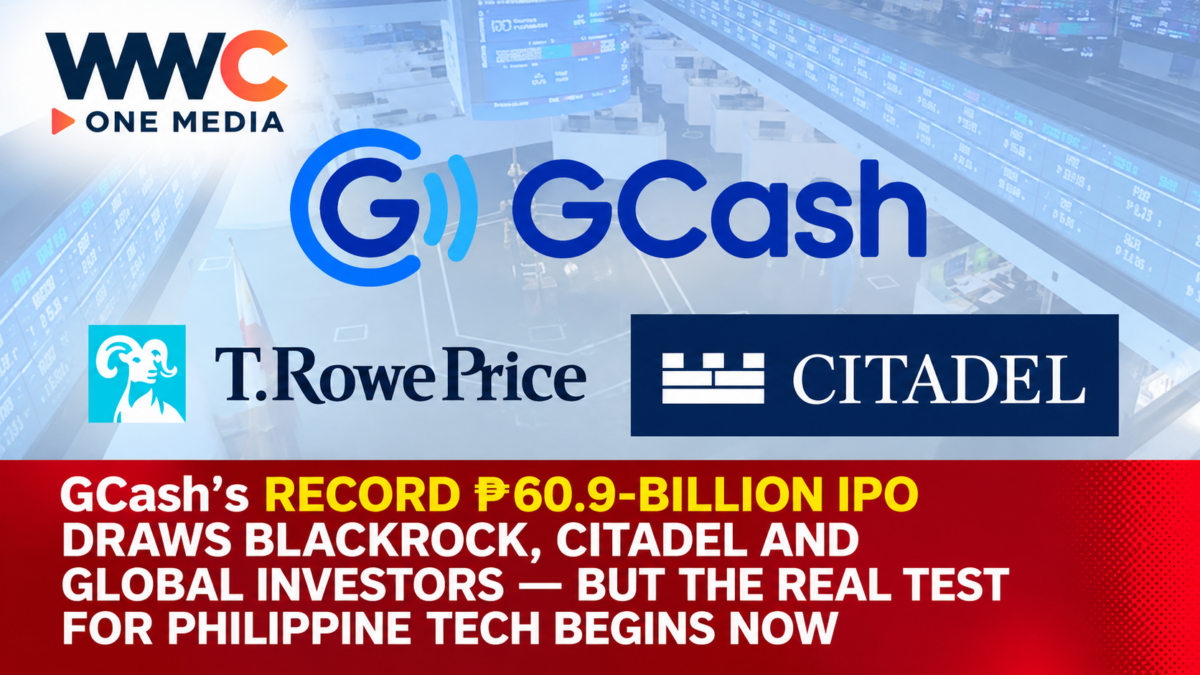
MANILA, Philippines — The Philippines has delivered a landmark moment for its technology and financial markets after GCash operator Mynt attracted some of the world’s biggest investment institutions to a record-breaking initial public offering worth up to ₱60.9 billion.
JPMorgan, one of the global banks that helped manage the transaction, said the blockbuster listing demonstrated that Philippine technology companies can compete for international investment capital despite weak local stock market liquidity and uncertain global financial conditions.
The October 20, 2026 debut brought internationally recognized investment firms, including BlackRock, Citadel, Capital Research and Fidelity International, into an offering that became the largest IPO in Philippine history when measured at its maximum size, including the overallotment option.
But while institutional demand was strong, Mynt’s shares ended their first trading day unchanged at the ₱6.60 offering price.
The flat debut created an immediate contrast between the enthusiasm surrounding the share sale and the more cautious reception in public trading.
For investors, the question is no longer simply whether Philippine technology can attract global money.
It is whether GCash can sustain growth, deliver stronger earnings, and persuade international shareholders to remain invested long after the excitement surrounding its historic listing fades.
JPMorgan: GCash Is a Milestone for Philippine Technology
Carlos Ma. G. Mendoza, JPMorgan Philippines senior country officer, described the listing as a significant development for the country’s capital markets.
In a statement on October 20, Mendoza said the transaction demonstrated that a high-quality Philippine digital business could secure strong support from both global and domestic investors.
The significance extends beyond GCash itself.
International institutional investors frequently assess companies based on business scale, profitability, governance, liquidity, industry position, and long-term growth prospects.
By attracting major investors from Asia, Europe, and the United States, Mynt demonstrated that a Philippine digital financial services company can compete for attention within the global investment market.
JPMorgan also highlighted the transaction’s contribution to the development of Philippine capital markets by bringing a technology-driven business to a stock exchange traditionally associated with large banks, property companies, infrastructure operators, and conglomerates.
The investment bank served as one of the international joint global coordinators and joint bookrunners, alongside Morgan Stanley and UBS.
Nearly 200 Institutional Investors Courted as Global Money Flows Into GCash
The GCash IPO attracted institutional demand from major financial centers around the world.
According to JPMorgan, nearly 200 institutional investors across Asia, Europe, and the United States were engaged during the international marketing campaign.
The offering generated orders several times larger than the available allocation, indicating substantial investor interest.
A record 20 cornerstone investors committed to the Philippine offering, including four institutions making their first cornerstone commitments in the local market.
The investor lineup included prominent international firms such as BlackRock, Capital Research, Citadel, Fidelity International and the International Finance Corporation.
Other institutional participants included domestic investment managers and financial institutions, including ATRAM Trust, BPI Asset Management, China Bank Capital and Metrobank Trust.
Cornerstone investors are major institutions that commit to purchasing shares as part of an IPO, often providing an important signal of institutional support.
Their participation can strengthen the marketing of an offering, but it does not guarantee that the company’s share price will rise after listing.
For Mynt, securing these investors represented a major achievement in a market that has struggled to attract large new equity offerings.
₱60.9 Billion: How GCash Broke Philippine IPO Records
Mynt priced its offering at ₱6.60 per share, below the initial maximum indicative price of ₱10.
The base offering of approximately 8.03 billion shares was valued at around ₱53 billion.
Including the overallotment option, the total potential offering size increased to approximately ₱60.9 billion.
That maximum size made the GCash listing the largest in Philippine IPO history.
The IPO also represented Southeast Asia’s largest initial public offering since 2021 and the region’s largest technology, media and telecommunications IPO over the same period, according to JPMorgan.
At the final offering price, Mynt carried a valuation of approximately ₱442 billion, or about US$7 billion.
The valuation positioned the fintech company among the Philippines’ most valuable listed financial businesses.
However, the IPO’s total offering size must be distinguished from money raised directly for the company.
Initial public offerings may include newly issued shares and shares sold by existing shareholders.
Only proceeds from newly issued shares flow directly to the issuer, while proceeds from secondary shares go to the selling shareholders.
This distinction matters when evaluating how much additional funding Mynt has available for its future expansion.
GCash Makes a Flat Stock Market Debut Despite Massive Demand
GCash’s historic listing did not result in an immediate share-price rally.
Mynt shares opened at ₱6.60 on October 20, climbed as much as approximately 2.4% during the session, and eventually closed at the original offering price.
The unchanged closing price showed that strong IPO subscriptions do not necessarily translate into aggressive buying once shares begin trading publicly.
Investors participating before a listing may have different objectives from those purchasing shares in the secondary market.
Some may seek long-term exposure to the company’s financial services platform, while others may trade based on short-term market conditions.
The flat debut also reflected the difficult environment facing Philippine equities, where limited liquidity and cautious investor sentiment have created challenges for major new listings.
For GCash, the first-day performance does not establish the long-term investment outcome.
The more important indicators will emerge as the company reports financial results, delivers its expansion strategy, and demonstrates whether its valuation is justified by future earnings.
More Than 140,000 GCash Users Join the Historic IPO
The offering did not attract international institutions alone.
More than 140,000 GCash users participated in the IPO through the application, collectively investing approximately ₱1.1 billion.
For many participants, the transaction represented their first opportunity to invest directly in shares of a Philippine-listed company.
The retail participation reflects another dimension of GCash’s business: its ability to use an established consumer financial platform to introduce investment products to users.
President Ferdinand Marcos Jr. welcomed the IPO as a development that could encourage additional companies to list on the Philippine Stock Exchange.
PSE president Ramon Monzon also expressed hope that the landmark offering could help stimulate interest in Philippine equities.
However, broad retail participation does not eliminate investment risk.
GCash users who purchased Mynt shares now face the same market uncertainties as other shareholders, including price volatility, changing earnings expectations and broader economic conditions.
The inclusion of thousands of first-time investors therefore creates an additional need for financial literacy and responsible investment disclosures.
GCash Has Become One of the Philippines’ Biggest Digital Financial Businesses
Mynt operates GCash, a financial services platform that has become central to digital payments and other consumer financial activities in the Philippines.
The platform provides services such as digital money transfers, bill payments, merchant transactions, savings products, credit access, investments and insurance offerings through its ecosystem.
It has expanded from its early mobile money-transfer origins into a broad financial technology business serving millions of consumers.
Reuters reported that GCash had approximately 41.5 million active users and processed ₱9.84 trillion worth of transactions during the first half of 2026.
That level of activity illustrates why international institutions consider the company a significant player in Philippine digital finance.
GCash is supported by major investors associated with Globe Telecom, Ant Group and the Ayala Group, alongside other strategic shareholders.
The company’s growth reflects wider changes in consumer financial behavior, including greater use of cashless payments, online shopping and app-based financial services.
However, a large user base does not automatically guarantee proportional earnings growth.
GCash must continue generating revenue from its services while managing operating expenses, regulatory obligations, competition and financial risks.
Profits Are Growing, but Investors Face New Questions
Mynt entered the stock market with an established profitable business, distinguishing it from technology companies that seek public investment while still recording substantial operating losses.
According to financial figures reported by Reuters, Mynt generated ₱43.27 billion in revenue during the first half of 2026, an increase of 10.4% from a year earlier.
Net income increased 7.3% to ₱10.82 billion over the same period.
Although the company remained profitable, net income grew more slowly than revenue.
That difference may become increasingly important as investors evaluate GCash’s future earnings potential.
Mynt also reported approximately ₱68.6 billion in cash and cash equivalents at the end of June 2026.
Its investment and deposit-related income has helped support profitability, even as the financial services industry faces changing competitive conditions.
Potential pressures include lower transaction fees, competition from banks and other fintech providers, credit quality concerns and evolving regulatory requirements.
For shareholders, GCash’s continued growth will depend on converting its scale and customer relationships into sustainable earnings.
Why the GCash IPO Matters for the Philippine Stock Market
The Philippines has historically struggled to attract the same volume of technology listings seen in larger financial markets.
Its stock exchange remains heavily represented by traditional industries, while many regional technology companies have sought funding through private investment rounds or foreign stock exchanges.
GCash’s listing changes the picture by introducing a large, profitable fintech company to the Philippine public market.
The transaction may encourage other businesses in digital payments, financial technology, e-commerce and software services to reconsider domestic listing opportunities.
It also demonstrates that international investment managers are willing to evaluate Philippine digital companies alongside businesses in larger Asian economies.
According to the Financial Times, Southeast Asian IPO activity has been recovering, supported by improved equity market conditions and renewed investor interest.
The region recorded approximately US$3.6 billion raised through 71 listings in the first nine months of 2026.
GCash’s listing adds a major transaction to that regional trend.
Nevertheless, a single successful fundraising exercise does not automatically produce a sustained market recovery.
Future issuers will still need attractive valuations, credible earnings prospects and sufficient investor demand.
Can GCash Trigger a New Wave of Philippine Technology IPOs?
The biggest potential impact of the offering may be felt beyond Mynt’s own financial statements.
For startup founders and technology entrepreneurs, GCash demonstrates that a Philippine-built digital business can reach a scale large enough to attract major global asset managers.
For venture capital and private equity investors, the listing could provide a reference point for valuing technology companies operating in the Philippines.
For investment banks, it offers evidence that large international funds are willing to participate in Philippine equity transactions when they consider the underlying business compelling.
And for policymakers, it highlights the importance of maintaining capital markets capable of supporting the financing needs of fast-growing domestic companies.
Still, replicating the GCash transaction will not be easy.
Mynt benefits from an unusually large customer base, established financial partners, a profitable business model and years of development.
Smaller technology companies may face greater difficulty meeting the financial, regulatory and governance standards expected by public market investors.
The next challenge is whether the country can create conditions in which additional technology businesses grow into viable stock market candidates.
The Bigger Test: Can Global Confidence Turn Into Sustainable Growth?
The GCash IPO has already achieved something historic.
It brought major international financial institutions into a Philippine technology offering, attracted broad participation from domestic investors and set a new benchmark for the country’s capital markets.
JPMorgan sees the transaction as proof that Philippine digital businesses can compete for global investment attention.
Yet the real test begins after the stock exchange debut.
Mynt must demonstrate that it can maintain profitability, expand its financial services business, protect customer trust and deliver results consistent with its valuation.
The Philippine Stock Exchange must also show that it can support more large-scale technology listings and attract sustained institutional participation.
For the country’s digital economy, the transaction represents an opportunity to build greater investor confidence.
But global investors will judge future Philippine technology companies on performance, not nationality or publicity.
GCash has proved that the world’s biggest investment firms are willing to back a Philippine fintech champion. The unanswered question is whether its historic ₱60.9-billion IPO will mark the beginning of a new era for Filipino technology—or remain a rare success in a stock market still struggling to attract global capital.