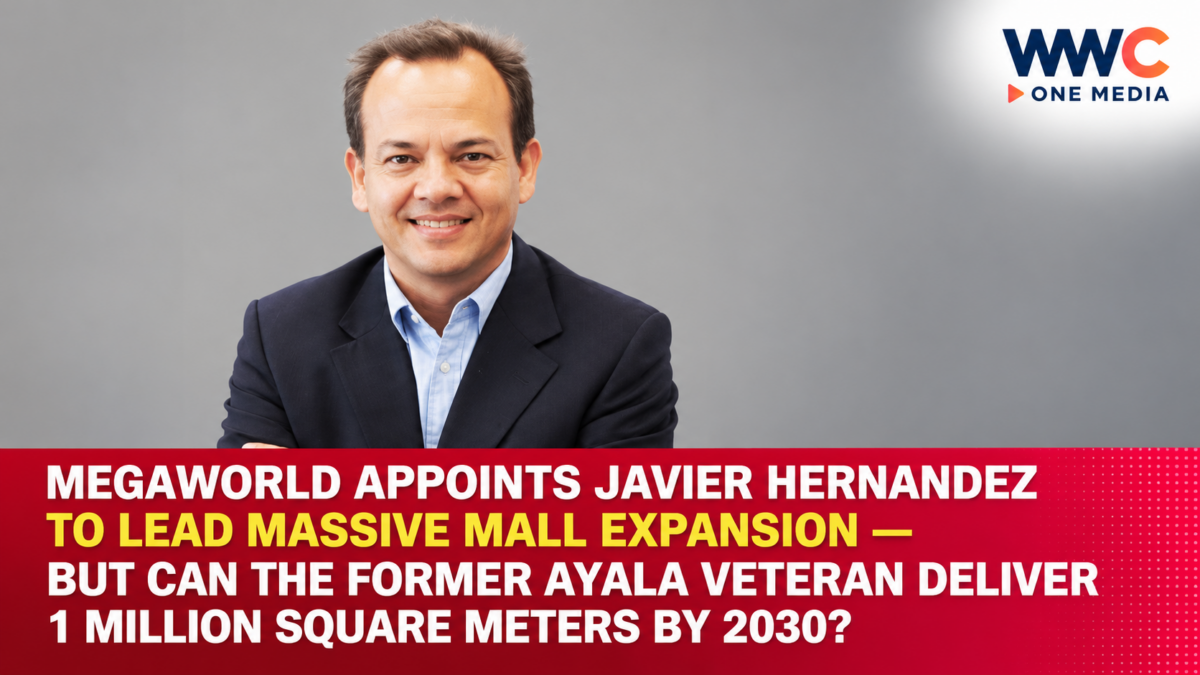
MANILA, Philippines — Megaworld Corporation is betting on an experienced property executive to accelerate its nationwide retail expansion, appointing former Ayala Land veteran Javier Hernandez as the new head of Megaworld Lifestyle Malls.
Hernandez succeeds Graham Coates, who led the retail and lifestyle mall business for eight years, and takes over a portfolio of 27 shopping destinations across the Philippines.
His appointment comes as Megaworld pursues an ambitious target: expanding its retail gross leasable area (GLA) to 1 million square meters by 2030.
The property developer is preparing new mall projects in Cavite, Rizal, Pampanga and Bacolod City, with groundbreaking activities targeted between 2026 and 2027.
But the appointment represents more than a leadership change.
It puts Hernandez in charge of a major growth campaign at a time when shopping malls must compete not only for retail tenants but also for consumers’ time, entertainment spending and loyalty.
The bigger question is whether the former Ayala Land executive can turn Megaworld’s ambitious retail expansion into sustainable growth without sacrificing occupancy, customer experience and profitability.
Javier Hernandez Takes Charge of 27 Megaworld Lifestyle Malls
Megaworld announced Hernandez’s appointment in October 2026 as part of its effort to strengthen its retail business.
He assumes leadership of Megaworld Lifestyle Malls, the property group’s retail and commercial mall operations.
The division manages 27 lifestyle malls nationwide, spanning established destinations and retail developments within Megaworld’s integrated townships.
Its portfolio includes venues serving residents, office workers, tourists and surrounding communities.
Hernandez brings more than three decades of experience across property development, retail, hospitality and tourism.
Approximately 20 years of his career have been spent in the shopping mall industry.
His appointment gives Megaworld a leader with experience in commercial operations, development, sales, marketing, hotels and tourism estates.
But he is not being appointed to run the entire Megaworld Corporation.
His announced responsibility is the group’s lifestyle mall business.
Megaworld President and CEO Lourdes Gutierrez-Alfonso continues to lead the listed property developer.
Former Ayala Executive Brings Decades of Retail Experience
Hernandez’s move is notable because of his previous experience with Ayala Land.
Earlier reporting from June 2026 identified him as a longtime Ayala Land executive who joined Megaworld on June 17.
He spent approximately two decades helping develop and manage the Ayala Malls business before moving into leadership roles involving hotels, resorts and tourism estates.
His experience included exposure to the Seda Hotels brand and Ayala’s broader hospitality operations.
This background is relevant to Megaworld’s business model.
The company’s malls are often integrated with residential developments, business districts, hotels and entertainment destinations.
Managing that type of retail environment requires coordination across different property uses.
A successful mall within a township must serve surrounding residents and office workers while also attracting visitors from outside the development.
Hernandez’s experience gives Megaworld additional expertise in integrating commercial, leisure and hospitality components.
However, his appointment alone does not guarantee that the company’s expansion targets will be achieved.
Kevin Tan Welcomes Hernandez’s Appointment
Alliance Global Group President and CEO Kevin Tan welcomed Hernandez to Megaworld Lifestyle Malls.
Tan expressed confidence that the new retail chief would contribute ideas and identify opportunities to improve the company’s existing destinations.
The leadership transition comes as Megaworld seeks to introduce more international brands while providing space for Filipino retailers and service providers.
Under Hernandez, the company plans to strengthen mall partnerships, explore new commercial formats and improve shopping experiences.
These priorities extend beyond simply building additional retail space.
The challenge is ensuring that new and existing properties attract tenants capable of sustaining business activity over time.
For the company, strong leasing performance is important because mall operations contribute recurring rental income rather than relying solely on one-time property sales.
Megaworld Targets 1 Million Square Meters of Retail Space by 2030
The most significant target facing Hernandez is Megaworld’s plan to grow its retail portfolio to 1 million square meters of gross leasable area by 2030.
Gross leasable area refers to space that can be leased to commercial tenants.
It is different from gross floor area, which can include corridors, service areas and other non-leasable spaces.
The distinction matters when comparing shopping mall development targets.
As of February 2026, Megaworld reported operating more than 500,000 square meters of retail gross leasable area.
Reaching the 1-million-square-meter target would therefore represent a substantial increase in its retail footprint.
But the target is not a guarantee that every proposed mall will be constructed on schedule.
Successful execution will depend on market demand, construction progress, financing, permits and the ability to secure suitable tenants.
The company must also ensure that its existing retail properties remain competitive while new developments are added.
Megaworld’s ₱10-Billion Mall Program Provides the Expansion Pipeline
The leadership appointment follows an earlier announcement that Megaworld would invest approximately ₱10 billion in lifestyle malls and other commercial retail projects during 2025 and 2026.
That pipeline includes more than 150,000 square meters of planned gross floor area across selected provincial townships.
Projects identified in the program include Capital Mall in Pampanga, Northwin Global Concourse in Bulacan, Maple Grove Mall in Cavite and The Upper East Mall in Bacolod City.
An expansion of Festive Walk Mall in Iloilo was also included in earlier reporting.
The spending program forms part of Megaworld’s larger capital expenditure plans across residential, office, hospitality and retail developments.
Importantly, the ₱10-billion amount was announced before Hernandez’s October appointment.
It should not be reported as a new ₱10-billion budget personally approved for the incoming mall chief.
The existing development program provides a foundation for the next phase of expansion.
Cavite, Rizal, Pampanga and Bacolod Among New Target Markets
Megaworld’s October announcement identified four locations where the company plans to break ground on new shopping mall developments between 2026 and 2027.
Cavite is an important part of the expansion strategy, supported by Megaworld’s Maple Grove township in General Trias.
Rizal is among the locations identified for additional retail investment, although the announcement did not provide a complete project specification or confirmed mall-opening date.
Pampanga remains a major growth area, supported by township development and commercial activity in Central Luzon.
Bacolod City is another significant destination as Megaworld expands its township footprint in the Visayas.
The geographic spread reflects the company’s strategy of developing retail facilities in growing residential and commercial centers outside Metro Manila.
New malls can provide commercial space for restaurants, stores, services and other businesses.
However, groundbreaking and opening are different project milestones.
The October 2026 announcement identified a target construction-start period; it did not guarantee that all four malls would be completed or operating by the end of 2027.
Graham Coates Leaves Behind an Expanded Retail Business
Hernandez succeeds Graham Coates, whose eight years leading Megaworld Lifestyle Malls included expansion, pandemic disruption and recovery.
During Coates’s tenure, the company developed or enhanced several retail destinations.
These included Lucky Chinatown’s Imperial Wing, The Shoppes at McKinley West and the redevelopment of Eastwood Mall.
The mall portfolio also introduced new dining, entertainment and international retail concepts.
One notable development was Tesla’s entry into the Philippine market through its Experience Center at Uptown Bonifacio.
Other international retailers, including KKV and Nitori, expanded their presence in Megaworld developments.
The company also strengthened its entertainment offerings through initiatives such as Uptown Tempur Cinema and REP Eastwood Theater.
These developments illustrate how Megaworld has sought to position its malls as lifestyle destinations rather than conventional collections of retail stores.
Hernandez now inherits that business model and must determine how to expand it sustainably.
Why Megaworld Is Betting on Lifestyle Malls
Shopping malls are increasingly being developed as destinations combining shopping, dining, leisure, entertainment and community activity.
For Megaworld, this approach supports its larger township model.
A mall within a mixed-use development can serve condominium residents, hotel guests, office workers and visitors throughout the day.
Restaurants and entertainment facilities can create reasons to visit beyond purchasing merchandise.
The integration of retail with offices, residential buildings and hospitality projects may also help generate demand for tenants.
But a larger retail network brings additional operating challenges.
The company must maintain facilities, respond to changing consumer preferences and help ensure that stores can generate sufficient sales.
Adding floor space without corresponding tenant demand could create vacancies and reduce returns.
That makes occupancy, tenant quality and recurring rental income critical measures of success.
Megaworld’s Retail Expansion Is Linked to Its REIT Strategy
The mall expansion is also connected to Megaworld’s real estate investment trust, MREIT Inc.
MREIT has been pursuing a strategy to diversify beyond office buildings by acquiring income-generating retail and hospitality assets.
In July 2026, Megaworld and MREIT approved a property-for-share transaction valued at approximately ₱27 billion.
The Wave 5 transaction involves about 303,900 square meters of gross leasable area across malls, offices and a hotel.
The retail portion includes five existing malls: Festive Walk Mall in Iloilo, Lucky Chinatown Mall in Manila, Venice Grand Canal Mall in Taguig, Eastwood Mall in Quezon City and Southwoods Mall in Laguna.
An official MREIT announcement in September confirmed regulatory progress for the transaction.
Upon completion, the expanded REIT portfolio is expected to exceed 950,000 square meters of gross leasable area.
This would represent a major diversification from a predominantly office-focused portfolio.
However, MREIT’s target of approximately 1 million square meters of total REIT assets is separate from Megaworld Lifestyle Malls’ target of 1 million square meters of retail space by 2030.
The two measurements should not be confused.
The REIT’s total includes office, retail and hotel assets, while the 2030 Megaworld Lifestyle Malls target refers specifically to retail leasing space.
Megaworld Reports Higher First-Half Earnings
The mall expansion comes against a backdrop of growth in Megaworld’s recurring income businesses.
The listed developer reported consolidated net income of approximately ₱12.7 billion for the first half of 2026, up 5% from the previous year.
Management attributed the improvement partly to continued expansion of its recurring income operations.
These include leasing and hospitality businesses.
For Megaworld, recurring income can provide a different earnings stream from residential property sales.
Mall operations may generate income through tenant leases and associated commercial arrangements.
However, the company has not disclosed a financial forecast showing precisely how much additional annual profit Hernandez’s new mall developments will generate.
The expansion’s eventual returns will depend on construction costs, lease rates, occupancy and operating expenses.
New Mall Projects Could Create Opportunities for Local Businesses
The planned shopping mall developments may create additional commercial opportunities in provincial markets.
Retailers, restaurants, service providers and entertainment operators could gain access to new spaces within Megaworld’s growing townships.
Construction activity may also create temporary employment and commercial demand during project development.
Once operating, shopping malls can support jobs involving retail sales, maintenance, security, logistics and customer service.
But job creation figures should not be assumed without verified company estimates.
Megaworld has not disclosed a consolidated employment forecast directly attributable to the newly announced October expansion sites.
Likewise, the arrival of new malls could intensify competition with existing retail establishments.
For smaller businesses, commercial opportunities will depend on affordability of leases, consumer demand and the suitability of locations.
Successful development should therefore be assessed not only by new buildings but also by how effectively they support sustainable commercial activity.
Can Megaworld Maintain Quality While Expanding?
Megaworld’s 2030 goal is ambitious because it requires growth in both the quantity and quality of retail space.
The company must develop new malls, expand existing destinations and maintain tenant relationships.
Hernandez has emphasized responsible growth and improvements to the customer experience.
That approach will be important as the company enters new provincial markets.
Retail conditions differ between Metro Manila and emerging commercial centers.
Consumer spending patterns, competition and local infrastructure can influence a mall’s performance.
A commercial concept that works in Bonifacio Global City may not automatically achieve the same results in another province.
As Megaworld expands, its management team will need to tailor retail formats to each local market.
It must also balance international tenants with opportunities for Filipino brands.
The Bigger Test for Javier Hernandez
The appointment of Hernandez marks a new phase for Megaworld Lifestyle Malls.
The incoming executive brings decades of experience and takes over an established portfolio of 27 destinations.
He is also inheriting a company that has publicly committed to a major retail expansion through 2030.
With developments planned in Cavite, Rizal, Pampanga and Bacolod, Megaworld is positioning itself for continued growth beyond its existing urban centers.
But the long-term performance of these projects will depend on execution.
Retail space must be built at manageable costs, leased to sustainable businesses and maintained as destinations people continue to visit.
The company’s REIT strategy adds another financial dimension by potentially creating a pathway for mature properties to contribute to an income-focused investment vehicle.
For Hernandez, the challenge is combining retail experience, township development and financial discipline.
Megaworld has appointed a seasoned former Ayala Land executive to help lead its 27-mall business toward 1 million square meters of retail space by 2030. But the biggest test is whether the expansion can deliver stronger destinations, reliable rental income and long-term value—not simply more malls on the map.