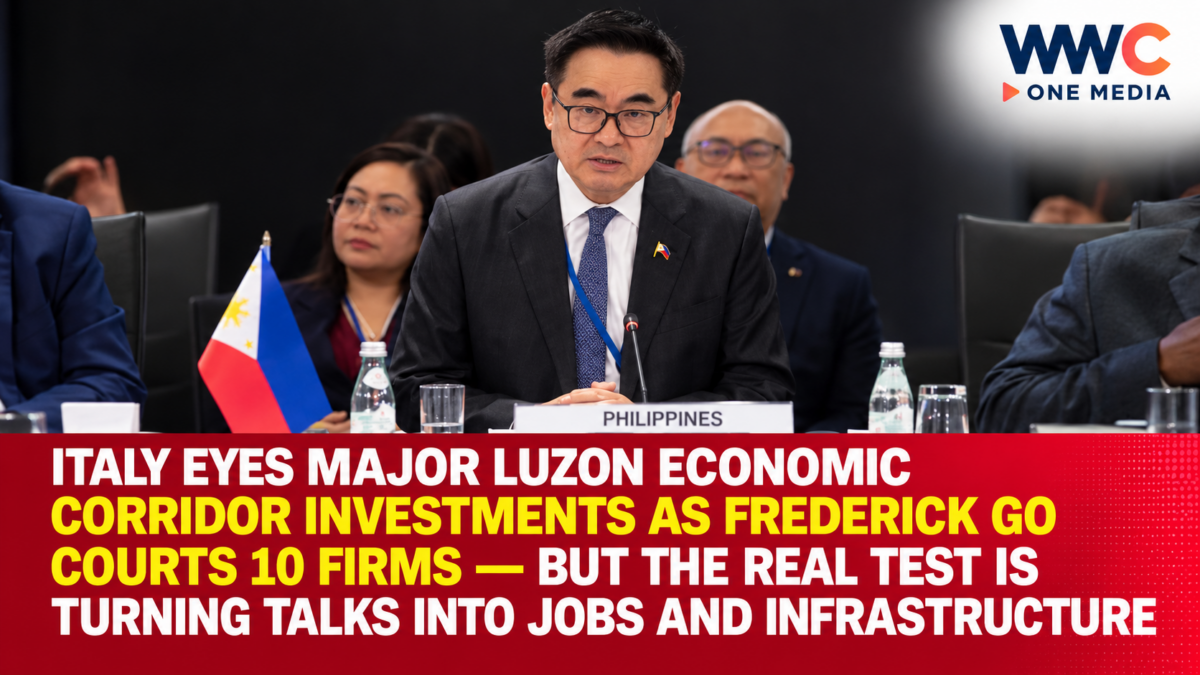
MANILA, Philippines — The Philippine government is intensifying its campaign to attract European investment into the Luzon Economic Corridor, with Finance Secretary Frederick D. Go hosting a delegation of major Italian companies interested in transportation, energy, infrastructure and industrial development.
The investment discussions, held on October 6, 2026, brought representatives of 10 Italian enterprises face to face with senior Philippine economic officials.
Among the participants were Fincantieri, CESI SpA, SIAD Macchine Impianti and MERMEC Group—companies associated with engineering, power systems, industrial technology, shipbuilding and rail-related services.
Italy’s delegation also included government-backed trade and financial institutions capable of providing financing instruments, guarantees and technical assistance for international projects.
The meetings focused on potential participation in the Luzon Economic Corridor, an international infrastructure and investment initiative intended to strengthen economic links among Subic Bay, Clark, Metro Manila and Batangas.
The Philippine government hopes stronger international cooperation will lead to employment, technology transfer, better infrastructure and expanded investment.
But the biggest question is whether growing foreign interest can be converted into signed projects, actual construction and lasting economic benefits for Filipinos.
Frederick Go Courts Italian Firms for Luzon Economic Corridor
The Department of Finance confirmed on October 16 that Go had met Italian business representatives led by Ambassador Davide Giglio.
Go, who serves as the Philippine chair of the Luzon Economic Corridor, encouraged potential investors to explore opportunities in strategic industries.
The discussions focused on areas where Italian companies have relevant capabilities, including transportation, energy, water management, shipbuilding and engineering.
The Philippine team presented investment opportunities that could involve direct capital investment, technical cooperation, project financing or commercial partnerships.
For the Marcos administration, the meeting represents part of a wider effort to position Luzon as a competitive center for advanced manufacturing, trade and logistics.
However, it was an exploratory investment meeting.
The DOF did not announce signed project contracts or a confirmed value of new Italian investment arising from the discussions.
That distinction matters because investor interest and committed capital are different stages of economic development.
Ten Italian Companies Bring Industrial Expertise
The delegation included established Italian businesses operating across several industrial sectors.
Fincantieri is an international shipbuilding company with experience in naval and commercial vessel construction.
CESI SpA provides technical services and expertise for the energy and electrical power industries.
SIAD Macchine Impianti develops industrial engineering and machinery solutions, including equipment associated with gas processing.
MERMEC Group specializes in technologies and systems used in railway infrastructure and monitoring.
Their participation is significant because the Luzon Economic Corridor’s priorities extend beyond conventional real estate development.
The initiative aims to encourage investment in transport connectivity, industrial facilities, digital infrastructure and power systems.
These industries require specialized equipment and technical capabilities.
International partnerships could provide access to expertise that helps Philippine projects move from design to implementation.
But the presence of a company at an investment meeting does not mean it has won a procurement contract, formed a joint venture or secured exclusive rights to a project.
Any subsequent agreements would need to be verified separately.
Italy’s Financing Institutions Also Join the Mission
The Italian trade mission included four institutions that support international commercial and investment activity.
They were Cassa Depositi e Prestiti (CDP), SIMEST, SACE and the Italian Trade Agency.
CDP provides financial support for investment and infrastructure initiatives.
SIMEST supports Italian companies expanding into international markets.
SACE offers financial protection and guarantee instruments that can help companies manage risks associated with business and investment activities.
The Italian Trade Agency supports export promotion and international business development.
Together, these organizations could help connect Italian companies with suitable financing arrangements.
For Philippine infrastructure projects, financing is often as important as technical design.
Major railways, energy systems and industrial facilities require substantial funding before they can become operational.
However, the delegation’s participation did not establish that CDP, SIMEST or SACE had already approved loans or guarantees for a specific Luzon Economic Corridor project.
The financial instruments discussed were potential mechanisms for future cooperation.
The Italian Trade Mission Was Held From October 5 to 7
Italy’s Embassy in Manila provided additional details about the visit.
According to its October 9 announcement, the mission was organized by the Italian Trade Agency in cooperation with the Embassy.
It ran from October 5 to 7, 2026.
The delegation first met Asian Development Bank officials to discuss potential collaboration on development and infrastructure projects.
On the second day, the companies met Go and the Philippine Department of Finance.
The delegation later participated in business-to-business meetings involving 23 Philippine companies.
The Italian mission followed earlier engagement at the Asian Development Bank’s September Business Opportunity Fair.
This sequence shows that the October meeting was part of a broader program of trade diplomacy, rather than a single isolated visit.
The Italian Embassy described the mission as an effort to deepen bilateral economic cooperation and expand the presence of Italian businesses in the Philippine infrastructure market.
North–South Commuter Railway Among Major Projects Presented
One of the most important projects highlighted during the discussions was the North–South Commuter Railway.
The railway forms part of the Philippine government’s long-term effort to improve public transportation and connectivity across Luzon.
At the meeting, DOF Undersecretary Catherine L. Fong’s Privatization and Partnerships Group discussed opportunities associated with the country’s infrastructure pipeline.
The North–South Commuter Railway was identified as an example of a project where Italian expertise or financing could potentially contribute.
Railway projects can create demand for electrical systems, signaling technology, rolling stock, construction services and specialized maintenance equipment.
Italian companies with expertise in these areas may therefore see commercial opportunities.
But the project’s inclusion in an investment presentation does not mean the entire railway is newly proposed, or that construction is awaiting this Italian delegation.
The North–South Commuter Railway already has an established development and financing history.
The meeting should be understood as exploring potential areas of participation rather than announcing a new Italian contract.
What Is the Luzon Economic Corridor?
The Luzon Economic Corridor is a major international cooperation initiative launched by the Philippines, United States and Japan in 2024.
Its objective is to strengthen critical infrastructure and support greater economic activity across a strategic part of Luzon.
The corridor links important industrial, logistics and commercial centers, including Subic Bay, Clark, Metro Manila and Batangas.
These locations are significant because they contain or connect major ports, airports, manufacturing areas, business districts and industrial estates.
Improved connectivity could help companies move raw materials, equipment and finished goods more efficiently.
The initiative also prioritizes digital connectivity, energy infrastructure, semiconductor supply chains and advanced manufacturing.
Rather than functioning as a single railway or highway project, the corridor provides a framework for coordinating multiple investments.
Its success will depend on the financing and execution of individual developments.
International Partnership Expands to 13 Members
The Luzon Economic Corridor began as an initiative involving the Philippines, United States and Japan.
In May 2026, the international partnership expanded to include Australia, Canada, Denmark, France, Italy, South Korea, Sweden and the United Kingdom.
In September, Spain and the European Union also joined.
This brought the coalition to 13 participants, counting the European Union separately from individual countries.
The widening group provides additional opportunities to draw on international expertise, financing institutions and private-sector relationships.
Italy’s participation is therefore part of a broader effort to turn the corridor into an international investment platform.
However, international membership alone does not guarantee financial contributions.
Each partner may participate through different forms of cooperation, including technical support, private investment, project development or financing arrangements.
The actual economic value will depend on the commitments eventually implemented.
September Investor Forum Drew More Than 600 Participants
The latest Italian mission followed the inaugural Luzon Economic Corridor Investment Forum held on September 10, 2026.
The event was organized by the Philippines, United States and Japan, with support from the U.S. Trade and Development Agency.
It brought together more than 600 government officials, investors and business leaders.
The forum focused on identifying investable opportunities in transportation, digital infrastructure, energy and advanced manufacturing.
President Ferdinand Marcos Jr. attended alongside senior Philippine, American and Japanese officials.
The gathering demonstrated interest in the corridor among public and private institutions.
But attendance at an investment forum is not the same as a signed project commitment.
The corridor’s progress must ultimately be measured through financing agreements, awarded contracts, project completion and resulting economic activity.
European Union Brings Additional Investment Frameworks
The European Union’s decision to join the corridor adds another potential channel for cooperation.
According to the Philippine News Agency’s September report, the EU is aligning its Global Gateway initiative with Luzon Economic Corridor priorities.
The identified programs include a €60-million Green Economy Programme and a €20-million Digital Economy Package.
These initiatives can support projects involving sustainability, energy efficiency, secure digital connectivity, innovation and workforce development.
However, the program amounts should not be treated as newly approved cash specifically for the October Italian mission.
They are separate funding frameworks associated with EU–Philippines cooperation.
The relevance to the Luzon Economic Corridor lies in the possibility of coordinating existing programs and future investments.
Italy Wants Opportunities Beyond Traditional Trade
Italy’s participation reflects the broader economic relationship between the two countries.
Historically, trade between the Philippines and Italy has involved merchandise, consumer goods, industrial products and other commercial exchanges.
Infrastructure investment adds a different dimension.
Italian companies may contribute specialized engineering capabilities or technology to projects that require large capital outlays and long implementation periods.
This could strengthen commercial ties beyond conventional exports and imports.
For Philippine firms, partnerships may provide opportunities to gain access to international technical expertise.
For Italian businesses, the Philippines offers a market with infrastructure requirements across transport, energy and utilities.
But future benefits depend on whether both sides can identify commercially viable projects.
Jobs and Technology Transfer Are Central to Go’s Pitch
Finance Secretary Go has emphasized that investment should create quality employment opportunities.
For the government, attracting foreign capital is important partly because large projects may generate demand for engineers, technicians, construction workers, service providers and suppliers.
International technology partnerships could also support workforce development.
But neither job creation nor technology transfer is automatic.
A foreign company may import specialized equipment without creating a large number of local technical positions.
Likewise, a project could rely heavily on foreign expertise unless training and local participation are included in its implementation.
For investments to create meaningful long-term benefits, the government and commercial partners may need to consider workforce development, supplier participation and knowledge sharing.
The October meetings did not establish a verified number of new jobs to be created.
Any specific employment forecast would therefore be premature.
Ease of Doing Business Becomes a Deciding Factor
Go also highlighted the need to make investment procedures more predictable.
Infrastructure companies must often navigate permitting, procurement rules, land issues, financing arrangements and regulatory requirements.
Delays can increase project costs and discourage investment.
The government wants to reduce unnecessary business expenses and make its approval systems easier for investors to understand.
But effective reform must balance efficiency with transparency, environmental safeguards, fair procurement and accountability.
Foreign companies are more likely to pursue long-term projects when the legal and regulatory environment is stable.
Predictable rules can be as important as tax incentives or promotional investment missions.
For Go, the challenge is ensuring that the Philippines offers an environment where complex projects can progress from initial interest to completed operations.
KKR Discussions Add Another Financing Opportunity
The Department of Finance disclosed a related development on October 19, 2026.
Senior DOF officials held discussions with representatives of global investment firm KKR about possible financing opportunities under the Luzon Economic Corridor.
Government Corporations and Investments Group Undersecretary Ma. Angela E. Ignacio met KKR Global Institute Partner and Chairman General David Petraeus.
According to the DOF, the discussions involved priority projects and potential expansion of KKR’s investments in the Philippines.
This development suggests the government is continuing to approach major international financial institutions after the September investment forum and October Italian mission.
But KKR’s stated interest should not be confused with a finalized investment commitment.
No completed financing agreement or specific new investment amount was announced in that October 19 update.
It is another potential source of capital, not a confirmed funding breakthrough.
Why Luzon’s Logistics Network Matters to the Entire Philippines
The Luzon Economic Corridor has national significance because its major locations support domestic and international trade.
Subic Bay and Batangas are important maritime gateways.
Clark is an aviation, logistics and industrial center.
Metro Manila remains the country’s largest commercial and financial center.
Improving connections between these locations could help businesses reduce delays and manage supply chains more effectively.
Transport and energy infrastructure can also influence where companies establish factories or distribution facilities.
However, investment concentrated in Luzon raises a wider policy question.
The Philippines also needs improved connectivity across the Visayas and Mindanao.
The corridor may generate national benefits through stronger supply chains, but those effects should not be assumed without evidence of actual project outcomes.
The Bigger Test: Turning Diplomatic Interest Into Completed Investments
Italy’s October trade mission represents a positive development in the government’s effort to broaden the Luzon Economic Corridor’s international network.
The delegation brought together industrial companies, financing institutions and Philippine officials to explore specific business opportunities.
The discussions included transport, energy, engineering and the North–South Commuter Railway.
They also connected Italian businesses with local companies through organized meetings.
But no confirmed new investment value or binding project award emerged from the public announcements reviewed.
For the Philippine government, the next step is converting expressions of interest into bankable projects.
That requires clear project preparation, reliable financing, transparent procurement and credible implementation schedules.
For Italian companies, the challenge is identifying opportunities that make commercial and technical sense.
And for Filipinos, the ultimate measure will be whether the investments produce better transportation, more reliable infrastructure, quality employment and broader economic growth.
Finance Secretary Frederick Go has brought major Italian companies into discussions about the Luzon Economic Corridor. But the real breakthrough will come only when international interest turns into signed commitments, construction, new jobs and infrastructure that businesses and communities can actually use.