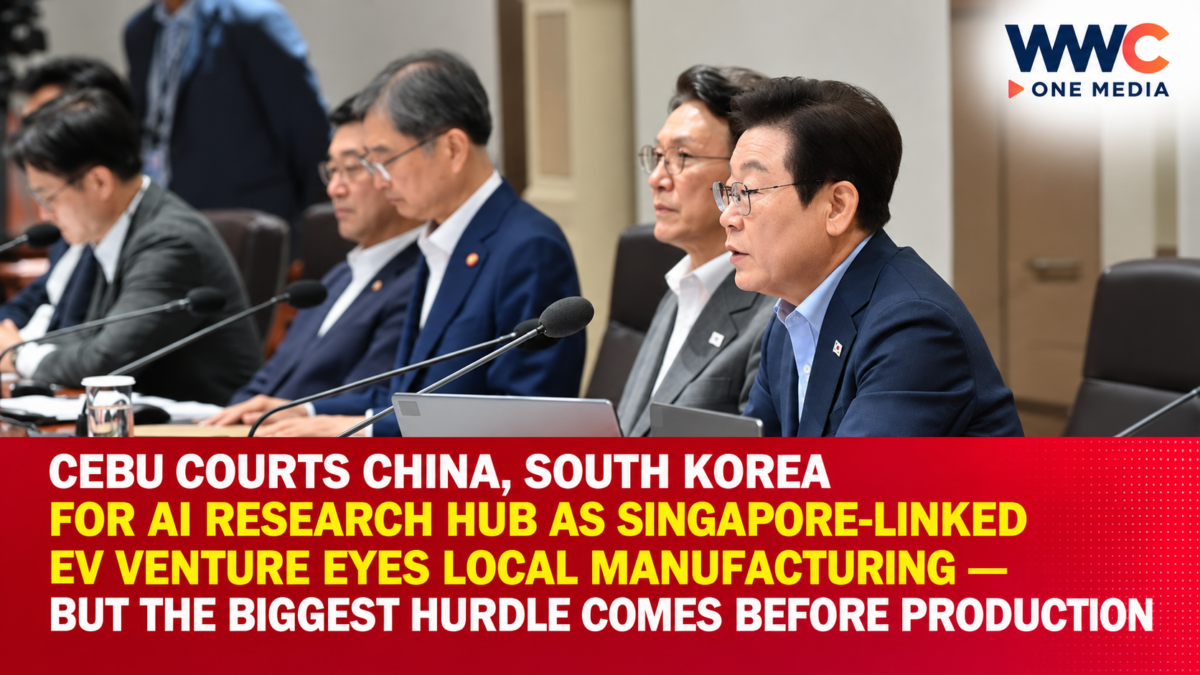
CEBU CITY, Philippines — Cebu is seeking to expand its technology and manufacturing industries through two proposed investments: an artificial intelligence research center involving companies from three countries and an electric motorcycle venture that could eventually produce complete vehicles locally.
The initiatives are among the potential business partnerships being developed following Cebu Economic Forum 4.0, held on September 8 and 9, 2026.
The two-day event attracted 515 participants from 13 countries, bringing together government officials, entrepreneurs, investors and financial institutions to explore opportunities across the province.
But Cebu’s latest ambitions remain at a critical early stage.
The companies involved are still conducting due diligence, evaluating commercial arrangements and determining how the projects could operate.
Provincial investment consultant and global strategist Brian To said agreements could be signed before the end of 2026, with some economic benefits potentially emerging in 2027.
The bigger question is whether Cebu can turn promising international partnerships into functioning businesses, skilled employment and a stronger regional industrial economy.
Three Startups Explore Cebu AI Research Center
One of the most significant proposals involves the establishment of an artificial intelligence research and development center.
The proposed venture would bring together three startup companies: one based in Cebu, another from China and a third from South Korea.
The businesses are exploring how to combine their technologies, expertise and resources under a joint commercial arrangement.
According to To, the center would focus particularly on AI security, safety and the reliability of systems used for research and decision support.
These are important areas as organizations increasingly use artificial intelligence to analyze information, automate processes and assist professional decision-making.
AI systems can produce inaccurate outputs, handle sensitive data or become targets for malicious activity.
Research into reliability and security can help address these problems through testing, software development and improved safeguards.
However, the participating companies have not yet publicly disclosed a finalized business plan.
The proposed center’s investment cost, location, staffing requirements and operating timetable remain undetermined.
The Proposed AI Facility Is Not a Data Center
One important clarification is the nature of the planned facility.
To said the investment would establish an office-based AI research and development operation, not a large physical data center.
The distinction matters because the two types of facilities have very different infrastructure requirements.
An AI research center typically focuses on software development, testing, engineering and technical collaboration.
A data center houses computing and networking equipment, requiring substantial electrical capacity, cooling systems and specialized infrastructure.
The proposed Cebu facility could employ software developers, cybersecurity specialists and other technology professionals if the venture proceeds.
But it should not be reported as a confirmed multibillion-peso data center investment.
No such investment amount has been announced.
Nor have the three startups been identified publicly in the reports reviewed.
The project is still being structured, and its eventual scale will depend on agreements among the participating businesses.
China and South Korea Could Bring Technology Expertise
The potential participation of startups from China and South Korea reflects the international dimension of Cebu’s investment strategy.
The two countries have established technology sectors and companies involved in software, electronics and advanced manufacturing.
For Cebu, partnerships with foreign firms could provide opportunities for exchanging technical knowledge and developing specialized services.
The local startup may contribute understanding of the Philippine business environment, workforce capabilities and regional market conditions.
But the specific responsibilities of the three companies have not yet been finalized.
There is also no verified announcement of a technology-transfer agreement or guaranteed research funding.
A partnership can create opportunities for collaboration, but those benefits must be established through commercial arrangements, project implementation and measurable results.
For the provincial government, the immediate task is helping the businesses complete the necessary negotiations and determine whether the proposed venture is viable.
Singapore-Linked Kilats Venture Explores Electric Motorcycle Manufacturing
A separate proposal involves electric motorcycle manufacturing.
The venture is associated with entrepreneur Sheldon Lee, co-founder of Singapore-based electric mobility company Kilats.
The initial plan is to establish a battery assembly operation in Cebu.
If that stage proves commercially viable, the company could gradually expand into other motorcycle components.
The longer-term ambition is to manufacture complete electric motorcycles locally.
That phased strategy would allow investors to begin with a smaller operation before committing to a larger manufacturing facility.
It also gives the project an opportunity to develop supply chains and production expertise progressively.
However, the facility has not yet been confirmed as operational.
The investors are still assessing potential production sites, permits, logistics requirements, manufacturing equipment and raw material sources.
No investment value, plant capacity, employment target or construction timetable has been publicly confirmed.
Battery Assembly Comes Before Full Vehicle Production
The electric motorcycle proposal is notable because of its staged approach.
Rather than immediately establishing a complete vehicle factory, the venture would begin with battery assembly.
The company could then expand into component production and eventually complete motorcycle manufacturing.
This approach can reduce the amount of capital required during the initial stage.
It can also help investors test production processes and assess market demand before increasing their commitments.
But a battery assembly operation is not equivalent to domestic battery-cell manufacturing.
Assembling battery packs may involve integrating cells, electrical connections, control systems and protective components sourced from different suppliers.
The reports do not establish that the Cebu venture will manufacture battery cells from raw materials.
Likewise, the proposal does not yet establish that complete electric motorcycles will be produced commercially in Cebu.
Each development stage would require further investment and successful execution.
Cebu Wants Smaller Manufacturing Projects That Can Grow
To said the province is emphasizing micro- and light-manufacturing opportunities instead of relying exclusively on large industrial projects.
Under this strategy, companies could begin with manageable investments and expand as business conditions improve.
This differs from immediately pursuing factories that require substantial land, financing and large-scale recruitment.
For investors, smaller initial operations may make it easier to evaluate risk.
For local communities, such projects could eventually create opportunities in manufacturing, maintenance, logistics and technical services.
But the actual economic impact will depend on whether commercial production begins.
An announced manufacturing proposal does not automatically translate into a specific number of jobs.
The provincial government has not released verified employment projections for the electric motorcycle venture.
Cebu Economic Forum 4.0 Attracts Investors From 13 Countries
The two proposed projects are part of the broader follow-up to Cebu Economic Forum 4.0.
The event was organized by the Economic Enterprise Council of the Province of Cebu and held on September 8–9.
It attracted 515 participants connected with 13 countries.
Discussions covered investment opportunities, public-private partnerships, infrastructure, tourism, technology, energy and access to financing.
Governor Pamela Baricuatro emphasized the need to move beyond promoting investment potential toward preparing commercially viable projects.
The provincial government subsequently reported that 51.7% of the accessible registration responses identified investment opportunities as an area of interest.
Public-private partnerships were selected by 46.4%.
Participants could select multiple areas, meaning these percentages should not be added to form a single total.
The figures provide an indication of the subjects that interested participants.
They do not measure the number of projects that received financing or reached commercial operation.
Investment Forum Attendance Is Not the Same as Investment Commitments
The number of international participants demonstrates interest in Cebu’s economic potential.
But it should not be confused with the number of actual investments secured.
A forum participant may be gathering information, meeting possible partners or exploring several business opportunities.
The process of establishing a project generally requires further steps.
These can include preparing a business plan, verifying commercial demand, securing financing, arranging a suitable site and obtaining necessary permits.
Companies must also determine whether a venture can operate profitably over time.
The proposed AI center and electric motorcycle factory have advanced into discussions and due diligence, according to provincial officials.
But the publicly available reports do not establish that either has secured final financing or begun construction.
The government’s objective is to help investors progress from exploration to formal agreements and eventual implementation.
Provincial Government Offers Investment Facilitation
To said Cebu’s investment team is helping prospective investors understand regulatory requirements, locate business partners and explore potential funding sources.
This support can be particularly useful for startups entering unfamiliar markets.
A foreign technology company may need assistance identifying local regulations, suitable office space and possible corporate partners.
A manufacturing investor may require information about industrial sites, utilities, logistics and workforce availability.
The province can help coordinate those discussions, although private companies remain responsible for commercial decisions and financing commitments.
The government is also considering startup-focused sessions intended to help emerging businesses develop stronger plans.
These activities reflect the province’s effort to turn investment promotion into project development.
Whether the approach succeeds will depend on the number and quality of projects that eventually proceed.
Cebu’s Technology Workforce Offers a Potential Advantage
Cebu already has an established information technology and business process outsourcing sector.
That creates a potential workforce base for new software and technology ventures.
The proposed AI research center may be able to recruit professionals with experience in software development, systems engineering, cybersecurity and related disciplines.
Cebu’s English-speaking workforce and existing technical capabilities are among the advantages emphasized by investment officials.
However, advanced AI security research may require specialized skills that are not automatically available in sufficient numbers.
Companies may need to invest in training, recruitment and partnerships with educational institutions.
Competition for qualified technology professionals could also influence staffing costs.
The proposed center’s ability to generate employment will therefore depend not only on investor interest but also on the availability of appropriately trained workers.
Electric Mobility Could Create Opportunities for Local Suppliers
The proposed battery assembly venture could potentially open a new market for Cebu-based suppliers.
If the company establishes commercial production, it may require packaging, components, electrical systems, mechanical parts, transport services and maintenance support.
Local businesses could benefit if they meet the required technical, quality and pricing standards.
But domestic procurement is not guaranteed.
The company may initially depend on imported cells, electronic components or specialized manufacturing equipment.
The extent of local participation will depend on sourcing decisions and the development of an appropriate supplier network.
For Cebu, an important measure of success would be whether the venture creates sustained industrial capabilities rather than simply importing finished components for final assembly.
That distinction can influence the long-term value of a manufacturing investment.
Manufacturing Expansion Also Depends on Electricity Reliability
Cebu’s ambitions come at a time when local businesses and power-sector stakeholders are addressing concerns about electricity availability and costs.
On October 12, Cebu government officials, energy companies, power distributors and industry groups formed the Cebu Energy Alliance to coordinate action on electricity supply constraints.
The initiative followed concerns about growing demand and the reliability of the regional power system.
Reliable electricity is essential for manufacturing facilities and technology offices.
Production operations can face disruptions when power becomes unstable.
Technology businesses also rely on dependable electricity to maintain computing equipment and digital services.
The Cebu energy situation does not establish that the proposed AI center or motorcycle venture has already experienced power problems.
But it underscores the importance of ensuring that infrastructure can support future industrial and technological investment.
Future Job Creation Remains Unquantified
Both proposed ventures could contribute to local employment if they proceed.
An AI research center may require developers, technical researchers, security professionals and administrative staff.
An electric motorcycle operation may eventually need production workers, engineers, logistics specialists and technicians.
But the number of positions has not been announced.
The projects also do not have confirmed commercial launch schedules.
Officials hope some investments emerging from the forum will begin contributing to economic activity in 2027.
That is an expectation rather than a binding employment commitment.
The distinction matters for residents hoping to benefit from new job opportunities.
Until project proponents publish their plans, employment figures should remain unspecified.
Cebu Economic Forum 5.0 Is Being Planned for March 2027
Following the September event, the provincial government is preparing another investment forum.
Cebu Economic Forum 5.0 is tentatively scheduled for March 2027.
Organizers expect the next gathering to last two to three days.
To said speakers from the United States and China had accepted invitations, although their names had not yet been disclosed.
The province wants to use the event to strengthen business networks, increase international engagement and attract additional opportunities.
But the next forum will also provide a potential checkpoint for measuring progress on earlier proposals.
By that time, investors and the public may have a clearer picture of whether the AI and electric motorcycle ventures have reached formal agreement stages.
A successful investment strategy should ultimately be measured through actual project implementation rather than attendance alone.
The Bigger Test: Turning Cebu’s Technology Ambitions Into Real Business
Cebu’s proposed AI research hub and electric motorcycle manufacturing venture represent two different opportunities.
The AI center could strengthen the province’s technology services sector.
The electric motorcycle initiative could help introduce new manufacturing capabilities and potential supplier relationships.
Both projects align with the government’s desire to diversify economic activity and create opportunities beyond traditional industries.
But neither project is a completed investment.
The companies still need to agree on their business structures, secure financing, finalize locations and meet regulatory requirements.
For the provincial government, the challenge is helping investors move through those steps without overstating the outcome.
For local workers and businesses, the important questions concern whether jobs will materialize, whether skills will be developed and whether local enterprises can participate.
Cebu is attracting interest from companies in China, South Korea and Singapore-linked electric mobility businesses. But the real measure of success will be whether the proposed AI center and battery assembly venture progress from negotiations into operational enterprises that create lasting economic opportunities for Cebuanos.