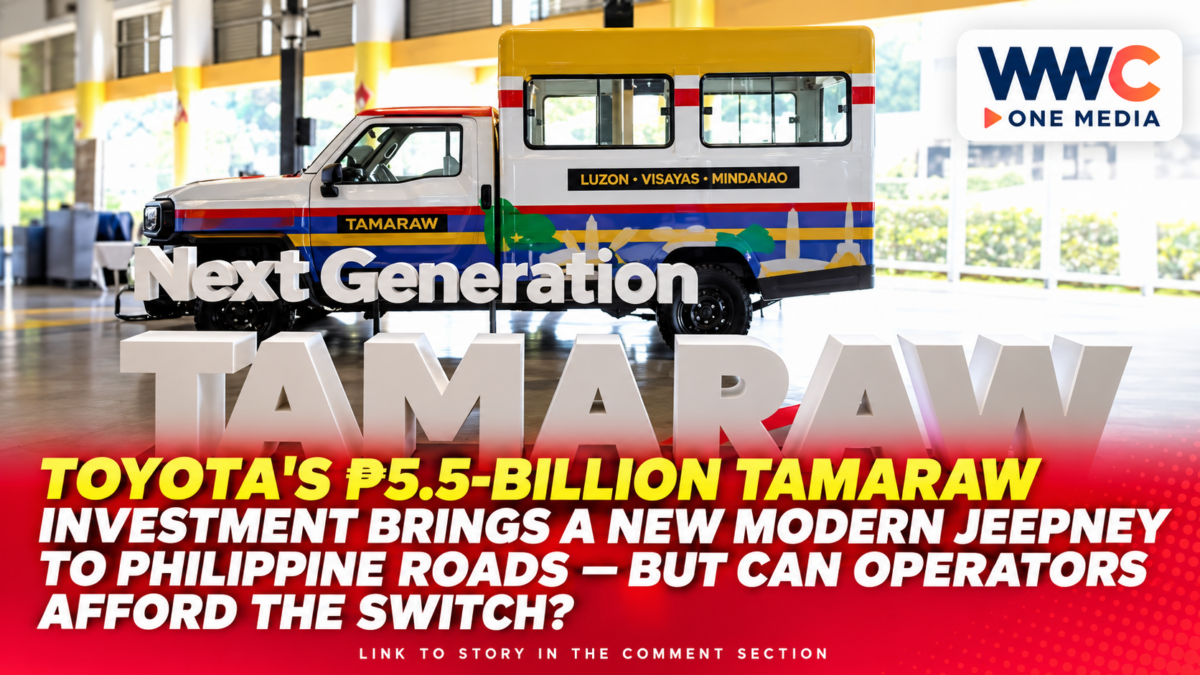
SANTA ROSA, LAGUNA, Philippines — Toyota Motor Philippines (TMP) is making a major push into the country’s public transport modernization program, unveiling a locally manufactured Tamaraw modern jeepney backed by its ₱5.5-billion investment in automotive production, parts localization and vehicle conversion.
The Japanese automaker introduced its Next Generation Tamaraw Modern Public Utility Vehicle (MPUV) on October 13, 2026, at its manufacturing complex in Santa Rosa, Laguna, marking a new chapter for one of the Philippines’ most recognizable commercial vehicle nameplates.
The Class 1 MPUV, which received certification from the Department of Transportation in May 2026, can accommodate 11 passengers and is designed primarily for intra-city transportation.
Its arrival gives transport cooperatives and operators another locally manufactured option as the Philippines continues its controversial transition toward modernized public utility vehicles.
But behind Toyota’s multibillion-peso manufacturing commitment is a bigger question: Can the new Tamaraw modern jeepney become affordable enough for Filipino drivers and transport cooperatives to adopt on a large scale?
₱5.5 Billion Invested in Philippine Manufacturing
Toyota’s Tamaraw program represents one of its major recent investments in domestic automotive manufacturing.
According to Toyota Motor Philippines’ sustainability reporting, the ₱5.5-billion commitment is divided into three components:
- ₱3.2 billion for vehicle production.
- ₱1.2 billion for parts localization.
- ₱1.1 billion for vehicle conversion capabilities.
The investment includes a 1.5-hectare Toyota conversion factory in Santa Rosa, designed to transform the Tamaraw platform into vehicles serving different commercial and public service needs.
Toyota describes the facility as a first-of-its-kind conversion operation within its Southeast Asian network.
The investment supports local manufacturing activities, specialized vehicle production and opportunities for Filipino automotive workers, suppliers and body builders.
Importantly, the ₱5.5 billion is the broader investment behind the Next Generation Tamaraw, originally launched in 2024. It is not an entirely new ₱5.5-billion investment announced exclusively for the October 2026 modern jeepney rollout.
Toyota Tamaraw Modern Jeepney Can Carry 11 Passengers
The modern public utility vehicle is based on the one-ton cab-over Tamaraw platform.
Its Class 1 configuration is intended for shorter urban routes and can accommodate 11 passengers.
The vehicle was developed using feedback from government agencies, local government units, transport cooperatives and operators.
TMP President Masando Hashimoto described the modern jeepney configuration as an important addition to the Tamaraw’s expanding role in Philippine mobility.
The vehicle joins other Tamaraw applications, including ambulances, patrol vehicles, fire trucks, food trucks, delivery vehicles and community shuttles.
This versatility forms part of Toyota’s strategy to position the Tamaraw as a practical vehicle that can serve businesses, government agencies and Filipino communities.
New Toyota Modern Jeepney Priced at ₱1.389 Million
One of the most important issues facing the Tamaraw MPUV is affordability.
According to automotive publication TheAutoPH, the Class 1 Tamaraw MPUV carries a reported price of ₱1,389,000.
The publication also reported a government subsidy of ₱210,000 for eligible transport sector enterprises.
If the full subsidy is available and applied, it would reduce the vehicle acquisition amount to approximately ₱1.179 million before financing charges, insurance and other applicable expenses.
However, eligibility requirements and the final amount payable will depend on the applicable government program and financing arrangement.
For transport operators, the sticker price is only part of the financial calculation.
Monthly amortization, interest rates, maintenance expenses, fuel costs, passenger demand and daily route earnings will determine whether the vehicle can become a practical investment.
The new Tamaraw’s long-term success could therefore depend as much on accessible financing and government support as on its engineering.
Toyota Plans Only 15 Modern Jeepneys a Month Initially
Despite the scale of Toyota’s Tamaraw manufacturing operation, initial production plans for the modern public utility version remain modest.
BusinessMirror reported that Toyota intended to produce approximately 15 Tamaraw MPUVs per month through the end of 2026, with output potentially increasing if market demand justified expansion.
The same report said the company had not yet secured firm purchase commitments from transport groups following the opening of preselling in September.
Instead, prospective customers were still seeking information about financing arrangements, documentary requirements and government incentives.
That highlights an important distinction between introducing a modern vehicle and securing actual commercial orders.
Toyota’s accredited body builder, Almazora Motors Corporation, has a dedicated operation capable of producing approximately 300 units monthly, according to BusinessMirror.
But production capacity does not automatically translate into demand.
Actual output will depend on confirmed orders, financing availability and transport operators’ willingness to purchase.
The body builder has also committed an additional ₱55 million toward MPUV-related operations, separate from Toyota’s existing ₱5.5-billion Tamaraw investment.
Tamaraw Production Reaches 34,739 Units
Toyota’s broader Tamaraw platform has already achieved substantial production volumes.
From January through September 2026, TMP manufactured 14,711 units of the Next Generation Tamaraw.
That brought cumulative production since 2024 to 34,739 vehicles.
Figures from the Chamber of Automotive Manufacturers of the Philippines showed that the Tamaraw had captured approximately 49% of the one-ton-and-above vehicle segment as of September 2026.
These figures demonstrate Toyota’s position in the commercial vehicle market.
However, the reported 49% share refers specifically to the one-ton-and-above category. It does not mean the Tamaraw controls nearly half of the entire Philippine automotive market or modern jeepney market.
Likewise, the cumulative production figure includes multiple Tamaraw vehicle configurations, not 34,739 modern jeepneys.
Local Suppliers Could Benefit From the Modernization Program
Toyota’s production expansion is also expected to create opportunities for Filipino manufacturers and businesses involved in the automotive supply chain.
The vehicle’s flexible platform requires components, accessories and conversion services for various commercial applications.
Toyota previously disclosed that local suppliers and body builders had planned approximately ₱500 million in additional investments associated with the broader Tamaraw program.
The Philippine Economic Zone Authority has also expressed support for the company’s automotive manufacturing activities, emphasizing the potential to expand domestic parts manufacturing.
According to Toyota, its wider dealer, supplier, subsidiary and affiliate network supports more than 83,000 jobs nationwide.
That number represents employment supported across Toyota’s larger Philippine business ecosystem, not jobs newly created by the Tamaraw modern jeepney project alone.
The economic impact of the modernization program will depend on how widely locally manufactured vehicles are adopted and how much production activity remains within the Philippines.
Modern Jeepney Program Still Faces Major Challenges
The introduction of a Toyota-branded modern jeepney comes as the Philippine government continues efforts to replace or upgrade aging public utility vehicles.
The modernization program aims to improve passenger safety, accessibility, vehicle reliability and environmental performance.
However, implementation has faced continuing concerns over high acquisition costs, financing difficulties and the potential financial burden on traditional jeepney operators.
Toyota’s entry could broaden the range of vehicles available to transport cooperatives, particularly for shorter urban routes.
But the Tamaraw’s 11-passenger configuration may not be suitable for every route.
Operators must assess passenger demand, road conditions, approved vehicle classifications and actual operating costs before determining whether the new MPUV fits their requirements.
And while modern vehicles may offer improvements in emissions performance and safety, the Tamaraw MPUV should not be described as an electric jeepney.
Toyota’s Tamaraw platform includes conventional gasoline and diesel powertrains, with the public transport version belonging to the combustion-engine vehicle category rather than being a zero-emission battery-electric model.
Toyota Chairman: Further Investment Will Depend on Demand
Toyota Motor Philippines Chairman Alfred V. Ty has indicated that further investments in the Tamaraw program will depend on customer demand and the company’s ability to maximize its existing facilities.
According to Context.ph, Toyota is exploring opportunities in public transportation, logistics, telecommunications and emergency service vehicles.
However, additional large-scale capital expenditure for the Tamaraw MPUV has not been confirmed.
The company must first evaluate whether demand from operators and commercial customers can sustain higher production volumes.
That makes customer financing, operating economics and government support critical factors in the next stage of the project.
Can Toyota’s Tamaraw Become the Modern Jeepney Filipinos Need?
Toyota’s entry into the modern public utility vehicle market creates an opportunity to connect Philippine transportation reform with local manufacturing.
Its ₱5.5-billion Tamaraw investment has already supported domestic production, supplier activity and new vehicle conversion capabilities.
The Class 1 modern jeepney expands those capabilities into everyday public transportation.
But the gap between manufacturing success and widespread transport adoption remains significant.
The vehicle may offer reliability, local assembly and a familiar nameplate, yet operators still need financing arrangements that make economic sense.
For drivers and cooperatives, the most important consideration will not simply be whether a modern Tamaraw is available.
It will be whether the vehicle can generate enough income to support its purchase and operating costs without placing an unsustainable burden on livelihoods.
Toyota has brought the Tamaraw back as a locally manufactured modern jeepney. The next challenge is proving that Filipino transport operators can actually afford to put it on the road.