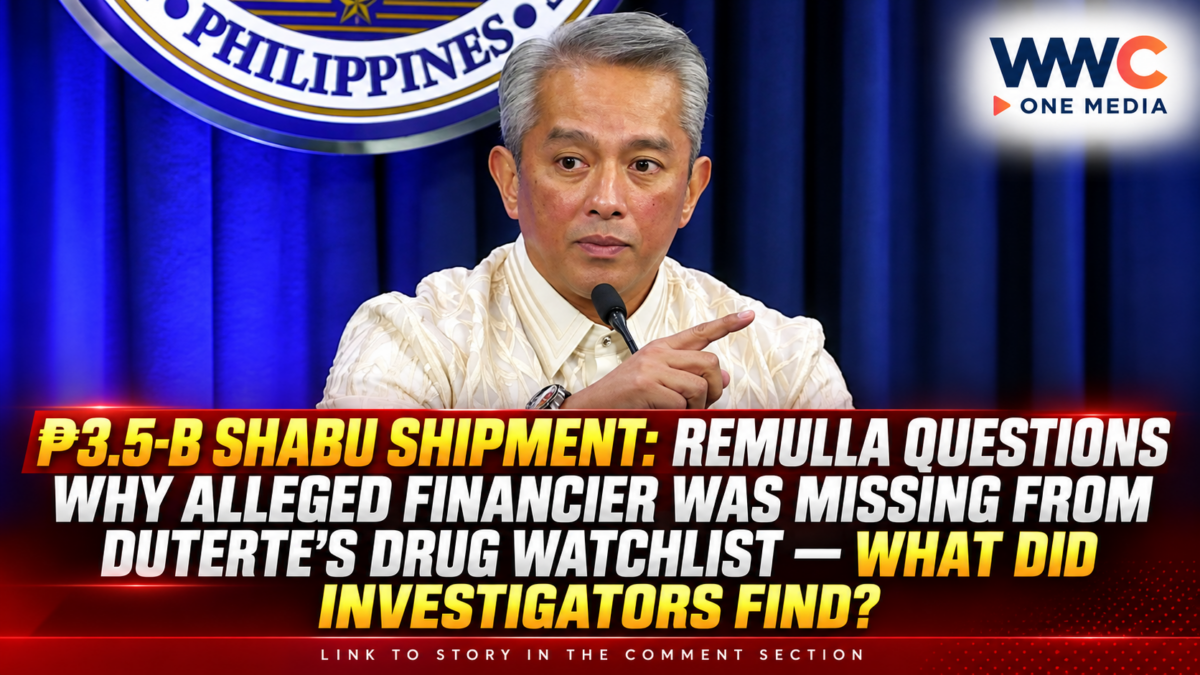
MANILA, Philippines — Interior Secretary Jonvic Remulla has raised questions about the former administration’s anti-drug monitoring efforts after a former Bangsamoro parliament member identified as an alleged financier of a massive drug-smuggling operation was reportedly not included in former President Rodrigo Duterte’s drug watchlist.
The issue emerged during the investigation into 521 kilograms of suspected methamphetamine hydrochloride, commonly known as shabu, valued at approximately ₱3.5 billion. Laotian authorities intercepted the shipment at Luang Prabang International Airport on October 1, 2026, before the planned delivery to the Philippines.
Remulla identified former Bangsamoro Parliament member Edrieza Hadji Nasser Rimbang, also known as Sultan, as the alleged financier of the operation. However, his suspected involvement remains subject to investigation, and the allegations have not established his guilt.
According to reporting by The Philippine Star on October 20, Remulla said Rimbang had never appeared on Duterte’s drug watchlist despite investigators’ suspicions about his alleged role in financing drug-trafficking activities.
“Never on the list, but we suspect that he has been a financier all this time,” Remulla said in an interview with ANC, as quoted by the newspaper.
The statement has raised questions about how suspected major players in the illegal drug trade were identified and monitored during the previous administration.
How the Alleged Drug-Smuggling Operation Was Supposed to Work
Investigators believe the shipment was part of a coordinated operation involving several individuals allegedly responsible for financing the transaction, procuring an aircraft, arranging its arrival and receiving the cargo.
During a Malacañang press briefing on October 16, Remulla, Philippine National Police chief Gen. Jose Melencio Nartatez Jr. and Philippine Drug Enforcement Agency officials presented a diagram outlining the alleged connections among 11 persons of interest.
Authorities identified the following individuals in connection with the investigation:
- Edrieza Hadji Nasser Rimbang — alleged financier of the operation.
- Fahad Mulok Dibarosan — arrested by Laotian authorities following the interception.
- Rioklyn Pizarras Toledo — allegedly arranged the aircraft used in the planned shipment.
- Police Master Sergeant Aileen Jayne Manalo Mendoza — allegedly helped arrange the flight’s arrival and the intended airport hangar.
- Abdullah Rimbang Macarimbang, Aldren Nadal Samante, Rudy Isidro, Abdulkarim Macalatas, Christian Fabrigas, Rohaniah Rimbang and Hilario de Vera — also identified as persons of interest.
Authorities alleged that the aircraft was supposed to travel from Malaysia through Laos before proceeding to the Philippines.
The planned arrival point was reportedly the MAPTRA hangar in Pasay City. Investigators said the operation involved multiple logistical arrangements that are now being examined as part of the case.
The PNP said Mendoza had been relieved of her post and placed under restrictive custody while the investigation proceeded.
These details were presented by government officials as investigative findings. The individuals named have not all been charged or convicted, and their respective roles must be established through evidence and the appropriate legal process.
CIDG Summons 21 People as Investigation Expands
The investigation has continued beyond the initial list of 11 persons of interest.
In a report published on October 20, The Philippine Star said the PNP Criminal Investigation and Detection Group had summoned at least 21 people in connection with the foiled shipment.
PNP spokesperson Col. Allen Rae Co said subpoenas had been issued to allow those involved to provide their statements. Most of those summoned had reportedly appeared before investigators, while authorities indicated that additional individuals could be called depending on the information gathered.
The expanding inquiry suggests investigators are examining not only the suspected shipment itself but also the people who may have financed, facilitated or prepared the operation.
The government has yet to establish the criminal liability of every person named in the investigation.
Was the Shipment Connected to a Larger Drug-Trafficking Network?
The scale of the intercepted cargo has also prompted scrutiny of possible links to international drug-trafficking networks.
The Philippine Star reported on October 20 that House dangerous drugs committee chairman Mark Anthony Santos said information from the PDEA pointed to a possible connection between the shipment and Sam Gor, a major transnational criminal network associated with the Asia-Pacific methamphetamine trade.
Authorities have also examined whether the shipment was connected to other drug recoveries in Philippine waters.
However, any alleged connection between the intercepted cargo and a broader criminal network must still be substantiated by investigators. A suspected link is not, by itself, proof that a particular organization directed or financed the shipment.
The case highlights the importance of international intelligence-sharing, financial investigations and cooperation among law enforcement agencies in tracking drug shipments that cross several countries.
Government Also Reviews Airport Security Procedures
The interception has raised concerns about how private aircraft and cargo are screened when they enter the Philippines.
During the October 16 briefing, Remulla said authorities needed to tighten inspections of cargo carried by private aircraft and examine possible security gaps at airports.
The planned use of a private aircraft and a designated hangar has placed aviation procedures under scrutiny as investigators work backward from the interception in Laos.
The PDEA and PNP have said they are coordinating with other agencies and foreign counterparts to trace the shipment’s movements and identify additional people who may have been involved.
The government’s challenge is to determine whether the alleged operation relied on weaknesses in airport security, the assistance of individual facilitators or a wider criminal network.
What Does the Missing Watchlist Entry Mean?
The reported absence of Rimbang from Duterte’s drug watchlist has become a central question because the previous administration made its anti-drug campaign a major policy priority.
Duterte publicly identified numerous people he alleged were involved in illegal drugs during his presidency. The latest case raises questions about the completeness of those lists and the methods used to identify suspected financiers and facilitators.
However, the absence of a name from a watchlist does not, by itself, prove that authorities deliberately protected someone, that the person was involved in criminal activity or that the previous administration had prior knowledge of a particular operation.
Those questions require documentary evidence, credible testimony and a thorough examination of the relevant intelligence and investigative records.
Remulla’s allegations therefore place renewed attention on the effectiveness of past anti-drug monitoring, while the current investigation must establish the facts surrounding the suspected shipment.
The Investigation Is Far From Over
The seizure of 521 kilograms of suspected shabu worth approximately ₱3.5 billion has triggered a widening investigation involving Philippine and foreign authorities.
With at least 21 people summoned by the CIDG, investigators are continuing to examine the alleged financing arrangements, the aircraft’s planned route, airport access and the intended recipients of the cargo.
The central questions remain: Who financed the shipment, who facilitated its movement, and were there other people or organizations behind the operation?
The answers could help authorities determine whether the intercepted cargo was an isolated attempt or part of a broader trafficking operation.
For now, the case remains an investigation—not a final determination of guilt—and the evidence gathered in the coming days will be critical to establishing accountability.