MANILA, Philippines — Security Bank Corporation is strengthening its defenses against money laundering and other financial crimes by deploying artificial intelligence capable of identifying suspicious name matches and financial connections that conventional banking systems could overlook.
Working with financial technology company Tookitaki, the Philippine lender has expanded its sanctions-screening coverage tenfold and extended checks to 100% of related contacts, marking a major upgrade to its financial crime compliance infrastructure.
The system uses advanced matching technology to detect potential risks even when names appear with different spellings, arrangements or linguistic variations.
The development comes as Philippine financial institutions face increasing pressure to maintain effective safeguards against money laundering, terrorist financing and other illicit financial activities.
But beyond the technology upgrade lies a more significant challenge: Can Philippine banks sustain stronger financial crime controls as the country approaches another major international evaluation in 2027?
Security Bank Expands Financial Crime Screening 10-Fold
The initiative centers on Tookitaki’s FinCense Screening platform, an AI-powered compliance system designed to identify potential matches against sanctions lists and other financial crime watchlists.
According to Security Bank and Tookitaki, the upgraded technology increased screening coverage tenfold compared with the lender’s previous setup.
It also expanded screening to all related contacts covered by the program, allowing the bank to examine relationships that might not have received the same level of attention under conventional screening procedures.
The companies reported a significant increase in confirmed matches identified each month.
However, they did not disclose the actual number of matches, making it impossible to independently calculate the scale of the improvement in detection performance.
Daniel Ang, Security Bank’s head of financial crime compliance, said the collaboration strengthened screening coverage, improved the identification of genuine matches and supported transparent, auditable decisions.
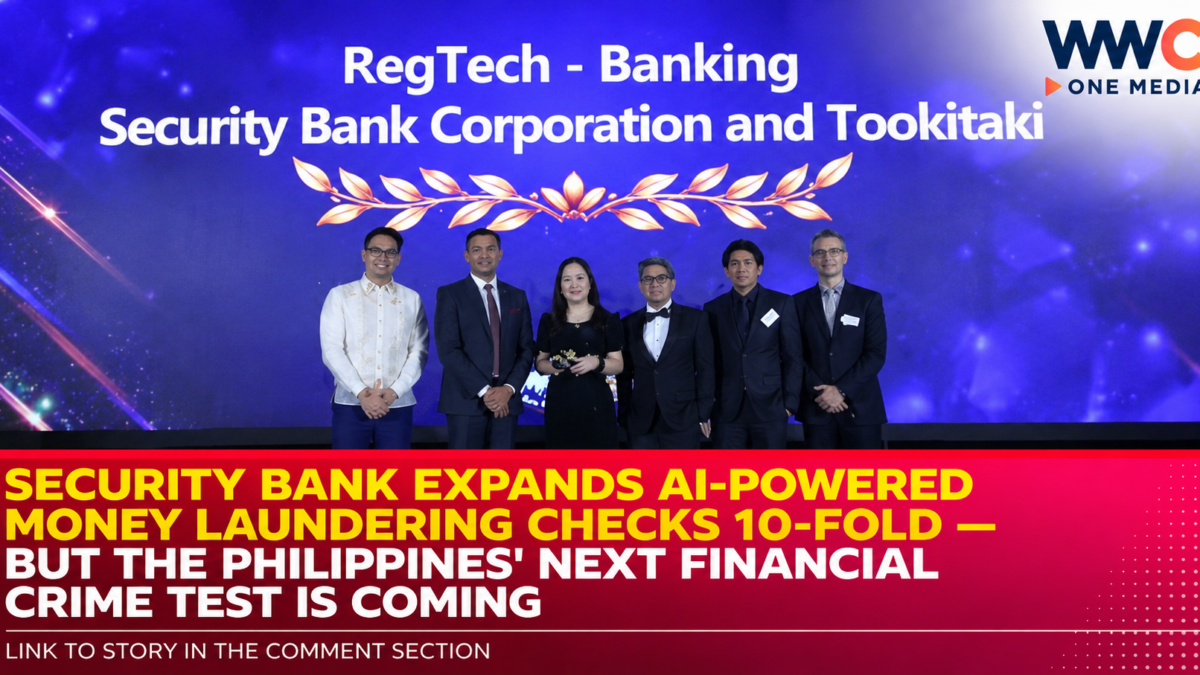
The bank’s initiative was recognized at the Asian Technology Excellence Awards on September 17, 2026, receiving the Best Technology Implementation by a Retail Bank award.
The recognition highlights the growing importance of regulatory technology, or RegTech, in modern banking operations.
How Artificial Intelligence Detects Names That Traditional Systems Miss
One of the biggest challenges in financial crime screening is identifying individuals whose names appear differently across databases, identification documents and financial records.
Traditional screening software can struggle when names are misspelled, reordered, abbreviated or translated into another language or writing system.
For example, a bank customer might use a different sequence of given names and surnames from the sequence recorded on an international sanctions list.
In the Philippines, middle names, maternal surnames and naming conventions can make accurate matching particularly complex.
FinCense Screening uses AI-assisted matching to recognize differences involving spelling, name order, phonetics, languages and scripts.
Instead of relying entirely on identical text, the system evaluates potential similarities and produces alerts for compliance teams.
These alerts can then be examined by investigators to determine whether the records actually refer to the same person.
This distinction is important.
A possible match is not proof of criminal involvement, and appearing on a screening alert does not automatically establish that a person has committed money laundering.
System Can Recheck Existing Customers as Watchlists Change
The platform also supports reverse screening, allowing previously established customer relationships to be checked again when sanctions and other relevant watchlists are updated.
This matters because financial crime risks do not necessarily remain unchanged after a customer successfully opens a bank account.
A person or organization may subsequently be added to a sanctions list or become subject to additional scrutiny.
By updating its screening process, the bank can identify potential risks involving customers and related contacts after the initial onboarding stage.
The technology also provides explainable risk scoring, which helps investigators understand why a particular record was flagged.
This can strengthen internal accountability by giving compliance teams clearer information for reviewing alerts and documenting their decisions.
For banks handling large numbers of customers and financial relationships, these capabilities can improve the scope and consistency of screening.
However, AI screening still requires reliable customer information, current watchlists, trained investigators and strong internal controls.
Why the Philippines’ 2027 Financial Crime Evaluation Matters
Security Bank’s technology upgrade comes at an important time for the Philippine banking industry.
On February 21, 2025, the Financial Action Task Force removed the Philippines from its list of jurisdictions under increased monitoring, commonly known as the FATF grey list.
The decision followed years of reforms aimed at strengthening the country’s defenses against money laundering, terrorist financing and proliferation financing.
FATF acknowledged progress in areas including financial intelligence, investigations, beneficial ownership information, supervision and financial sanctions.
The Philippines had been placed under increased monitoring in June 2021.
Its removal from the grey list represented a major regulatory milestone, but it did not mean that risks involving illicit financial flows had disappeared.
Financial institutions must continue demonstrating that their compliance systems operate effectively.
The country’s next anti-money laundering and counter-terrorism financing mutual evaluation is expected to begin in 2027.
That examination will look beyond the existence of laws and compliance frameworks to consider how effectively the country applies its financial crime safeguards.
For Philippine lenders, the challenge is therefore not simply adopting technology but demonstrating that it improves actual risk identification, investigation and compliance outcomes.
Financial Crime Prevention Is Becoming a Technology Race
Security Bank’s adoption of AI reflects a broader shift in the global banking industry.
Financial institutions are increasingly using automated monitoring, data analytics and artificial intelligence to strengthen risk detection.
The growing complexity of digital banking, international transactions and customer relationships has made traditional rule-based systems more difficult to manage on their own.
Globally, major banks are investing in AI applications for financial crime compliance, cybersecurity, customer operations and risk management.
HSBC, for example, announced an expanded partnership with Google Cloud in June 2026 involving AI applications that include financial crime risk management.
These developments suggest that AI is becoming an important part of how banks manage the balance between operational efficiency and regulatory obligations.
However, the effectiveness of these systems depends on the quality of their underlying data and the reliability of the models.
Poorly calibrated technology can generate false alerts, overlook genuine threats or make investigations more complicated.
For this reason, AI should support professional compliance judgment rather than automatically replace it.
Security Bank Is Pursuing a Broader Digital Transformation
The sanctions-screening project is part of Security Bank’s wider effort to modernize its technology infrastructure.
In 2025, the bank expanded its use of digital systems for customer due diligence, data processing and regulatory compliance.
Its Transactor Due Diligence platform, introduced across hundreds of branches, digitized know-your-customer processes.
The bank also adopted real-time data streaming technology to improve access to operational information and support faster decision-making.
In November 2025, Security Bank formalized a separate partnership with WIZ.AI to introduce conversational AI capabilities in selected customer-facing operations, including collections.
These initiatives show how the lender is applying technology across different functions rather than limiting AI adoption to a single banking service.
Its strategy includes improving digital customer experiences while strengthening back-office controls and compliance processes.
For customers, more effective systems could ultimately support safer banking transactions and more consistent risk management.
But technology upgrades do not guarantee that every fraudulent transaction or financial crime attempt will be detected.
The Challenge: Detect More Risks Without Penalizing Innocent Customers
AI-powered screening creates opportunities to identify risks that might otherwise go unnoticed.
Yet more comprehensive screening can also create operational challenges.
Customers with common names or legitimate variations in their identification records may be flagged for further review.
Banks must therefore distinguish actual risks from false positives and avoid unnecessary disruptions to legitimate customers.
This makes human oversight essential.
Compliance teams need clear procedures for examining alerts, correcting inaccurate matches and documenting decisions.
Financial institutions must also protect sensitive customer information and ensure that AI-assisted compliance tools operate within applicable privacy and regulatory requirements.
The balance between stronger detection and fair customer treatment will be critical as AI adoption expands.
Can Security Bank’s AI Investment Deliver Measurable Results?
Security Bank’s reported tenfold expansion in screening coverage represents an important operational milestone.
Its technology partner says the platform has strengthened oversight of customer relationships and improved the identification of confirmed watchlist matches.
The project has also gained industry recognition.
But important questions remain.
How much has the technology reduced missed matches? Has it improved investigation speed? Does it generate fewer unnecessary alerts? And can the bank demonstrate sustained effectiveness under international regulatory scrutiny?
The publicly available announcements do not provide enough figures to answer all of those questions.
The next stage will involve turning broader screening coverage into measurable and sustainable compliance improvements.
A Bigger Test Is Coming for Philippine Banking
Security Bank’s AI-powered compliance upgrade demonstrates how Philippine lenders are responding to increasingly sophisticated financial crime risks.
The deployment extends screening across more customer relationships, improves the detection of potential name matches and supports continued monitoring as watchlists evolve.
These developments could strengthen the financial system’s ability to identify suspicious connections before they become larger compliance problems.
However, the bank’s technology initiative is only one part of the country’s wider effort to protect the integrity of its financial system.
The Philippines successfully exited FATF’s grey list in February 2025. But with another international evaluation approaching in 2027, maintaining that progress will require more than advanced software.
For Security Bank and the wider industry, the real test is whether AI-powered systems can consistently deliver reliable detection, effective human investigations and stronger financial crime safeguards.
The bank has expanded its screening coverage tenfold. The bigger question is whether Philippine banking can stay ahead of increasingly sophisticated financial crime networks.










