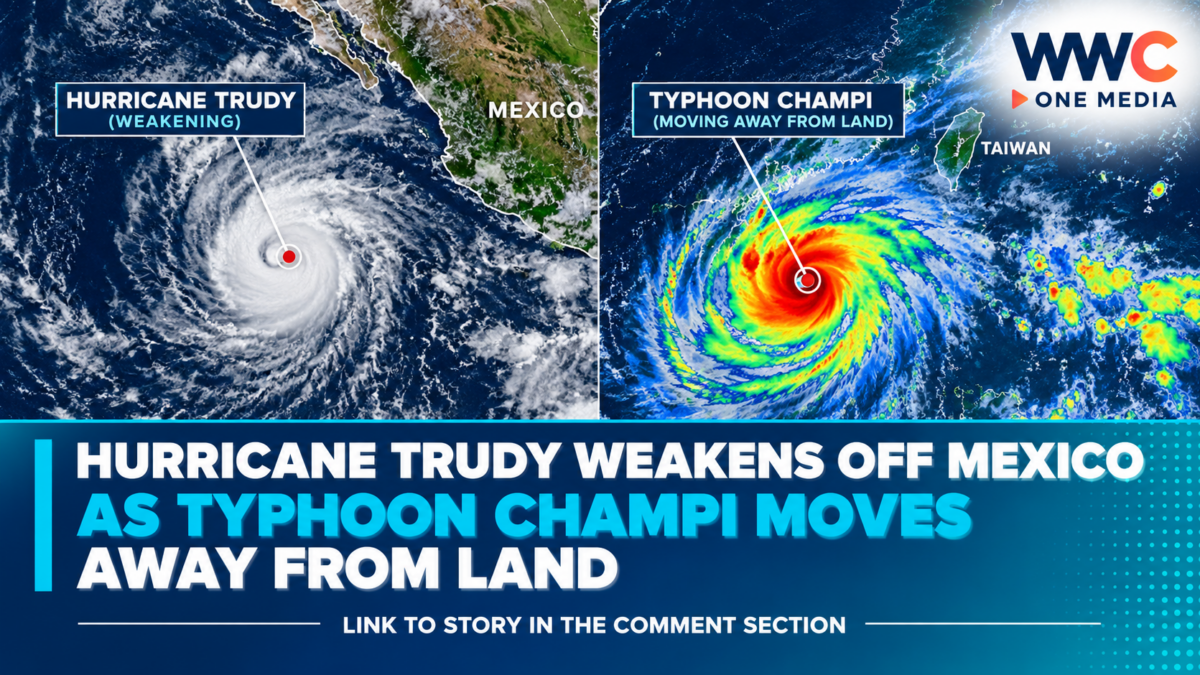
MIAMI — Hurricane Trudy began weakening rapidly on Sunday (Oct 18) after bringing heavy rain and strong winds to Mexico’s Pacific coast, while Typhoon Champi moved farther into the Philippine Sea after passing close to Guam.
Trudy had weakened to a Category 1 hurricane, with maximum sustained winds of 80 mph (130 kmh), according to the US National Hurricane Center. The storm was moving northwest at about 11 kmh and was expected to travel away from Mexico’s coastline before passing south of the Baja California Peninsula on Monday and Tuesday.
Although the hurricane was moving away from land, forecasters warned that additional rainfall remained possible in areas where the ground was already saturated by successive storms.
Flooding and Landslides Remain a Concern in Mexico
Trudy brought heavy rainfall and powerful winds to parts of Mexico’s Pacific coast, raising concerns about flooding, rising rivers and landslides, particularly in areas with steep terrain.
Authorities had previously issued hurricane warnings for coastal areas between Manzanillo, in Colima state, and Cabo Corrientes, in Jalisco. Those warnings were later discontinued as the storm moved farther offshore.
The Mexican navy urged coastal residents and mariners to remain cautious because of dangerous waves and the possibility of further heavy rain.
Even as Trudy weakened, saturated ground increased the risk that additional rainfall could trigger flooding and mudslides. Residents in southwestern and west-central Mexico, as well as Baja California Sur, were advised to continue monitoring the storm’s progress.
Typhoon Champi Moves Away From Guam
Meanwhile, Typhoon Champi moved from the western Pacific into the Philippine Sea, carrying maximum sustained winds of about 175 kmh by midday Monday, Asia time.
The storm had earlier passed close to Guam, prompting emergency measures across the US territories of Guam and the Northern Mariana Islands.
The governors of both territories requested emergency disaster declarations on Friday. US President Donald Trump approved an emergency declaration for Guam, allowing the Federal Emergency Management Agency to coordinate federal disaster assistance.
Airports, harbours and some health facilities had been closed as the storm approached. The agency warned that relief supplies might take three to five days to reach affected islands.
The region was already facing the challenge of recovering from earlier powerful storms, including Super Typhoons Sinlaku and Bavi, which struck in April and July.
Authorities Continue to Monitor Conditions
Although both weather systems were moving away from land, officials continued to monitor their effects.
In Mexico, the main concern remained additional rainfall over already saturated ground. Around Guam and the Northern Mariana Islands, attention turned to assessing damage, restoring essential services and delivering relief supplies.
The storms highlight the continuing risks posed by powerful tropical systems, even after their centres move away from populated areas.