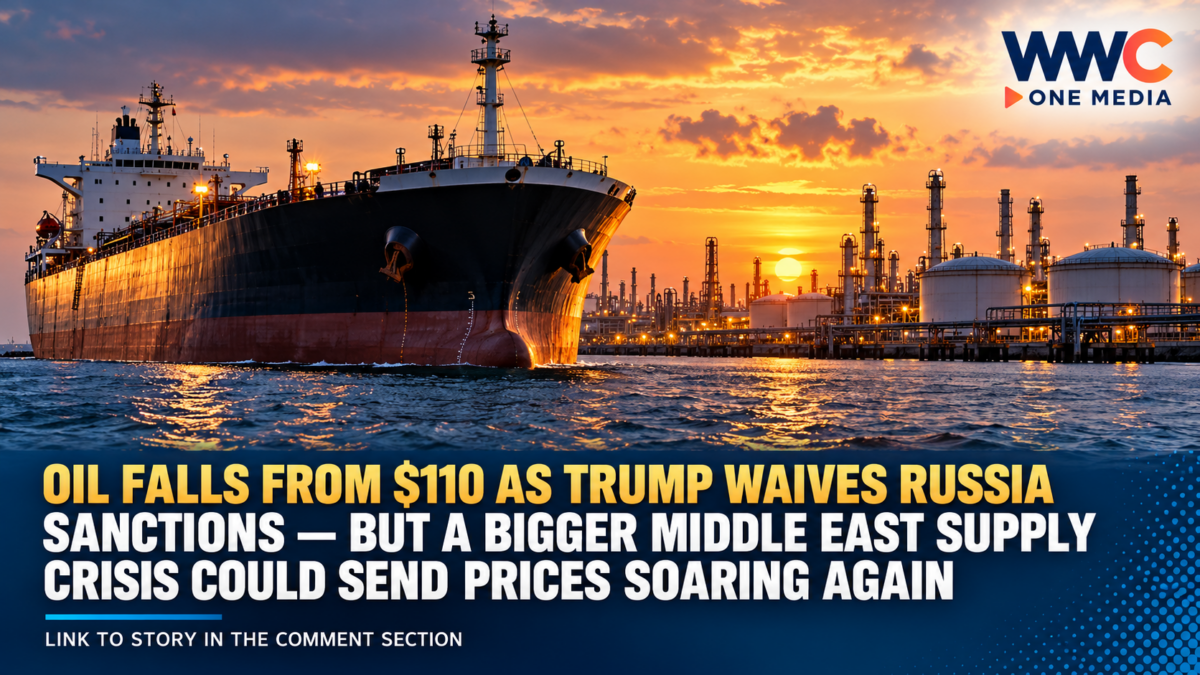
SINGAPORE — Global oil prices pulled back on Tuesday as investors weighed a potential increase in Russian energy exports following U.S. President Donald Trump’s decision to waive certain Russia-related sanctions and tariffs. But escalating attacks across the Middle East are keeping the threat of another major oil supply shock firmly in focus.
The decline comes after Brent crude briefly surged above $110 per barrel, highlighting an increasingly fragile global energy market caught between Washington’s shifting sanctions policy, Russia’s disrupted energy industry and growing security threats around critical Middle Eastern oil infrastructure.
At 0010 GMT on Tuesday, international benchmark Brent crude futures declined 49 cents, or 0.45%, to $109.06 per barrel.
U.S. West Texas Intermediate crude futures for November delivery slipped 0.33% to $103.32 per barrel, while the more actively traded December contract fell 46 cents, or 0.47%, to $98.08.
The latest retreat followed a volatile session in which Brent reached $110.70 per barrel, its highest level since May 20.
Trump’s Russia Sanctions Waiver Changes the Oil Market Equation
The immediate catalyst was an executive order issued by Trump on Friday that waived key sanctions and tariffs connected to Russia, including certain penalties related to purchases of Russian oil and natural gas.
The decision potentially opens the door to additional Russian energy supplies entering international markets at a time when refiners and oil-importing economies are struggling with elevated prices and supply uncertainty.
However, the policy’s longer-term implications remain unclear.
Trump subsequently indicated that a final decision had not been announced, while U.S. Secretary of State Marco Rubio said Washington wanted additional time to evaluate the broader economic consequences.
The possibility of additional Russian diesel and petroleum supplies has encouraged traders to reconsider how tight the global market could remain over the coming months.
Yet sanctions relief does not automatically translate into an immediate increase in physical oil production or exports.
Russia continues to face operational constraints, damaged energy infrastructure and logistical challenges linked to the Ukraine conflict.
Russian Oil Production Remains Below Last Year’s Levels
International Energy Agency figures cited in the latest market reporting show that Russian crude production increased by approximately 65,000 barrels per day in September to 8.43 million barrels per day.
Despite that improvement, output remained roughly 870,000 barrels per day below the comparable level a year earlier.
The figures underline a critical problem for global energy markets: even if Washington relaxes some trade restrictions, Russia may not be able to rapidly restore lost production or eliminate existing supply constraints.
Ukraine’s continuing attacks on Russian refining and energy facilities add another layer of uncertainty, particularly for the availability of refined petroleum products such as diesel.
Middle East Attacks Keep Oil Supply Risks Elevated
While the possibility of increased Russian supply has eased some immediate price pressure, developments in the Middle East remain a major concern for energy traders.
Yemen’s Iran-aligned Houthi movement claimed responsibility on Monday for attacks targeting several Saudi Arabian facilities, including an Aramco installation in Yanbu, the Shaybah oilfield and airports in Riyadh and Abha.
Saudi authorities had not immediately confirmed those claims, and Reuters was unable to independently verify them.
Separately, an attack on a government security forces training camp in Yemen’s Shabwa province reportedly killed 58 people and injured more than 200 others.
The latest violence has intensified concerns about the security of energy facilities, shipping routes and transportation networks connecting Middle Eastern producers with international buyers.
The Strait of Hormuz remains particularly important because disruptions there can affect large volumes of oil shipments destined for Asian markets.
Even relatively brief interruptions can drive up shipping costs, complicate refinery operations and increase the risk premium built into global crude prices.
Why Oil Prices Could Stay Elevated Despite Sanctions Relief
The latest market movements illustrate the competing forces shaping global energy prices.
On one side, Washington’s Russia sanctions waiver could allow additional petroleum exports to reach global buyers, potentially improving fuel availability.
On the other, continuing geopolitical tensions threaten infrastructure, refining capacity and international shipping routes.
The result is an unstable balance in which oil prices may retreat temporarily without the underlying supply crisis being resolved.
For international energy traders, the central question is no longer simply whether Russia can export more fuel.
It is whether those additional supplies can offset actual or potential disruptions across the Middle East.
If attacks on oil facilities or shipping routes intensify, any relief from Russian exports could quickly be overwhelmed by another surge in supply concerns.
What Higher Oil Prices Mean for the Philippines and Asia
The stakes extend well beyond international financial markets.
For oil-importing economies such as the Philippines, persistently expensive crude can increase the cost of imported petroleum products and put upward pressure on local gasoline, diesel and transportation prices.
Higher fuel costs can also affect freight rates, food distribution, electricity generation costs in oil-dependent systems and the operating expenses of businesses.
However, changes in global crude prices do not translate immediately or proportionately into Philippine pump prices. Domestic fuel adjustments also depend on refined-product benchmarks, exchange rates, taxes and local pricing arrangements.
Across Asia, refiners and major importers such as India, China, Japan and South Korea are also exposed to the consequences of tightening supply and costly maritime transportation.
A prolonged period of crude prices above $100 per barrel could complicate inflation management and weigh on economic activity, although the impact would differ significantly across countries.
The Next Oil Market Test
Attention is now turning toward whether Washington’s sanctions waiver produces measurable increases in Russian oil and fuel exports, and whether the Middle East can avoid further attacks on critical energy infrastructure.
Traders are also watching U.S. petroleum inventories for evidence of changing supply and demand conditions.
Preliminary market expectations suggest American crude and refined-product inventories may have declined in the latest reporting week, potentially adding another source of support for prices.
For now, the retreat from Brent’s latest high offers limited relief to energy consumers.
The bigger question is whether additional Russian supply can calm international markets before another disruption in the Middle East sends oil prices sharply higher again.
And with tensions still surrounding some of the world’s most important energy shipping routes, the next major movement in crude prices may be determined as much by geopolitics as by global supply and demand.