HONG KONG — October 14, 2026 — Hong Kong’s booming stock market is facing an escalating crackdown after securities regulators restricted nearly US$600 million in assets and exposed a series of suspicious practices that could allow companies and investors to manufacture demand for initial public offerings.
The Securities and Futures Commission (SFC) has warned investment banks, IPO sponsors and financial intermediaries to watch for unusual loans, last-minute share orders, hidden investors and secret agreements that may distort the true level of interest in newly listed companies.
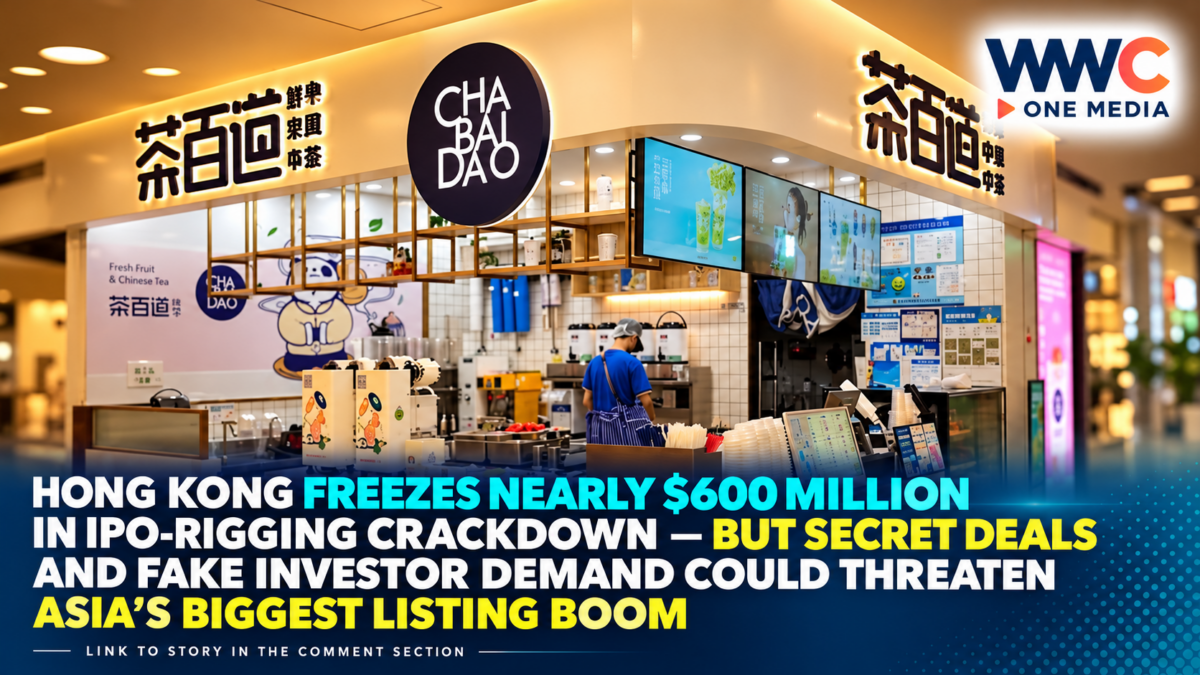
The warning follows major enforcement action on October 13, when the regulator restricted dealings in approximately HK$4.7 billion (US$599 million) in assets held through 31 brokerages and ordered the suspension of trading in shares of Sichuan Baicha Baidao Industrial Co., the operator of the ChaPanda bubble-tea chain.
The measures form part of investigations into suspected IPO-rigging syndicates accused of creating artificial demand for shares.
But the crackdown comes at a particularly sensitive moment.
Hong Kong is experiencing a surge in listings, fueled partly by Chinese technology and artificial intelligence companies seeking international capital.
As billions of dollars flow into new offerings, regulators are becoming increasingly concerned that some transactions may be supported by undisclosed financing, artificial subscriptions and arrangements designed to influence share prices.
The bigger question is whether Hong Kong can preserve its position as a leading global fundraising center while preventing questionable practices from undermining investor confidence.
Hong Kong Regulator Restricts Nearly $600 Million in Assets
On October 13, the SFC announced major enforcement measures targeting suspected IPO manipulation.
The regulator restricted dealings in approximately HK$4.7 billion in assets across 31 brokerage firms in connection with investigations into suspected rigging syndicates.
The measures are intended to preserve assets while the regulator examines the alleged arrangements.
They do not mean the 31 brokerages have all been found guilty of misconduct.
The distinction is significant because brokerages may hold client accounts affected by regulatory restrictions without the brokerage itself being accused of participating in the underlying suspected scheme.
The watchdog also directed the Hong Kong Stock Exchange to suspend trading in Sichuan Baicha Baidao Industrial Co., known by its consumer brand ChaPanda.
Regulators said they had serious concerns about possible manipulation of the company’s IPO.
The case has drawn attention to a broader question: whether apparent investor enthusiasm for some offerings reflects genuine market demand or financial arrangements that are hidden from ordinary shareholders.
How IPO Demand Can Be Artificially Inflated
An initial public offering allows a company to sell shares to investors and begin trading on a stock exchange.
During the offering process, investment banks collect indications of interest from potential buyers and help determine the number of shares to sell and the offer price.
The process is known as bookbuilding.
A heavily subscribed offering can signal strong investor demand and may encourage other investors to participate.
However, the SFC warned that demand can be distorted if subscriptions are financed by the listing company itself or supported through undisclosed financial guarantees.
For example, an investor may appear to be independently purchasing a substantial number of shares when the money has effectively come from the issuing company or an associated party.
In other situations, an investor may receive an undisclosed promise that losses will be covered or returns guaranteed.
Such arrangements can create the appearance of genuine investment interest while reducing the economic risk faced by selected participants.
The result can be misleading pricing and unfair treatment of investors who do not know about the arrangements.
Red Flag No. 1: Sudden Loans and Unusual Money Transfers
One of the regulator’s biggest concerns involves substantial payments, loans or investments made by a company preparing to list.
The SFC warned that companies may transfer money to prospective investors or connected parties shortly before or after an IPO.
If that money is then used to subscribe for shares, the transaction may create the impression that independent investors are supporting the offering.
The regulator is particularly concerned when these transfers occur after the most recent audited financial statements or close to the publication of the prospectus.
Such financial movements may require further investigation and disclosure.
The concern is not that every large loan or investment made before an IPO is improper.
Rather, unexplained transfers involving prospective shareholders can indicate that the company’s own funds are indirectly supporting demand for its shares.
Red Flag No. 2: Secret Agreements With Selected Investors
The SFC also identified undisclosed commitments between companies and investors as a major warning sign.
These arrangements may involve promises of future business opportunities, financial support, guaranteed returns or preferential treatment.
Some agreements may be reached before a company formally launches its offering.
Others may affect how shares are allocated once the order book opens.
If investors have been privately promised financial benefits, their subscriptions may not represent the same commercial risk faced by ordinary market participants.
This can undermine the fairness of the offering.
The regulator is therefore urging banks and sponsors to investigate arrangements that are inconsistent with normal commercial practice or have not been properly disclosed.
Red Flag No. 3: Huge Orders Arriving Just Before the Deadline
Another suspicious pattern involves large share subscriptions submitted near the close of an IPO order book.
Last-minute orders are not automatically evidence of misconduct.
However, they may warrant additional scrutiny if an investor has shown little previous interest in the offering or the order is unusually large relative to the investor’s known financial resources.
The SFC warned banks to investigate cases where substantial orders appear suddenly without a credible commercial explanation.
Such orders could influence the apparent level of demand and potentially affect pricing or allocation decisions.
The regulator expects intermediaries to examine these situations rather than accepting unusual subscriptions without appropriate checks.
Red Flag No. 4: Investors Whose Real Identity Is Hidden
The regulator is also concerned about arrangements that conceal the ultimate owners of shares.
Some investors may use derivatives or complex financial structures to obtain exposure to an IPO without appearing as the obvious beneficial owners.
In other cases, multiple investment accounts may be controlled by the same individual or entity.
If these connections are hidden, an offering may appear to have attracted a broad range of independent investors when a substantial portion of the shares is effectively controlled by a much smaller group.
That can weaken transparency and raise questions about public-shareholding requirements.
The SFC has reminded intermediaries of their responsibility to identify clients, understand beneficial ownership and challenge suspicious account structures.
Red Flag No. 5: Companies Interfering With Share Allocations
Hong Kong regulators also warned about listing applicants becoming unusually involved in selecting IPO investors.
Companies naturally have an interest in attracting long-term shareholders.
However, the regulator is concerned when their involvement exceeds the ordinary role expected during marketing and allocation.
For example, a company may seek to direct shares toward investors with whom it has undisclosed relationships.
Other warning signs include allocations that contradict previously agreed marketing strategies or involve accounts opened shortly before the offering.
Such arrangements can concentrate ownership in the hands of selected participants and undermine the independence of the bookbuilding process.
Regulators are urging investment banks to ensure that allocation decisions remain properly documented and compliant with applicable requirements.
Red Flag No. 6: Hidden Support for Share Prices After Listing
The SFC’s concerns extend beyond the initial sale of shares.
Some suspicious arrangements may involve efforts to maintain a company’s market capitalization or generate trading activity after the IPO.
Investors could be encouraged or financially supported to hold or trade shares in ways that create an artificial impression of market interest.
In particularly concerning cases, money may flow from the listed company to designated investors or connected parties.
Such arrangements could be part of broader market manipulation schemes.
The consequences may be especially serious for retail investors who purchase shares based on misleading price movements or trading volumes.
However, legitimate market-making, disclosed stabilization arrangements and ordinary investor trading should not be confused with illegal manipulation.
The regulator’s focus is on arrangements that improperly distort the market or are concealed from investors.
ChaPanda Trading Suspension Raises Fresh Questions
The crackdown has placed Sichuan Baicha Baidao Industrial Co., the operator of the popular ChaPanda bubble-tea chain, under renewed scrutiny.
The company raised approximately US$330 million through its Hong Kong IPO in April 2024.
Its shares fell around 27% on their first trading day and subsequently struggled to trade above their offering price.
On October 13, 2026, the SFC ordered the suspension of trading amid concerns that the IPO may have been manipulated.
Regulators are examining suspected arrangements designed to create an artificial impression of demand.
The investigation does not establish that the company’s executives or every participant in the original offering committed wrongdoing.
Any determination of liability will depend on the evidence and applicable legal proceedings.
Nevertheless, the case demonstrates how questionable IPO arrangements can attract regulatory scrutiny long after a company has begun trading.
Hong Kong’s IPO Boom Faces Growing Scrutiny
The enforcement action comes as Hong Kong enjoys a major resurgence in equity fundraising.
Chinese companies, particularly those linked to artificial intelligence, advanced technology and industrial supply chains, have been seeking to raise capital through the city’s stock exchange.
According to Reuters reporting in September, IPO and share-placement fundraising in Hong Kong reached approximately HK$651 billion during the first eight months of 2026, an increase of around 76% from the previous year.
That figure includes broader equity fundraising activity, not just conventional IPO proceeds.
The strength of the market has brought significant business to investment banks, law firms, auditors and financial advisers.
But the rapid expansion has also increased pressure on the institutions responsible for checking the quality of prospective listings.
Regulators are concerned that some IPO sponsors may be taking on too many transactions or failing to investigate business and financial claims thoroughly enough.
The challenge is ensuring that Hong Kong’s fundraising revival is supported by credible companies, transparent disclosures and genuine investor participation.
Regulators Suspend Review of 65 Listing Applications
The SFC’s October 13 supervisory update revealed that regulatory vetting had been suspended for 65 listing applications between January and September 2026.
Of those, 14 had resumed as of October 1 after the relevant concerns were resolved.
These suspensions reflect a broader effort to strengthen IPO due diligence and sponsor accountability.
The regulator identified problems involving insufficient business information, questionable revenue claims, inadequate investigation of major customer and supplier relationships, and weaknesses in explanations provided by sponsors.
In some cases, the regulator also raised concerns about business sustainability, persistent losses or the legality of proposed operations.
The SFC reported that the number of active listing applications in Hong Kong’s pipeline had increased to more than 610 by September, compared with more than 420 in January.
The figures show why stronger supervision has become increasingly important.
A growing deal pipeline creates opportunities for capital markets, but it also increases the workload faced by investment banks and regulatory authorities.
Investment Banks Face Tougher Responsibilities
The regulator has instructed IPO sponsors, overall coordinators and capital-market intermediaries to take a more active role in identifying suspicious transactions.
Banks are expected to investigate unusual share orders, examine undisclosed financial arrangements and verify the identities of investors.
Where concerns remain unresolved, intermediaries are expected to reject suspicious orders.
They must also escalate appropriate concerns to regulators and maintain records showing how potential warning signs were investigated.
The requirements could increase compliance costs and slow some transactions.
However, stronger scrutiny may also help protect investors from misleading offerings.
Banks involved in sponsoring IPOs can face substantial reputational and regulatory consequences if they fail to meet their responsibilities.
The SFC has made clear that commercial pressure to complete a listing does not remove an intermediary’s obligation to investigate suspicious circumstances.
Why the Crackdown Matters to International Investors
Hong Kong remains an important gateway linking Chinese companies with global investors.
Institutional funds, international banks and individual shareholders participate in its markets because of its established financial infrastructure and access to major Chinese businesses.
The credibility of the IPO process is therefore critical.
If investors believe share subscriptions can be artificially manufactured or that important financial arrangements are hidden, confidence in new listings could weaken.
That may lead to greater caution over valuations and stronger demands for transparency.
At the same time, decisive enforcement can strengthen the market’s reputation by demonstrating that regulators are willing to investigate suspected misconduct.
The outcome will depend on whether authorities can address questionable practices without unnecessarily obstructing legitimate fundraising.
Could Hong Kong’s Listing Boom Slow Down?
The immediate effect of tighter supervision may be greater scrutiny of IPO applications, share allocations and funding arrangements.
Some companies could face delays while sponsors provide additional information.
Others may need to revise proposed offerings or address disclosure deficiencies.
However, a broader collapse in Hong Kong’s IPO market is not an established outcome.
The city continues to attract significant interest from companies seeking public capital, including technology businesses and major mainland Chinese enterprises.
Regulatory action may ultimately improve the quality of listings and encourage more sustainable investor confidence.
The bigger risk would arise if undisclosed agreements and artificial demand were found to be widespread enough to undermine confidence in new share offerings.
For now, the evidence supports serious regulatory concerns and investigations, not a conclusion that the entire Hong Kong IPO market is fraudulent.
What Happens Next?
Investors will be watching for further updates on the suspected IPO-rigging syndicates, the trading suspension involving Baicha and any additional regulatory proceedings.
Investment banks are also likely to face closer examination of their underwriting practices and investor-allocation procedures.
The SFC has emphasized that market integrity remains central to Hong Kong’s financial competitiveness.
Future developments will help determine whether the enforcement campaign results in additional sanctions, changes to industry practices or stronger safeguards for investors.
For Hong Kong, the stakes are considerable.
The city is competing to attract major Chinese and international companies while maintaining its reputation as a transparent and reliable fundraising destination.
A booming IPO market can generate billions of dollars in investment opportunities.
But those opportunities depend on investors believing that share prices reflect genuine demand rather than hidden financial arrangements.
Hong Kong’s nearly US$600-million asset restrictions have exposed a serious regulatory challenge — but the bigger question is whether authorities can uncover suspicious IPO arrangements, restore confidence in the integrity of new listings and protect one of Asia’s most important financial markets from a deeper credibility crisis.