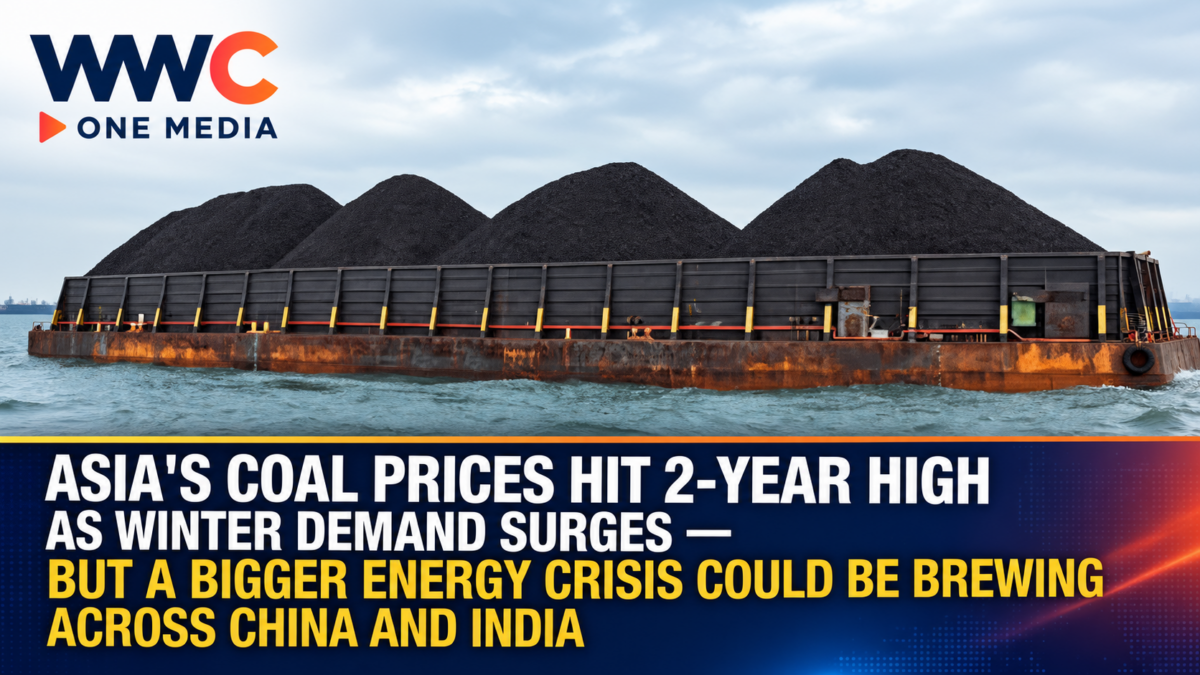
SINGAPORE — October 14, 2026 — Asia’s dependence on coal is proving far more difficult to reverse than expected, with thermal coal prices climbing to their highest levels in two years as winter approaches, electricity demand rises and supply disruptions squeeze major producers from China to Indonesia.
The rally comes at a critical moment for global energy markets, as the Middle East conflict sends oil and natural gas prices soaring, forcing Asian power producers to reconsider their fuel strategies.
Newcastle thermal coal futures, a major benchmark for coal shipped into Asia, have surged more than 40% since the beginning of 2026, closing on October 13 at their highest level since August 2024, according to Bloomberg.
The price increase reflects a powerful combination of seasonal demand, mining disruptions, higher transportation costs and growing concerns about energy security.
Despite international efforts to reduce coal consumption because of its environmental impact, the fuel is once again attracting attention from utilities seeking reliable electricity supplies.
The bigger question is whether Asia’s renewed reliance on coal represents a temporary response to an energy shock — or a longer-lasting shift that could complicate the global transition to cleaner energy.
Asian Coal Prices Reach Their Highest Levels in Two Years
Coal has become one of the unexpected beneficiaries of the global energy crisis.
As oil and natural gas prices rise, power companies are increasingly evaluating coal as a lower-cost alternative where their electricity systems can switch between fuels.
The financial incentive is substantial.
Reuters reported on October 9 that Australian thermal coal was approximately 80% cheaper than liquefied natural gas in Asia on a comparable energy-content basis.
That difference has encouraged utilities to maintain or increase coal purchases ahead of the northern hemisphere winter.
The situation is particularly important for China, Japan and South Korea, where colder weather can increase electricity and heating requirements.
Winter stockpiling is adding to demand at a time when major exporters are struggling to expand production.
With coal supplies tightening, buyers have become more willing to secure shipments in advance rather than risk higher prices or delivery disruptions later.
Morgan Stanley Raises Long-Term Coal Price Forecast
The market rally has prompted investment banks to reconsider their longer-term assumptions about coal.
Morgan Stanley analysts, including Amy Gower, recently raised their long-term forecast for Newcastle thermal coal prices by 4% to approximately $125 per metric ton.
The bank attributed the change partly to the impact of the Middle East energy crisis on fuel security and consumption.
This represents an important shift in expectations.
For years, the dominant assumption in energy markets has been that the growth of renewable power would eventually push thermal coal into sustained decline.
However, current disruptions are demonstrating that electricity systems still require dependable sources of power when gas becomes expensive or renewable output is insufficient.
Morgan Stanley’s forecast suggests that the economic case for coal may remain more resilient than previously anticipated.
But higher long-term price expectations do not guarantee sustained demand growth indefinitely.
Government climate policies, renewable investment, battery storage and future natural gas prices could still alter the market.
Global Coal Demand May Reach Another Record in 2026
The International Energy Agency has revised its outlook for coal consumption as energy security concerns intensify.
According to Bloomberg’s October 14 report, the IEA shifted from expecting global coal demand to decline in 2026 to forecasting a 1.2% increase, potentially taking consumption to another record.
The reversal highlights the effect of expensive oil and gas on electricity generation decisions.
Coal remains widely available, relatively easy to store and important for maintaining power supply in many developing economies.
Countries facing higher natural gas costs may therefore increase coal generation when their existing infrastructure allows it.
However, this increased reliance comes with an environmental cost.
Coal produces more carbon dioxide per unit of electricity than natural gas and contributes significantly to air pollution.
A sustained increase in coal-fired generation would make international climate targets more challenging.
China’s Coal Market Faces a Major Supply Squeeze
China, the world’s largest coal consumer and producer, is at the center of Asia’s tightening market.
Domestic thermal coal prices have climbed sharply as mine disruptions and safety restrictions constrain production.
On October 12, the benchmark coal price tracked by the China Coal Transportation and Distribution Association reached approximately 1,004 yuan per metric ton, its highest level in three years.
Prices have risen by roughly 25% since mid-July.
Part of the pressure stems from stricter mining safety inspections following a fatal accident in Shanxi province in May.
Authorities introduced safety measures that reduced output from affected mining operations.
The production slowdown has coincided with higher energy demand and difficulties obtaining competitively priced imported coal.
China continues expanding renewable energy and battery storage, but coal still provides a substantial share of the country’s electricity.
That dependence makes the market sensitive to even temporary disruptions in domestic production.
Indonesia’s Coal Supply Restrictions Tighten Regional Markets
Indonesia, the world’s largest thermal coal exporter, is another major contributor to the supply squeeze.
The country has been managing coal production through government quotas while some mining regions have experienced drought-related disruptions.
Lower water levels have complicated the movement of coal by barge from inland mines to export ports.
This matters because river transportation is an important part of Indonesia’s coal logistics network.
Restrictions on mining output, combined with transportation problems, have reduced the availability of export cargoes.
According to industry data reported by the Indonesian Coal Mining Association, Asia’s seaborne thermal coal imports fell to approximately 70.04 million metric tons in September.
That represented a decline of 7.25% from a year earlier and 5.14% from August.
The figures show that physical coal trading volumes have weakened even as prices have risen.
This illustrates a market where constrained supply and strong demand for available cargoes can support higher prices despite lower overall shipments.
India Faces Electricity Shortages as Coal Stockpiles Shrink
India is confronting a particularly difficult energy situation.
A weak monsoon has reduced hydropower generation, while unusually hot weather has increased electricity consumption for cooling and agricultural irrigation.
As a result, coal-fired power stations have been required to generate more electricity.
Reuters reported on October 13 that India’s coal-fired generation increased 13.3% year on year in September, while hydropower production declined approximately 20%.
Electricity shortages reached 560 million kilowatt-hours during September, the highest monthly shortfall since August 2023.
The pressure has created disruptions for industrial businesses and households.
Bloomberg reported on October 12 that factories, metal smelters and smaller businesses had experienced blackouts as coal stocks at power stations declined.
Some industrial customers have also struggled to obtain sufficient coal because priority has been given to grid-connected power plants.
The situation highlights the importance of reliable fuel supplies for India’s expanding economy.
More Than Half of India’s Coal Plants Face Low Inventories
Although coal transportation has improved in October, inventories remain under pressure.
India’s coal supply data showed that 107 of 191 monitored power plants had stocks sufficient for only zero to five days as of October 10.
Total coal inventories at domestic coal-based stations stood at approximately 18.2 million metric tons.
Improved railway transportation has helped increase deliveries.
Average daily coal train loading rose from around 426 rakes in September to 469 during early October, an increase of approximately 10%.
The improvement has slowed the rate at which inventories are being depleted.
However, the continued presence of plants with very limited stocks means that supply interruptions could still create electricity shortages.
India’s challenge is not simply producing enough coal nationally, but transporting it to the power stations that need it most.
India May Need Up to 150 GW of Additional Coal Power Capacity
The country’s long-term electricity requirements are also growing rapidly.
Reuters reported on October 13 that India’s Central Electricity Authority believes the nation may need to add between 105 and 150 gigawatts of coal-fired generating capacity to meet rising demand.
The projection exceeds an earlier plan for approximately 97 gigawatts of additional capacity by 2035.
India currently has around 230 gigawatts of installed coal-fired capacity.
The latest projections reflect growing electricity consumption from industrial activity, urbanization, air-conditioning and wider economic development.
At the same time, India continues investing in renewable energy.
Officials say solar and wind capacity must be supported by reliable electricity sources, including coal, nuclear power and pumped-storage hydropower, particularly when demand rises after sunset.
This creates a major policy challenge: maintaining electricity reliability while reducing the emissions intensity of economic growth.
Winter Could Trigger Another Wave of Coal Imports
Seasonal demand may provide additional support to the coal market during the final quarter of 2026.
Reuters analysis indicates that Asian utilities traditionally increase purchases ahead of winter, particularly in China, Japan and South Korea.
If historical patterns repeat, combined coal exports from Indonesia and Australia could rise by nearly 30 million metric tons in the fourth quarter compared with the third quarter.
However, that outcome depends on whether mines and transportation networks can deliver sufficient supplies.
Supply disruptions, production quotas or prolonged drought could limit the expected recovery.
Higher coal prices may also encourage some buyers to reduce purchases, draw on stockpiles or use alternative fuels where available.
The balance between these responses will help determine whether prices remain elevated through the winter.
Higher Oil Prices Are Making Coal More Expensive to Produce
One of the more surprising developments is that expensive oil is both increasing demand for coal and raising coal production costs.
Diesel powers mining equipment, heavy trucks and many transportation operations.
As diesel prices climb, coal producers face higher expenses.
Those costs can affect mining profitability and the prices producers charge customers.
In some markets, industrial companies are also switching from expensive oil-based fuels or feedstocks toward coal-related alternatives.
The result is a complicated market where oil prices influence coal through several channels.
Expensive oil and gas can make coal more competitive for certain uses, but higher diesel costs can make coal mining and delivery more expensive.
This reinforces the importance of monitoring the wider energy market rather than coal prices alone.
What This Means for the Philippines and Southeast Asia
The regional coal rally has important implications for the Philippines, where coal-fired power stations remain a major source of electricity.
Higher international coal prices can increase fuel procurement costs for generators that rely on imported coal or market-linked supply contracts.
Depending on contractual arrangements and regulatory rules, those higher costs may eventually influence electricity generation charges.
However, increases in international coal prices do not automatically produce identical increases in household electricity bills.
Local tariffs also reflect fuel inventories, exchange rates, power supply agreements, transmission charges and other regulated components.
Indonesia’s production and logistics problems are especially relevant to Southeast Asian importers because of the country’s importance as a regional coal supplier.
For Philippine businesses, sustained fuel-cost pressures could create additional uncertainty for operating expenses.
More expensive electricity can affect manufacturing, commercial establishments and energy-intensive industries.
The situation also reinforces the importance of developing additional generation capacity, grid infrastructure, storage and diversified sources of energy.
The Climate Challenge: Energy Security Versus Emission Reductions
Asia’s renewed reliance on coal exposes a central contradiction in the global energy transition.
Governments want to reduce dependence on fossil fuels, but they also need to provide affordable and reliable electricity.
When natural gas becomes exceptionally expensive or supply becomes uncertain, existing coal power stations can offer an alternative.
Yet coal has a substantial environmental impact.
Higher consumption can increase greenhouse gas emissions and worsen local air pollution.
The challenge for policymakers is ensuring that near-term energy security measures do not unnecessarily lock economies into higher emissions for decades.
That could require accelerating renewable deployment, transmission upgrades, storage investments, energy efficiency and the development of reliable alternatives to coal generation.
Five Factors That Could Determine Coal’s Next Move
1. Winter electricity demand: Colder weather in China, Japan and South Korea could increase coal consumption and stockpiling.
2. Chinese mining output: A recovery in production following safety inspections could ease pressure on domestic and imported coal prices.
3. Indonesian export supply: Government production quotas, river transportation and weather conditions will influence available shipments.
4. India’s power shortages: Continued weak hydropower generation and low coal inventories could increase demand for alternative electricity supplies and additional coal.
5. Global oil and LNG prices: A decline in competing fuel prices could reduce incentives to switch toward coal, while further energy disruptions could strengthen demand.
The Bigger Picture: Coal’s Comeback Exposes Asia’s Energy Security Dilemma
The latest rally demonstrates that coal remains deeply embedded in Asia’s electricity systems despite years of international pressure to accelerate the shift toward cleaner energy.
China continues expanding renewable power but still needs coal to support its electricity system.
India faces rapidly growing demand and limited fuel inventories.
Indonesia is balancing export supply with government production policy and logistical difficulties.
Meanwhile, Japan and South Korea are preparing for winter amid elevated natural gas prices.
These competing pressures have helped lift coal prices to their highest levels in two years.
But the industry’s near-term resilience does not establish that the transition away from coal has permanently reversed.
Future demand will depend on energy prices, economic growth, climate policies and how rapidly alternatives become capable of supplying dependable electricity.
Asia’s coal market is booming as winter approaches, but the deeper warning is that the world’s transition to cleaner energy may face a much tougher test when electricity shortages, supply disruptions and soaring fuel costs collide.