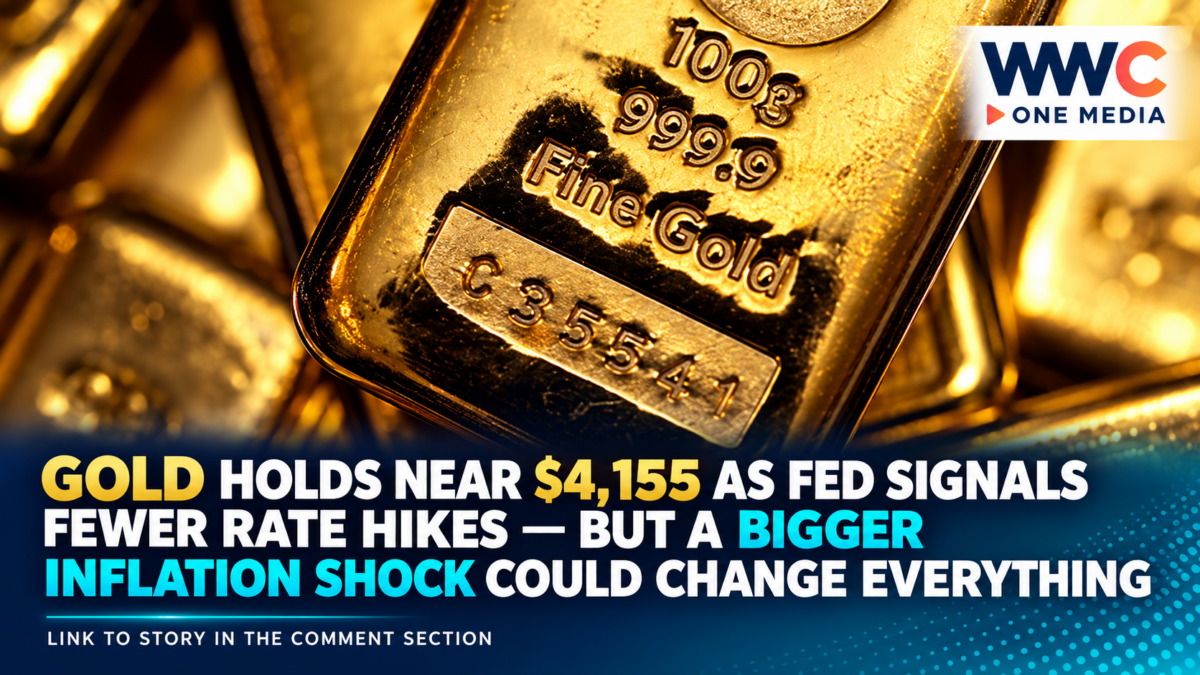
SINGAPORE / NEW YORK, October 14, 2026 — Gold prices steadied near $4,155 an ounce on Wednesday as investors reassessed the Federal Reserve’s interest-rate outlook following comments from a senior US central bank official suggesting that monetary tightening may be approaching its final stages.
The precious metal found some support after New York Federal Reserve President John Williams indicated that another interest-rate increase may be appropriate before the end of 2026, but additional tightening might not be necessary in 2027.
The remarks offered some relief to bullion investors concerned that persistently high inflation and rising borrowing costs could place further pressure on gold.
However, the outlook remains uncertain as escalating Middle East tensions threaten global energy supplies, while upcoming US inflation data could determine whether the Federal Reserve maintains its cautious approach or adopts a more aggressive stance.
Gold’s next major move may depend on whether inflation cools sufficiently to prevent another round of interest-rate increases.
Gold Prices Stabilize After Two-Day Decline
According to Bloomberg, spot gold traded near $4,155 an ounce during early Asian trading on October 14, after losing approximately 0.8% over the previous two sessions.
At 8:05 a.m. Singapore time, spot bullion slipped 0.1% to $4,157.37 an ounce.
Other precious metals showed mixed performance:
- Gold: $4,157.37 per ounce, down 0.1%
- Silver: $59.04 per ounce, down 0.2%
- Platinum: Down 0.4%
- Palladium: Little changed
The Bloomberg Dollar Spot Index was broadly unchanged after declining 0.2% in the previous session.
The relatively stable dollar and easing Treasury yields helped reduce some of the immediate pressure on bullion.
Gold typically benefits when bond yields fall because the opportunity cost of holding the non-interest-bearing metal becomes less significant.
However, its relationship with interest rates is not automatic, particularly during periods of geopolitical tension or financial-market uncertainty.
Fed Official Signals One More Rate Hike Could Be Enough
The latest developments followed remarks from New York Fed President John Williams, who suggested that another increase in US interest rates could be appropriate this year.
His comments also indicated that the Federal Reserve might not need further rate increases in 2027 if inflation and economic conditions evolve as expected.
That distinction is important for financial markets.
Investors have spent much of 2026 adjusting their expectations as persistent inflation, expensive energy and strong demand associated with artificial intelligence investment have complicated the Federal Reserve’s efforts to stabilize prices.
In September, the central bank raised its benchmark interest-rate range by 25 basis points to 3.75%–4.00%, its first increase since 2023.
The possibility of a more limited tightening cycle has offered support to gold, which generally faces stronger competition from bonds and cash when interest rates climb.
Still, Williams did not guarantee an end to monetary tightening.
Future decisions will depend on inflation, economic activity and financial conditions.
Markets See October Pause but December Hike Still Possible
Interest-rate traders are increasingly betting that the Federal Reserve will leave borrowing costs unchanged at its October 27–28 policy meeting.
According to Bloomberg, swaps markets saw only a low probability of an October increase but assigned roughly a 90% probability to a hike in December.
Reuters separately reported that investors were pricing in a 77% chance of unchanged rates at the October meeting.
These estimates reflect different market instruments and observation times, but both indicate that investors consider an immediate increase less likely than another move later in the year.
Market expectations can change rapidly following important economic releases or comments from central bank officials.
That makes Wednesday’s US consumer price index report a crucial event for investors.
US Inflation Data Could Determine Gold’s Next Direction
The September US consumer price index is expected to offer fresh evidence about whether inflation is cooling or remaining stubbornly elevated.
Analysts cited by MarketWatch expected core consumer prices, which exclude volatile food and energy costs, to increase approximately 0.2% from the previous month.
Headline inflation was expected to rise more sharply because of higher energy prices.
For gold investors, the difference between those figures matters.
If underlying inflation slows, traders may become more confident that the Federal Reserve can delay additional rate hikes.
That could put downward pressure on Treasury yields and the US dollar, potentially helping gold recover.
However, stronger-than-expected inflation could revive expectations of more aggressive monetary tightening.
Such an outcome could make interest-bearing assets more attractive and create renewed selling pressure in precious metals.
The market reaction will also depend on whether the data materially differs from investors’ existing expectations.
Middle East Conflict Adds Another Layer of Uncertainty
While Federal Reserve policy remains a major driver of gold prices, developments in the Middle East are complicating the outlook.
Reuters reported on October 14 that Brent crude climbed to approximately $106.58 per barrel, while US West Texas Intermediate crude advanced to around $94.94.
The increases came as traders evaluated threats to Saudi Arabian energy infrastructure and wider supply disruptions associated with regional conflict.
Oil prices matter because sustained energy inflation can spread through transportation, manufacturing and household expenses.
That can force central banks to maintain tighter monetary policy for longer.
For gold, the implications are mixed.
Geopolitical instability can increase demand for safe-haven assets, including bullion.
But if higher oil prices strengthen inflation expectations and push interest rates upward, gold could face pressure from rising bond yields and a stronger dollar.
This creates a difficult environment in which geopolitical risks can both support and undermine precious-metal prices.
Gold Has Already Experienced a Volatile 2026
The latest stabilization follows a difficult period for bullion.
Reuters reported on October 9 that gold had climbed to a one-week high of $4,194.36 an ounce, supported by bargain hunting, a softer dollar and easing Treasury yields.
The recovery followed an earlier decline to a two-month low.
Gold also suffered significant losses in September as higher energy costs, rising bond yields and expectations of further US monetary tightening reduced investors’ appetite for the metal.
Despite those pressures, gold continues to attract attention as a potential portfolio diversifier and hedge against financial instability.
However, its reputation as a safe-haven asset does not guarantee that prices will rise during every crisis.
Gold can experience substantial losses, particularly when rising interest rates and a stronger dollar outweigh defensive demand.
What Does This Mean for Gold Buyers in the Philippines and Asia?
The global movement in bullion prices is also important for investors and consumers across Asia, particularly in countries where gold jewelry, savings products and precious-metal investments remain popular.
In the Philippines, international gold prices influence local market valuations, although the exchange rate between the US dollar and Philippine peso also matters.
Because global gold is generally quoted in dollars, changes in the peso can affect the local cost of gold even when the international market price remains relatively stable.
A weaker peso can increase the peso-denominated cost of imported bullion, while a stronger peso can partly offset higher international prices.
Local gold jewelry prices also reflect fabrication costs, retailer margins, purity, taxes and other charges.
For investors considering gold, these factors can significantly influence the difference between the international spot price and the actual purchase or resale price.
Five Major Factors That Could Move Gold Prices Next
1. US inflation data: A hotter-than-expected consumer price reading could increase expectations of further Federal Reserve tightening.
2. Federal Reserve statements: Comments from central bank officials may determine whether investors expect one additional rate hike or a longer tightening cycle.
3. US Treasury yields: Rising yields generally increase competition for gold, while falling yields can support bullion.
4. The US dollar: A stronger dollar can make gold more expensive for buyers using other currencies, potentially limiting international demand.
5. Middle East energy risks: Further oil supply disruptions could generate safe-haven buying but also revive inflation fears.
Together, these forces could produce substantial short-term price volatility.
The Bigger Picture: Gold’s Next Move May Be Decided by the Fed
Gold’s stabilization near $4,155 reflects a market balancing two powerful and competing forces.
On one side, suggestions that US interest-rate increases may be approaching an end have helped ease pressure on precious metals.
On the other, persistent inflation, elevated oil prices and geopolitical uncertainty continue to threaten that outlook.
For investors, the coming inflation figures and subsequent Federal Reserve decisions will provide important evidence about whether the current period of monetary tightening is nearing its conclusion.
A more restrained interest-rate outlook could support gold’s recovery.
But renewed inflation pressures could quickly reverse market expectations and expose bullion to another bout of selling.
Gold may have found temporary stability near $4,155 — but whether that becomes the foundation for a sustained recovery or merely a pause before another correction could depend on the Federal Reserve’s next move.