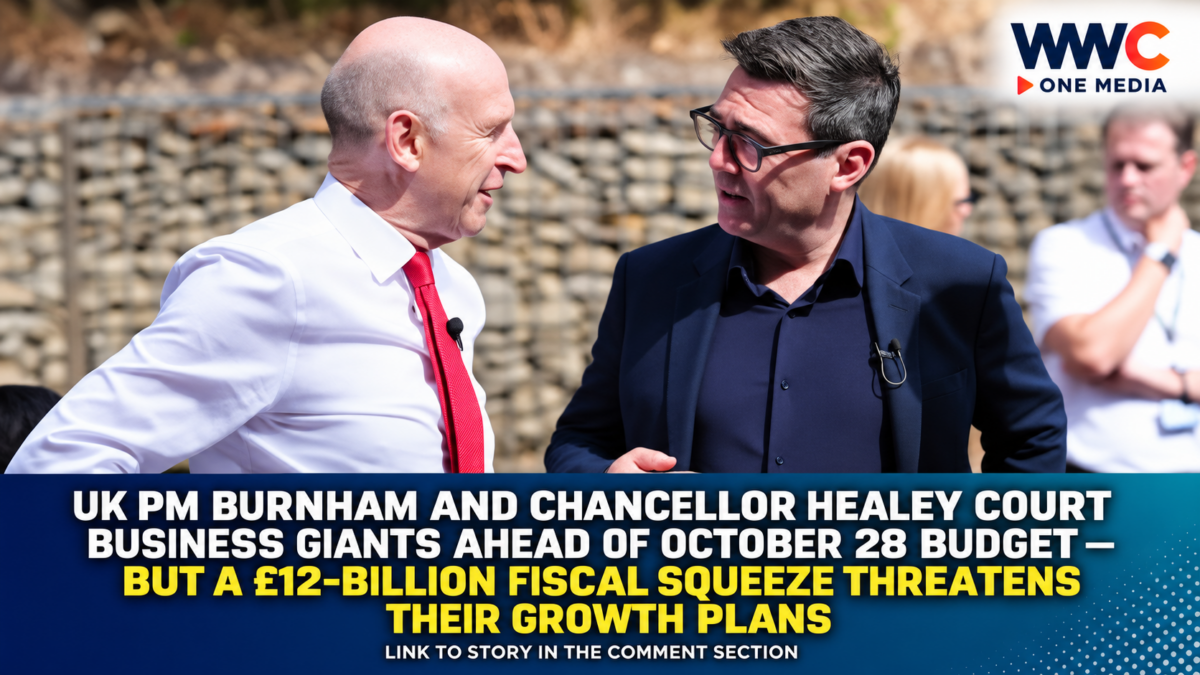
LONDON, United Kingdom — October 14, 2026 — British Prime Minister Andy Burnham and Chancellor of the Exchequer John Healey are intensifying efforts to rebuild confidence among the country’s biggest employers ahead of a crucial government Budget that could determine the direction of taxation, investment and economic growth.
The Labour government held a series of meetings with business leaders on October 13, seeking to reassure executives concerned about rising employment costs, high energy prices and the possibility of further tax increases.
Burnham hosted entrepreneurs and corporate executives at Downing Street, while Healey met leaders from the retail, hospitality and leisure industries.
The outreach followed Bloomberg’s October 12 report that both officials were preparing to engage directly with business executives before the October 28 Budget.
But the meetings come at a difficult moment for Britain’s public finances.
Rising government borrowing costs and the economic consequences of the Middle East conflict have reportedly reduced the Chancellor’s available fiscal buffer from approximately £23.6 billion to about £12 billion.
That leaves Healey facing competing demands: businesses want tax relief, households want protection from rising living costs, and financial markets expect the government to demonstrate fiscal discipline.
Burnham and Healey are promising to listen to Britain’s biggest employers. But the real test will come on October 28, when the government must show whether it can support business growth without triggering another tax shock or undermining investor confidence.
Burnham Invites Business Leaders to Downing Street
The Prime Minister’s outreach was designed to strengthen relations between Labour and corporate Britain.
Bloomberg reported on October 12 that Burnham would host a gathering of leading entrepreneurs and chief executives at Downing Street.
The event brought together executives from established companies and newer technology businesses.
Its focus was the relationship between government policy, corporate investment and economic growth.
The meetings followed concerns about Burnham’s economic philosophy and his previous criticism of financial-market influence over public policy.
Some investors have questioned whether the government intends to adopt higher taxes or a more interventionist economic approach.
The Prime Minister has sought to counter those concerns by emphasizing his record of working with businesses during his time as mayor of Greater Manchester.
The Financial Times reported on October 14 that Burnham reassured executives of the government’s commitment to a pro-business and pro-growth environment.
However, an encouraging meeting is not equivalent to a formal policy commitment.
Businesses will ultimately judge the government by the measures announced in the Budget.
Healey Meets Britain’s Biggest Retail and Hospitality Companies
At the same time, Chancellor John Healey held discussions with executives from major high-street businesses.
According to Sky News and The Guardian, the meeting included leaders associated with Tesco, Marks & Spencer, Sainsbury’s, Costa Coffee and the Co-op.
The discussions focused on the costs facing retailers, hospitality operators and smaller businesses.
Employers raised concerns about National Insurance contributions, business rates and the difficulty of creating jobs.
The talks took place at No. 11 Downing Street on October 13.
Among the executives identified by The Guardian were Marks & Spencer chief executive Stuart Machin and Sainsbury’s chief executive Simon Roberts.
Helen Dickinson, chief executive of the British Retail Consortium, also participated.
The retail industry has argued that rising taxes and employment costs are making it more difficult to hire workers and maintain competitive prices.
Healey acknowledged those concerns and emphasized the government’s ambition to support economic growth.
However, no broad tax-relief package was formally announced at the meeting.
Employers Want Relief From National Insurance Costs
One of the most important issues concerns employer National Insurance contributions.
Changes introduced under former Chancellor Rachel Reeves lowered the annual earnings threshold at which employers begin paying National Insurance from £9,100 to £5,000.
Businesses argue that the change increased employment costs, especially for companies relying on part-time and lower-paid workers.
Retailers and hospitality operators have been particularly vocal because they employ substantial numbers of young people.
At the October 13 meeting, business representatives called for the threshold to be increased to £6,000.
That would partially reverse the earlier change.
Supporters argue that the adjustment could make it more affordable to hire entry-level employees.
They also say it could help reduce pressure on retail prices.
But the proposal would have a cost for government revenue.
The Chancellor must therefore weigh potential employment benefits against the need to maintain public finances.
No decision to raise the threshold had been confirmed as of October 14.
Britain’s Youth Employment Crisis Adds Urgency
The debate over employment costs is closely connected to concerns about young people struggling to find work.
Retail and hospitality jobs have traditionally provided important entry points into the labour market.
They offer experience, income and opportunities for career progression.
But employers argue that higher payroll costs make it more expensive to provide those opportunities.
The government’s review of youth employment, led by former Labour minister Alan Milburn, has examined ways to improve access to work and training.
Milburn has proposed a pre-apprenticeship programme intended to help young people gain the skills and experience needed for employment.
The policy discussion comes amid concerns about the number of young people not in education, employment or training.
However, youth unemployment has multiple causes.
Employer taxes are one factor, alongside skills mismatches, economic conditions and changes in recruitment.
It would be inaccurate to attribute the entire youth employment problem to National Insurance policy.
Business Leaders Warn Against Another Tax Shock
The October discussions follow repeated warnings from business organizations.
Employers have argued that additional tax increases could weaken investment and discourage hiring.
Financial institutions have also expressed concerns about potential changes to the taxation of banking and investment.
Banks say higher sector-specific taxes could reduce their capacity or willingness to lend.
Retailers argue that employment-related tax increases can eventually be passed on to consumers or absorbed through lower profit margins.
The British Retail Consortium has warned that the sector is already facing billions of pounds in additional employment costs.
Business leaders have also called for greater predictability.
They argue that investment decisions become harder when companies are uncertain about future tax treatment.
But the Treasury must also consider demands for public services, infrastructure investment and fiscal sustainability.
The government faces pressure from both sides.
Chancellor Reportedly Rules Out Full Capital Gains Tax Equalisation
One important development emerged after Bloomberg’s original October 12 report.
The Financial Times reported on October 14 that Healey had rejected proposals to align capital gains tax rates fully with income tax rates.
Reuters separately reported the development on October 13.
Capital gains tax applies to profits from certain asset sales, including shares and property investments.
The UK currently applies standard capital gains tax rates of 18% and 24%, depending on the taxpayer’s circumstances.
Income tax rates are generally higher for some taxpayers.
Some Labour figures and policy researchers have argued that aligning the rates would make the tax system fairer and raise additional revenue.
However, business and investment groups have warned that large increases could discourage investment or encourage investors to delay asset disposals.
Healey has reportedly ruled out full equalisation.
A smaller increase in capital gains tax has not been definitively excluded.
Crucially, the Treasury has emphasized that tax decisions are announced through formal fiscal events.
The October 28 Budget remains the authoritative statement of government policy.
A £12-Billion Fiscal Squeeze Complicates the Budget
The government’s financial constraints have intensified in recent weeks.
According to Financial Times analysis, higher borrowing costs and other economic pressures have reduced the fiscal buffer available to the Treasury.
The buffer had been estimated at approximately £23.6 billion in March.
It is now thought to be closer to £12 billion.
That is a substantial reduction.
The figure refers to estimated fiscal headroom under government borrowing rules.
It is not a cash reserve sitting in a bank account.
Fiscal headroom measures the projected margin between government finances and the limits set by its fiscal rules.
A smaller buffer means the government has less room to absorb negative economic developments without changing taxes, spending or borrowing plans.
The situation is particularly challenging because Healey has pledged to maintain fiscal credibility.
A Budget that appears insufficiently funded could increase anxiety in bond markets.
But aggressive tax increases or spending cuts could weaken economic activity.
Higher UK Bond Yields Create Additional Pressure
Government borrowing costs are an important part of the problem.
The UK finances part of its spending by issuing government bonds, known as gilts.
When gilt yields rise, new borrowing becomes more expensive.
Higher interest costs can also increase the projected expense of servicing government debt.
British bond yields have increased sharply amid global financial-market volatility and geopolitical tensions.
The rise has reduced the government’s room to introduce new spending commitments.
The pressure also affects households and businesses.
Mortgage lenders use financial-market funding costs and interest-rate expectations when pricing some products.
Higher bond yields can therefore contribute to more expensive borrowing across the economy.
This is why investors are closely watching the Budget.
If the government announces unfunded commitments or weakens confidence in its fiscal strategy, market pressure could intensify.
However, gilt yields are influenced by many factors, including inflation, global interest rates and investor demand.
The Budget is important, but it is not the only driver.
Iran Conflict Adds to Britain’s Economic Problems
The continuing conflict involving Iran has disrupted global energy markets and contributed to increased economic uncertainty.
Higher oil and gas prices can raise costs for households and companies.
They can also complicate inflation forecasts.
For the government, higher inflation and interest rates may increase certain spending obligations and borrowing costs.
The Financial Times estimated that the energy shock and associated market developments had significantly reduced Britain’s fiscal headroom.
Healey has emphasized the need for governments to prepare for global economic disruptions.
Ahead of international financial meetings, Reuters reported that the Chancellor would urge major economies to adopt credible plans for controlling borrowing.
That position illustrates the tension facing the Treasury.
Healey wants to support the domestic economy while convincing investors that the government remains committed to financial discipline.
The IMF Offers Some Encouraging News
Not every economic indicator is negative.
The International Monetary Fund has upgraded its UK growth forecast for 2026.
Its latest outlook projects economic expansion of approximately 1.3% this year.
That represents a 0.5-percentage-point improvement from its April forecast.
The IMF identified investment associated with artificial intelligence and stronger activity in certain sectors as contributing factors.
However, it expects UK growth to moderate to approximately 1.2% in 2027.
The forecasts suggest that the economy has shown resilience despite global uncertainty.
But moderate growth does not eliminate the challenges facing public finances or individual businesses.
The government must still address weak productivity in some sectors, employment pressures and the costs of energy and housing.
The growth upgrade provides encouraging context.
It is not a guarantee that the Budget will succeed.
Retailers Fear Further Pressure on Consumer Spending
Higher operating costs can affect consumers through several channels.
Retailers may raise prices to recover additional expenses.
They may reduce staffing or limit opening hours.
Some businesses may postpone expansion plans.
Others could close locations that are no longer commercially viable.
For households already facing elevated energy and living costs, additional retail price increases could weaken purchasing power.
The British Retail Consortium has warned that employment-related tax increases may ultimately affect customers.
However, businesses do not always pass every cost increase directly to shoppers.
Competitive pressures, profit margins and consumer demand influence pricing decisions.
The impact will vary among retailers.
The industry’s central request is for a Budget that reduces rather than increases the cost of employing workers.
Hospitality Businesses Want Help With Rates and Energy Bills
Restaurants, pubs, hotels and other hospitality businesses have also been affected by rising operating costs.
Energy bills, wages, rent and business rates all influence profitability.
The sector often depends on discretionary consumer spending.
When household budgets are under pressure, customers may reduce dining out, travel and entertainment expenses.
Industry representatives have called for changes to business rates and employment taxes.
The government has previously indicated that it wants to support high-street businesses.
However, the Budget must determine which measures can be funded.
Targeted relief may be possible.
A comprehensive reduction in business taxation would require a larger fiscal commitment.
Banks Are Watching for Possible New Levies
The banking sector has also entered the pre-Budget debate.
Healey has met financial-services representatives amid speculation about potential tax changes.
Industry groups have warned that new bank taxes could make the UK less competitive.
They argue that additional levies may affect investment and lending decisions.
The government, however, must consider whether the financial sector should contribute more to public revenue.
Banks have benefited from certain financial conditions, but their earnings and business models vary.
A tax targeting the sector could generate revenue while also affecting incentives and profitability.
The final impact would depend on the structure of any measure.
As of October 14, no new comprehensive bank-tax package had been formally confirmed for the October 28 Budget.
Technology and AI Investment Are Part of the Growth Strategy
Burnham’s outreach also includes technology businesses and investors.
The government has identified innovation and investment as important sources of economic growth.
Artificial intelligence is a particularly important area.
The UK’s technology sector includes software companies, AI developers, financial-technology businesses and research institutions.
Stronger investment could support productivity and high-value employment.
However, technology growth alone cannot resolve every economic challenge.
Large parts of the UK economy depend on retail, healthcare, manufacturing, construction and public services.
The government will need policies that support both advanced industries and traditional employers.
The challenge is creating a credible growth strategy without undermining fiscal stability.
Business Confidence Becomes a Test of Burnham’s Leadership
The outreach is also politically important.
Burnham became prime minister after previously serving as mayor of Greater Manchester.
His economic rhetoric has sometimes emphasized stronger public intervention and reduced dependence on financial-market priorities.
That position has concerned some business figures.
The Prime Minister is now attempting to demonstrate that his government can work constructively with private companies.
The meetings provide an opportunity to hear concerns directly and explain policy objectives.
But reassurance must eventually be followed by measurable action.
Executives will assess the government according to taxation, regulation, access to capital and economic performance.
A successful pre-Budget charm offensive could improve relationships.
An unpopular Budget could quickly reverse those gains.
What the October 28 Budget May Prioritize
The government faces several competing policy demands.
Among the issues under consideration or public discussion are employer National Insurance costs, business rates, capital gains tax, financial-sector taxation, household energy support and employment programmes.
Defence spending and social care also require significant resources.
The Treasury must determine how to balance these demands with fiscal rules.
Not every proposal discussed publicly will appear in the final Budget.
Some ideas may be rejected.
Others could be modified or deferred.
The government has not yet published its complete tax and spending measures.
For that reason, predictions should be treated as scenarios rather than confirmed policy.
Why International Investors Are Watching
The UK remains an important financial centre.
Its bond, equity and currency markets influence global investment decisions.
International companies also operate major businesses in Britain.
A Budget perceived as fiscally credible could help stabilize confidence.
Measures encouraging investment could support longer-term growth.
But unexpected tax increases or doubts over borrowing plans could unsettle investors.
The October 28 statement will therefore be assessed beyond Westminster.
Financial institutions, multinational companies and sovereign investors will examine both the announced measures and their broader economic implications.
However, market reactions are not predetermined.
Investors will compare the Budget with expectations, economic conditions and global market developments.
What the Philippines and Asia Should Watch
The UK economy has important links with Asia through trade, finance, education, technology and business services.
British financial institutions operate internationally.
Asian companies invest in UK businesses, property and infrastructure.
Changes to British taxes or investment rules can influence corporate decisions.
For the Philippines, the UK is also a destination for workers, students and business relationships.
However, the October 13 meetings did not announce any specific change to Philippine trade arrangements or overseas employment policies.
The relevance is broader.
A successful UK growth strategy may support business confidence and international investment.
A deterioration in fiscal conditions could influence global financing costs and currency markets.
Any direct local effect would require separate evidence.
Five Developments to Watch Before the Budget
1. October 28 tax announcements
The final Budget will clarify whether employer taxes, capital gains tax or financial-sector levies change.
2. Fiscal headroom
Investors will assess how much room remains under the government’s borrowing rules.
3. Business rates
Retailers and hospitality companies will watch for measures affecting high-street operating costs.
4. Youth employment
Any reduction in employer costs or new training initiatives could influence hiring.
5. Financial-market reaction
Bond yields, sterling and UK equities may respond to the Budget and its economic forecasts.
These developments will show whether the government’s business outreach has translated into policies capable of improving confidence.
The Bigger Question: Can Burnham and Healey Rebuild Trust Without Raising Taxes?
Britain’s pre-Budget meetings reveal a government trying to repair its relationship with business at a difficult economic moment.
The Prime Minister wants stronger private investment.
The Chancellor wants sustainable public finances.
Retailers want lower employment costs.
Banks want protection from additional taxes.
Households need relief from rising living expenses.
And financial markets expect credible borrowing plans.
There is no simple solution that satisfies every group.
Lower taxes may support investment but reduce government revenue.
Higher spending may help public services but place pressure on borrowing.
Greater fiscal restraint may reassure investors while limiting economic stimulus.
The Budget will therefore be a test of the government’s ability to balance conflicting priorities.
Burnham and Healey have opened the doors of Downing Street to Britain’s business leaders. But the bigger challenge is still ahead: With fiscal headroom nearly halved and employers warning against more taxes, can the government deliver a genuinely pro-growth Budget — or will October 28 expose how little room Britain has left to manoeuvre?