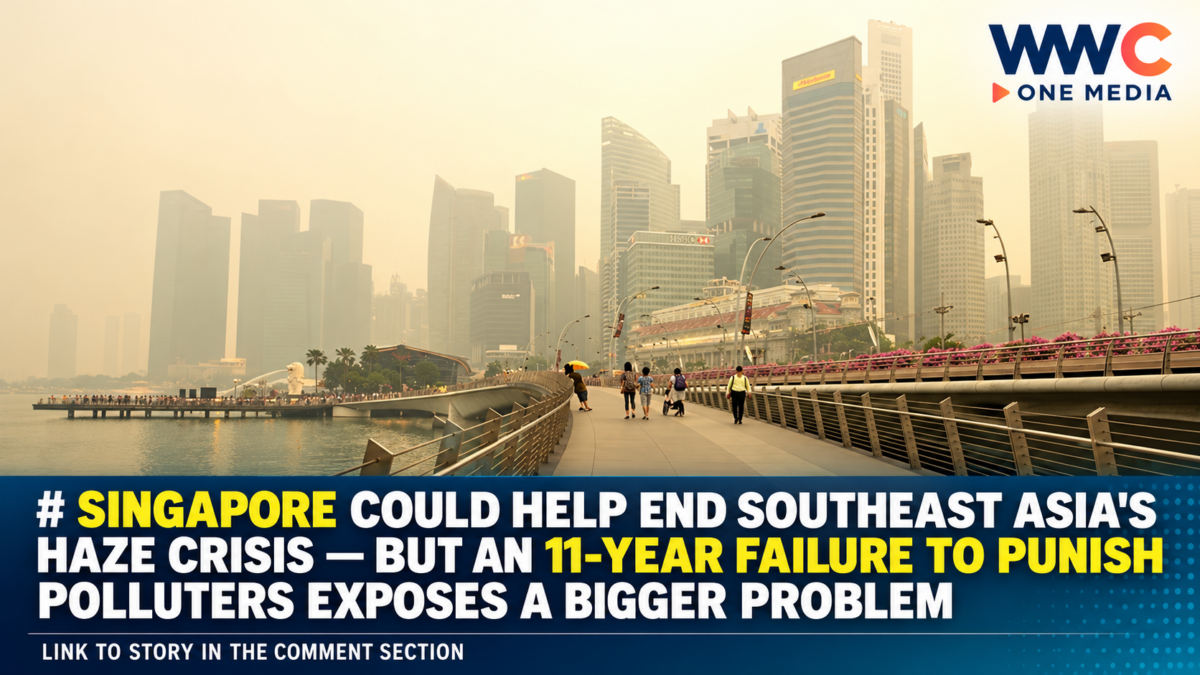
SINGAPORE — October 14, 2026 — Southeast Asia is choking under another wave of toxic haze as widespread forest and peatland fires in Indonesia spread smoke across borders, forcing school closures, disrupting travel and raising fresh questions about why one of the region’s most persistent environmental crises remains unresolved.
But a provocative Bloomberg Opinion column argues that the solution may lie not only in Indonesia’s burning forests, but also in Singapore’s powerful financial system.
In an October 12 commentary titled Singapore Can Fix Southeast Asia’s Haze, If It Wants To, Bloomberg columnist David Fickling argued that the city-state could exert far greater pressure on businesses connected to deforestation and land-clearing fires.
His central argument is that Singapore, as a major financial and corporate hub for Southeast Asian agriculture and commodities, has influence over businesses that depend on its banking, investment and capital markets.
That influence could be used to demand greater transparency over plantation ownership, concession maps and agricultural supply chains.
The proposal comes amid an escalating regional emergency.
Indonesia is experiencing one of its worst wildfire seasons in years, with an intense El Niño contributing to extremely dry conditions.
Smoke has spread across parts of Indonesia, Malaysia, Singapore and other Southeast Asian countries.
Yet Singapore’s existing legal framework has produced limited enforcement results.
Although the city-state introduced its Transboundary Haze Pollution Act in 2014, no company has been fined under the legislation.
Four investigations relating to the devastating 2015 fires remain open more than a decade later.
Singapore already has laws designed to hold companies accountable for cross-border haze. But the bigger question is whether it is prepared to use its financial influence to confront the businesses and supply chains that may be profiting from practices linked to repeated forest fires.
Southeast Asia Faces Another Major Haze Emergency
The 2026 haze crisis has affected several countries across the region.
Large forest and peatland fires in Indonesia have produced extensive smoke pollution.
Dry conditions associated with El Niño have contributed to the rapid spread of fires, particularly in Sumatra and Kalimantan.
Singapore and parts of Malaysia have recorded unhealthy air quality.
Schools in affected areas of Malaysia have temporarily closed, while transportation, tourism and outdoor activities have experienced disruptions.
On October 13, Reuters reported that Indonesian President Prabowo Subianto had ordered additional resources to fight the wildfires.
The Indonesian government has deployed firefighting personnel and equipment as authorities attempt to contain the outbreaks.
However, extensive fires remain difficult to extinguish, especially when they affect peatlands.
The situation has revived memories of the devastating 2015 Southeast Asian haze crisis.
But the consequences are not limited to uncomfortable skies.
Smoke pollution can create serious public-health risks, economic losses and long-term environmental damage.
Bloomberg Opinion Says Singapore Has More Power Than It Admits
David Fickling’s Bloomberg column challenges the idea that Singapore has little ability to influence fires occurring outside its territory.
Singapore cannot directly govern land use in Indonesia.
It also cannot simply send enforcement officers across the border without Indonesian cooperation.
However, Bloomberg argues that Singapore’s economic influence provides another source of leverage.
Many agricultural and commodity companies operating across Southeast Asia rely on regional financial institutions, corporate structures or capital markets connected to Singapore.
Plantation businesses may seek loans, investment or stock exchange listings through the city-state.
Banks, investors and commodity traders may also have commercial relationships with companies operating plantations or processing agricultural products.
According to Fickling, these financial relationships provide opportunities to demand greater transparency and accountability.
His argument is not that Singapore can physically extinguish every fire.
It is that the country can make environmental accountability a condition for access to capital.
That remains a policy proposal, not an existing requirement imposed universally across Singapore’s financial system.
Singapore’s 2014 Haze Law Has Yet to Produce a Fine
Singapore introduced the Transboundary Haze Pollution Act in 2014.
The law was designed to hold companies accountable for causing or contributing to haze pollution in Singapore, even when the activities occurred overseas.
It allows authorities to investigate companies and pursue penalties under specified circumstances.
The law can impose corporate fines of up to S$100,000 per day, capped at S$2 million.
It also permits certain civil claims for losses resulting from transboundary haze.
Despite those provisions, the enforcement record remains limited.
Channel News Asia reported on October 12 that no entity has been fined or successfully sued under the legislation since it took effect.
The absence of penalties has raised questions about whether the law can operate effectively without stronger cross-border cooperation.
However, a lack of completed enforcement action is not equivalent to proof that Singapore has undertaken no investigation or regulatory activity.
The authorities have previously served legal notices and continue to examine unresolved cases.
Four Investigations From the 2015 Haze Crisis Remain Open
The strongest evidence of the enforcement challenge comes from cases dating to 2015.
After that year’s severe haze episode, Singapore’s National Environment Agency identified fires on concession land associated with six Indonesian companies.
Legal notices were issued to all six.
Investigations involving two companies were subsequently closed after authorities accepted explanations that the businesses were no longer associated with the relevant land at the time of the fires.
Four investigations remained open as of October 12, 2026.
The companies identified by Singapore’s NEA are:
- PT Bumi Andalas Permai
- PT Bumi Mekar Hijau
- PT Sebangun Bumi Andalas Wood Industries
- PT Rimba Hutani Mas
The companies have been associated in previous reporting with supply chains serving Asia Pulp & Paper.
However, inclusion in an investigation does not establish legal responsibility for a particular fire.
Singapore’s NEA has said it cannot disclose further details while the investigations remain ongoing.
The extraordinary length of the cases illustrates how difficult it can be to investigate alleged environmental damage across international borders.
Why Indonesia and Singapore Have Struggled Over Enforcement
A major obstacle involves the ability to obtain evidence and question relevant company representatives.
The fires may occur in Indonesia, while the affected population, commercial relationships and potential enforcement proceedings are located in Singapore.
Investigators need reliable evidence linking particular fires to landowners, managers or other responsible entities.
That may require land-concession documents, satellite imagery, corporate records and information from local authorities.
In 2016, Singapore’s attempts to question a company director in connection with haze investigations generated diplomatic disagreement.
Indonesia also objected to certain information requests from Singapore.
These tensions have contributed to the difficulty of enforcing the law.
However, it would be too simplistic to say that Singapore has merely described haze as an unavoidable natural disaster.
Singaporean ministers have previously identified commercial land-clearing practices as a root cause.
The stronger criticism concerns the gap between acknowledging the problem and securing enforceable accountability.
Plantation Ownership Is One of the Biggest Obstacles
Agricultural supply chains in Southeast Asia can be complicated.
Large palm oil producers and processing companies may purchase crops from their own plantations as well as independent suppliers.
Those independent suppliers may include smaller growers and intermediaries.
Palm oil fruit can pass through several hands before reaching a processing mill.
The difficulty is that material produced on responsibly managed land may become mixed with supplies whose origins are harder to verify.
Pulpwood supply chains can also involve complex relationships among forestry concessions, suppliers, contractors and major industrial buyers.
Such arrangements can make it difficult to identify the party responsible for a particular fire.
Bloomberg argues that this opacity benefits businesses able to distance themselves from environmentally damaging practices within their supply networks.
However, the presence of a complicated supply chain does not prove that every participating company is involved in illegal burning.
Establishing liability requires evidence.
Why Peatland Fires Are Especially Destructive
Peatlands contain large amounts of partially decomposed organic material accumulated over long periods.
When these landscapes remain wet, they can store substantial quantities of carbon.
But draining peatland for development or agricultural activity can make the material highly flammable.
Once peat dries and ignites, fires can burn beneath the surface.
These underground fires can continue for extended periods and are extremely difficult to extinguish.
They generate thick smoke containing fine particles and other pollutants.
They can also release large quantities of carbon dioxide.
That creates both a public-health problem and a climate problem.
Firefighting is important, but preventing peatland degradation and maintaining adequate water levels can be equally critical.
This is why environmental experts increasingly emphasize better land management alongside emergency firefighting.
El Niño Makes the Crisis Worse — But Does Not Explain Everything
The current haze emergency has been intensified by El Niño.
El Niño can contribute to below-normal rainfall across parts of maritime Southeast Asia.
Dry vegetation becomes more susceptible to fire.
Peatlands can also become more vulnerable when prolonged dry conditions lower water levels.
The ASEAN Specialised Meteorological Centre has warned that the risk of transboundary haze will remain elevated while dry conditions persist.
However, weather conditions do not explain why fires begin in the first place.
Human land use, deliberate burning, accidental ignition and inadequate fire prevention can all contribute to outbreaks.
The distinction matters.
Governments cannot eliminate El Niño, but they can strengthen land management, fire prevention and enforcement.
A severe dry season should therefore be treated as an advance warning, not as proof that destructive fires are unavoidable.
Bloomberg Proposes Financial Disclosure Requirements
The most important proposal in Fickling’s column involves access to capital.
He argues that plantation companies seeking financing or listings through Singapore should be required to provide detailed, current information about their land holdings and suppliers.
That could include concession maps showing where businesses operate.
It could also include records identifying the sources of agricultural products entering mills and processing facilities.
Such information could help investors, regulators and civil society organizations trace fires to specific areas.
The approach would attempt to make environmental accountability part of financial decision-making.
Companies that provide reliable information could potentially demonstrate lower environmental risk.
Businesses unwilling or unable to disclose their supply networks might face greater scrutiny.
However, the proposal would require careful implementation.
Regulators would need to decide what information is mandatory, how it should be verified and what consequences should follow from inaccurate disclosures.
Could Singapore Banks Become Part of the Solution?
Singapore is an important center for banking, investment management and commodity finance.
That creates opportunities for financial institutions to influence business practices.
Banks could consider whether agricultural borrowers have adequate fire-prevention policies.
They could request independent assessments of land concessions and supplier relationships.
Investors could evaluate whether companies face material environmental liabilities.
Insurers and other financial institutions could also incorporate wildfire exposure into their risk assessments.
But these approaches involve tradeoffs.
Strict rules may raise compliance costs, especially for smaller suppliers.
Poorly designed requirements could exclude smallholders from formal financing rather than improve their practices.
Effective policy would therefore need to combine accountability with technical assistance and realistic implementation schedules.
The objective should be to improve land management rather than merely transfer environmentally risky activity outside regulated financial channels.
Why Land-Concession Maps Matter
Satellite technology can detect active fire hotspots.
It can also help identify areas experiencing land-cover change.
But identifying the location of a fire is not the same as proving who caused it.
Concession maps help establish which entities have rights or responsibilities over particular parcels of land.
When combined with reliable corporate and supply-chain records, they may support investigations.
However, land administration in Indonesia can be complicated.
Different maps may contain overlapping boundaries.
Customary land rights and formal concessions may not always align.
Ownership structures can also change.
Consequently, maps would be an important component of stronger enforcement, but they would not automatically resolve every dispute over responsibility.
Independent verification and legal cooperation would still be necessary.
European Supply-Chain Rules Offer a Possible Model
Bloomberg points to European efforts to improve agricultural supply-chain traceability.
The European Union’s deforestation-related regulatory framework is intended to require companies selling certain commodities into its market to demonstrate that products meet specified environmental and legal requirements.
Palm oil is among the covered commodities.
The underlying concept is that buyers should know where agricultural products originate.
This can reduce opportunities for products linked to unacceptable land-use practices to enter supply chains without scrutiny.
However, the framework’s implementation timetable and regulatory details have been politically contested.
Singapore would not necessarily need to copy European rules exactly.
It could develop requirements suited to its role as a regional financial center.
Any policy would also need to account for smallholder livelihoods, data quality and cooperation with producing countries.
Singapore Says It Is Already Working Through ASEAN
The Singapore government has defended its existing approach to transboundary haze.
In an October 6 parliamentary reply, Minister for Sustainability and the Environment Grace Fu outlined bilateral and regional measures.
She pointed to the ASEAN Task Force on Peatlands and broader cooperation on sustainable land management.
The region has adopted a collective ambition of becoming transboundary haze-free by 2030.
ASEAN initiatives include technical cooperation, fire prevention and peatland-management programs.
Singapore also participates in monitoring and information-sharing arrangements.
These activities provide evidence that the country has not ignored the problem.
However, they have not eliminated recurring haze episodes.
That raises a legitimate question about whether voluntary cooperation and existing enforcement tools are sufficient.
Indonesia’s Government Faces Its Own Legal Challenge
The pressure is not limited to Singapore.
Residents and civil society groups in Indonesia’s West Kalimantan province have brought legal proceedings against government officials and agencies over the handling of severe forest fires.
According to Associated Press and The Guardian, the plaintiffs allege negligence in preventing and responding to the fires.
The defendants include senior Indonesian officials.
The lawsuit seeks greater accountability for the effects of smoke pollution and inadequate fire management.
However, the allegations remain subject to legal proceedings.
The lawsuit does not establish that the defendants have been found liable.
The significance is that affected Indonesian communities are also demanding stronger action.
This challenges the idea that haze is simply a dispute between Indonesia and its wealthier neighbors.
Many of the people facing the most direct consequences live close to the fires themselves.
Indonesia Orders More Resources to Fight Wildfires
On October 13, Reuters reported that President Prabowo Subianto had directed officials to increase firefighting resources.
The instruction followed rising criticism of the government’s response.
Indonesia has deployed substantial personnel and equipment to fight the fires.
The government also faces difficult decisions about international assistance.
Malaysia and Singapore have offered help.
At the time of the report, Indonesia had not accepted foreign assistance or declared a national disaster.
This does not mean Indonesian authorities have undertaken no firefighting action.
They have launched significant operations.
The debate concerns whether the scale and effectiveness of the response are sufficient given the severity of the crisis.
Longer-term fire prevention will also remain essential after the current emergency subsides.
Malaysia Is Facing Major Economic and Health Consequences
Malaysia is among the countries most directly affected by smoke from Indonesian fires.
Poor air quality has led to school closures in affected areas.
Residents have been advised to reduce outdoor exposure during hazardous conditions.
Haze also affects tourism, transportation and businesses that depend on outdoor activity.
The crisis has renewed calls for stronger cooperation between Malaysia and Indonesia.
However, Malaysia also has commercial connections to plantation industries operating across the region.
That means responsibility for sustainable agricultural practices is not confined to one country.
Businesses, investors and regulators across Southeast Asia may have roles in addressing the causes.
Singapore’s 2015 Haze Losses Show the Economic Stakes
The costs of haze extend beyond emergency healthcare and reduced visibility.
Severe air pollution can lead to lost working hours, disruptions to tourism and lower productivity.
A study by researchers at Nanyang Technological University estimated that the 2015 haze episode cost Singapore approximately S$1.83 billion.
The estimate included tangible losses, such as healthcare expenses, tourism effects and reduced productivity, as well as intangible costs.
That amount was equivalent to roughly 0.45% of Singapore’s GDP at the time.
The finding illustrates why haze prevention can also be viewed as an economic investment.
Spending on monitoring, sustainable agriculture and fire prevention may reduce the risk of much larger future losses.
However, the 2015 estimate should not be presented as the confirmed financial cost of the 2026 haze crisis.
A separate assessment would be needed.
Researchers Estimated a Severe Human Toll in 2015
The 2015 fires were also associated with enormous health consequences.
A 2016 study by researchers from Harvard and Columbia universities estimated that smoke from the fires contributed to approximately 100,000 premature deaths across Indonesia, Malaysia and Singapore.
That was a modeled estimate of additional mortality associated with air pollution.
It was not a count of individually certified deaths.
The distinction is important for accurate reporting.
The study nevertheless demonstrates the potential scale of the public-health burden.
Fine particulate pollution can penetrate deep into the lungs and aggravate respiratory and cardiovascular conditions.
Children, older adults and people with existing illnesses may face increased risks during prolonged exposure.
Haze prevention is therefore a public-health priority as well as an environmental concern.
Why the Philippines Should Watch the Crisis
The 2026 fires have also drawn attention in the Philippines.
Regional reporting has described haze reaching parts of the country under certain weather conditions.
However, poor air quality at a particular Philippine monitoring station should not automatically be attributed entirely to Indonesian fires.
Local pollution, weather conditions and other sources can also affect readings.
The Philippines has an interest in stronger regional monitoring and pollution-control arrangements.
As ASEAN chair in 2026, it is also involved in diplomatic efforts to address the issue.
Reuters reported that transboundary haze is expected to feature in discussions among ASEAN foreign ministers in November.
For the Philippines, the crisis highlights the importance of regional cooperation on environmental threats that do not respect national borders.
ASEAN Plans to Discuss the Crisis in November
The regional diplomatic response is developing.
Reuters reported on October 12 and 13 that ASEAN foreign ministers are expected to discuss transboundary haze during meetings in November.
The Philippines, as ASEAN chair, has indicated that the issue will be on the agenda.
Discussions may address regional cooperation, fire prevention and strategies to reduce repeated cross-border pollution.
However, the scheduling of talks does not guarantee a binding new agreement or immediate enforcement action.
The effectiveness of any initiative will depend on implementation.
The challenge for ASEAN is that members must balance environmental protection with sovereignty, economic interests and domestic political considerations.
The continuing fires show why cooperation needs to produce measurable outcomes.
Can Singapore Really Solve Southeast Asia’s Haze Alone?
This is the central question behind Bloomberg’s argument.
Singapore has significant financial influence.
It also possesses legislation designed to address transboundary haze.
But the country cannot unilaterally regulate every Indonesian plantation, investigate every fire or enforce judgments without cooperation.
Land management ultimately depends heavily on authorities and businesses in the countries where fires occur.
Indonesian enforcement, local governance, peatland restoration and support for sustainable agriculture remain essential.
Singapore’s financial leverage could complement those measures.
It could increase transparency and make environmental performance more important to investors.
But it is not a complete substitute for effective laws and institutions in the places where fires originate.
The strongest regional strategy would likely combine financial accountability, reliable mapping, local fire prevention, stronger enforcement and practical assistance to affected communities.
What Happens Next?
Several developments deserve close attention.
Indonesia’s firefighting operations: Authorities will need to contain existing fires and prevent new outbreaks.
El Niño conditions: Continued dryness could increase fire risks before wetter weather arrives.
Singapore’s haze investigations: The four unresolved 2015 cases remain an important test of the country’s enforcement framework.
Financial-sector disclosure: Policymakers and institutions may face calls to require greater transparency from agricultural businesses.
November ASEAN meetings: Regional leaders will have an opportunity to consider stronger cooperative measures.
Public-health conditions: Air-quality monitoring will remain essential while haze persists.
Long-term peatland management: Sustainable water and land-use practices will determine whether future fire seasons become less destructive.
The Bigger Question: Will Southeast Asia Finally Hold Polluters Accountable?
The 2026 haze crisis has once again exposed a failure that has troubled Southeast Asia for decades.
Smoke spreads across borders.
Communities suffer the health consequences.
Businesses and governments face financial losses.
Yet identifying and penalizing those responsible remains difficult.
Bloomberg’s proposal shifts attention from firefighting alone toward the financing and commercial relationships behind agricultural supply chains.
Singapore may not control Indonesian land use, but its role as a financial and corporate center gives it potential influence.
The existing record shows both action and failure.
Singapore enacted a dedicated haze law, issued notices and participated in regional initiatives.
But more than a decade after the 2015 crisis, four investigations remain unresolved and no penalties have been imposed under the Act.
For affected residents, that gap raises difficult questions about the effectiveness of existing policies.
Singapore cannot extinguish Southeast Asia’s forest fires by itself. But it may be able to help change the financial incentives that allow irresponsible land use to persist. The bigger test is whether the region’s governments, banks and agricultural giants are prepared to make accountability more than a promise — before another generation is forced to breathe the consequences.