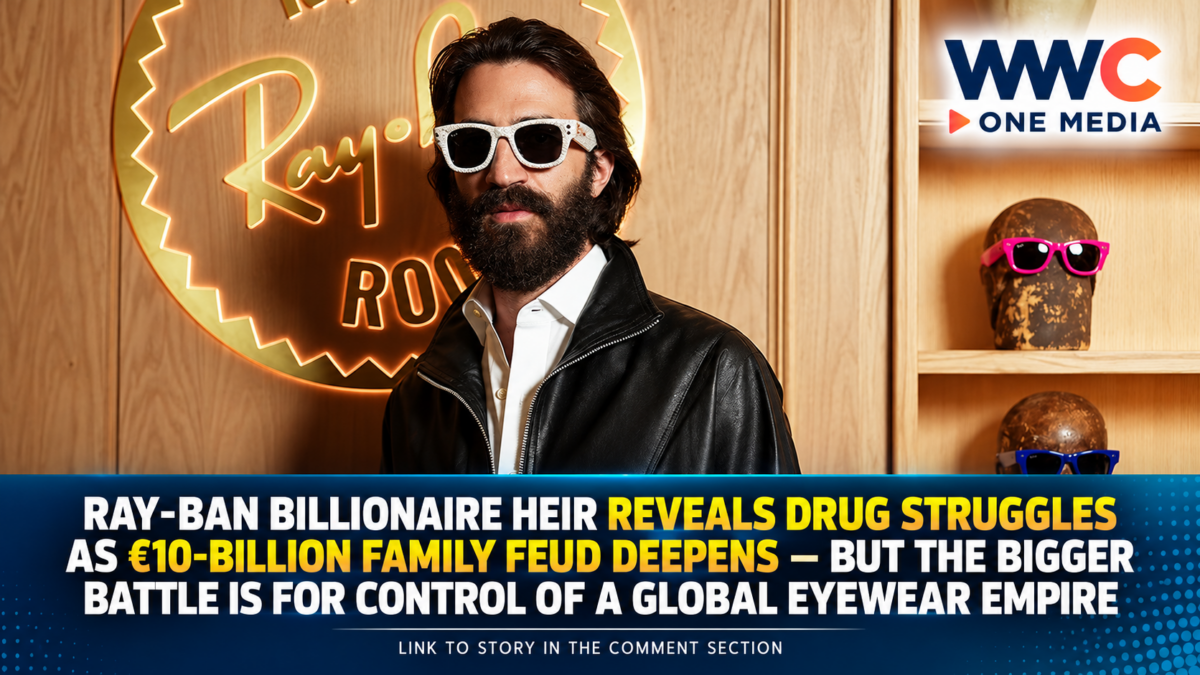
MILAN, Italy — October 14, 2026 — One of Europe’s most prominent billionaire families is facing renewed public scrutiny after Leonardo Maria Del Vecchio, the 31-year-old heir to the Ray-Ban fortune, revealed his struggles with substance dependence while launching another attack on the leadership of EssilorLuxottica, the global eyewear company founded by his late father.
In an unusually candid interview on Italian rapper Fedez’s Pulp Podcast, Del Vecchio discussed his dependence on medications used to help him sleep, his complicated relationship with his father and the personal difficulties surrounding his extraordinary inheritance.
But the interview quickly moved beyond his private life.
Del Vecchio renewed his criticism of EssilorLuxottica chairman and chief executive Francesco Milleri, questioning the company’s direction as its shares have fallen approximately 46% in 2026.
His comments come amid a continuing dispute over the roughly €10-billion proposed acquisition of two siblings’ stakes in Delfin, the Luxembourg-based holding company that controls the Del Vecchio family’s largest investment.
The controversy raises a far bigger question than the heir’s personal revelations: Can one of Europe’s most valuable family business empires overcome its succession battle before internal divisions further damage investor confidence?
Ray-Ban Heir Opens Up About Substance Dependence and His Father’s Legacy
Leonardo Maria Del Vecchio’s latest interview offered a rare look into the personal life of an heir whose wealth is estimated by Forbes at approximately $5.8 billion.
Speaking on Pulp Podcast, he acknowledged experiencing problems involving benzodiazepines, a class of prescription medications commonly used to treat conditions including anxiety and insomnia.
He discussed how emotional difficulties and his relationship with his father contributed to his experiences with substance use.
The younger Del Vecchio described growing up with immense financial privilege while feeling that important emotional needs had not been met.
His father, Leonardo Del Vecchio, was the billionaire industrialist who built Luxottica into a global eyewear powerhouse.
Despite the financial success of the family, Leonardo Maria said he had struggled personally.
He also described fatherhood as an important source of positive change, saying his daughter Bianca had helped give him renewed direction.
However, he did not claim to have completely overcome his substance dependence.
His remarks were personal disclosures about his own experiences, not a medical diagnosis or an independently verified account of every circumstance he described.
Heir’s Claims About His Private Life Draw International Attention
The interview also attracted widespread attention because of Del Vecchio’s comments about his romantic life.
He claimed to have had relationships or sexual encounters with more than 2,000 women and described his efforts to impress partners by singing Enrique Iglesias’ song “Hero.”
The remarks were widely reported by Bloomberg, Financial Times, the New York Post and Italian media.
However, the figure is a self-reported personal claim and has not been independently verified.
Although the comments generated sensational headlines, the more consequential business revelations concerned his continuing disagreements with EssilorLuxottica’s management and the distribution of power within his father’s estate.
The contrast between his personal disclosures and the financial stakes surrounding the family dispute has made the interview a major international business story.
Del Vecchio Attacks EssilorLuxottica CEO Francesco Milleri
The most significant corporate development was Del Vecchio’s renewed criticism of Francesco Milleri.
Milleri was a longtime associate of Leonardo Del Vecchio and was selected to lead EssilorLuxottica.
Following the founder’s death in June 2022, Milleri remained a central figure in the management of the eyewear company and the family’s investment holding structure.
Leonardo Maria argued that EssilorLuxottica had failed to deliver the performance he expected following his father’s death.
He pointed to the company’s falling share price and questioned whether management had demonstrated an appropriate long-term strategy.
Speaking to the podcast hosts, he said the disagreement was not fundamentally about his personal relationship with Milleri.
Instead, he presented the dispute as a matter of corporate performance and accountability.
His comments included criticism of what he described as frozen salaries and inadequate business vision.
Those are his assertions and should not be treated as independently established evidence of management misconduct.
EssilorLuxottica Shares Have Fallen Approximately 46% in 2026
The public dispute comes during a difficult year for EssilorLuxottica shareholders.
According to Bloomberg reporting, shares of the French-Italian eyewear company had declined approximately 46% during 2026.
The performance placed the group among the weakest performers in the Euro Stoxx 50 index.
At the time of the reporting, EssilorLuxottica’s market capitalization was approximately €68.1 billion.
The decline is particularly notable because the company controls major international brands and maintains an influential position in the global eyewear industry.
Its portfolio includes:
- Ray-Ban
- Oakley
- Persol
- Oliver Peoples
- Vogue Eyewear
- LensCrafters
- Sunglass Hut
EssilorLuxottica is also active in prescription lenses, optical services, medical technology and wearable devices.
However, the decline in its share price does not establish that the company’s businesses have stopped growing or that the family feud alone caused the losses.
Market valuations are influenced by earnings expectations, broader economic conditions, investor sentiment and the outlook for future growth.
EssilorLuxottica Board Defends CEO Amid Family Criticism
The company’s board has publicly rejected the suggestion that management has lost its direction.
On September 9, 2026, EssilorLuxottica issued an official statement unanimously reaffirming confidence in Francesco Milleri, deputy chief executive Paul du Saillant and the executive leadership team.
The board also endorsed the company’s medium- and long-term strategy.
The statement emphasized stability, corporate responsibility and the interests of employees, shareholders and customers.
The endorsement followed public criticism from Leonardo Maria Del Vecchio.
The company’s official financial reporting provides another perspective.
In July, EssilorLuxottica announced that its first-half 2026 revenue had achieved nearly double-digit growth and adjusted operating profit had increased 15% at constant exchange rates.
Those results indicate that the company’s underlying operations were showing growth even as its stock market valuation weakened.
The disagreement therefore involves different interpretations of corporate performance.
Del Vecchio emphasizes the share-price decline and his dissatisfaction with leadership.
The board points to operating results and its confidence in management’s strategy.
€10-Billion Buyout Becomes Center of Family Power Struggle
Behind the personal and management controversy lies a complex dispute involving ownership of Delfin.
Delfin is the Luxembourg-based holding company established by Leonardo Del Vecchio to manage his family’s investments.
Following the billionaire founder’s death in 2022, eight heirs inherited interests in the holding structure.
Each received a 12.5% stake.
Leonardo Maria has sought to increase his ownership from 12.5% to 37.5% by acquiring the combined 25% held by siblings Luca and Paola Del Vecchio.
The proposed transaction was valued at approximately €10 billion.
If completed, the acquisition would make him the largest individual shareholder in Delfin.
That could give him significantly greater influence over discussions involving investments, governance and succession.
However, the transaction became entangled in disagreements over financing and shareholder approval procedures.
In April 2026, Bloomberg and Reuters reported that a majority of family shareholders had approved the proposed acquisition.
Subsequent developments complicated the transaction, including a legal challenge involving another heir and difficulties securing financing through the holding company.
The latest reporting indicates that Leonardo Maria has not completed the proposed increase to 37.5% ownership.
His current position should therefore not be confused with the much larger stake he had hoped to acquire.
Delfin Controls a Major Stake in EssilorLuxottica
The importance of the dispute becomes clearer when examining Delfin’s investments.
According to Reuters, the family holding company owns approximately 32.4% of EssilorLuxottica.
That makes Delfin the company’s largest shareholder.
The ownership structure means the Del Vecchio heirs collectively hold considerable influence over one of the world’s largest eyewear companies.
However, their individual interests are divided.
Major decisions within Delfin require broad shareholder agreement, making family cooperation essential.
When heirs disagree about leadership, dividend distribution or investment strategy, decision-making can become more difficult.
The problem is intensified when disagreements involve the same executives who oversee the underlying operating company.
Milleri’s leadership role in EssilorLuxottica and chairmanship of Delfin place him at the center of the governance debate.
Why the Del Vecchio Inheritance Has Become So Complicated
Leonardo Del Vecchio built his fortune over several decades.
He founded Luxottica in 1961 and transformed the company into a major international eyewear manufacturer and retailer.
The combination of Luxottica and French lensmaker Essilor in 2018 created EssilorLuxottica, a global business spanning lenses, frames, retail distribution and eye-care technology.
After his death in 2022, the founder’s wealth passed to eight heirs through a carefully structured holding company.
The arrangement was intended to preserve the family’s financial legacy.
However, equal ownership interests and stringent approval requirements have created difficulties when shareholders disagree.
The family must make decisions involving billions of euros in assets, dividend payments and corporate governance.
A prolonged disagreement could affect how quickly Delfin can respond to investment opportunities or changes in its portfolio.
Nevertheless, a family dispute does not automatically give any single heir the power to remove the CEO of a publicly traded company.
EssilorLuxottica operates under its own corporate governance rules and board structure.
Dispute Over Dividends Adds Pressure on Heirs
The family’s disagreements are not limited to who controls the holding company.
Dividend policy has become another contentious issue.
According to Reuters and Bloomberg reporting earlier in 2026, heirs discussed changes that would allow a larger portion of Delfin’s profits to be distributed to shareholders.
One proposal involved distributing 80% of profits for the years 2025 through 2027.
The debate reflects competing priorities.
Some heirs may favor receiving more income from the holding company’s investments.
Others may prefer retaining profits to finance acquisitions, reduce debt or strengthen the investment portfolio.
These disagreements can become significant when the underlying assets are worth tens of billions of euros.
The challenge is to establish a financial policy that meets shareholders’ needs without undermining the group’s long-term investment strategy.
Leonardo Maria Reportedly Faces Substantial Borrowings
Leonardo Maria’s personal financial position has also attracted attention.
According to Bloomberg reporting cited by Hindustan Times, he disclosed borrowings totaling approximately €950 million.
The amount reportedly includes around €500 million in personal debt, with the remainder associated with investments through LMDV Capital.
These figures provide context for the financing discussions surrounding the attempted €10-billion acquisition.
However, debt is not automatically evidence of financial distress.
Borrowing is commonly used by wealthy investors to finance acquisitions, manage liquidity and support business development.
The relevant considerations include repayment obligations, financing costs, asset values and available cash flows.
The available reporting does not establish that Del Vecchio has defaulted on these obligations.
Meta Smart Glasses Raise the Stakes for EssilorLuxottica
The leadership dispute comes as EssilorLuxottica is investing in the future of smart eyewear.
The company has partnered with Meta Platforms to develop AI-powered smart glasses through brands including Ray-Ban and Oakley.
These products combine traditional eyewear design with features such as cameras, audio systems and artificial intelligence assistance.
The partnership is intended to expand the eyewear category beyond conventional optical and fashion products.
Meta is also an EssilorLuxottica shareholder, adding a strategic investment relationship to the commercial partnership.
In September 2026, EssilorLuxottica and Meta announced further developments in their AI glasses lineup.
For investors, the collaboration represents an opportunity to participate in a potentially important new consumer technology market.
However, smart glasses must still demonstrate that demand, product margins and long-term consumer adoption can support the industry’s growth expectations.
For EssilorLuxottica, stable leadership and clear investment priorities could become increasingly important as the company expands in technology.
Ray-Ban’s Global Brand Remains a Valuable Strategic Asset
Ray-Ban is one of the most recognizable eyewear brands in the world.
Its products have remained popular for decades, supported by distinctive designs, international marketing and wide distribution.
EssilorLuxottica’s broader portfolio includes prescription eyewear, premium sunglasses, retail chains and specialized optical products.
The group’s size provides advantages in manufacturing, product development and global distribution.
These strengths remain relevant regardless of disagreements among members of the founding family.
However, family-controlled companies can face investor concerns when ownership disputes become unusually public.
Shareholders may question whether disagreement among major owners could eventually influence strategy, management appointments or capital allocation.
The central issue is whether the company’s governance structure can maintain continuity while major shareholders debate its future.
Legal Challenge Complicates the Family Buyout
The proposed purchase of two siblings’ holdings faced legal complications earlier in 2026.
Bloomberg reported in May that Rocco Basilico, another heir, had challenged the approval process for the transaction in a Luxembourg court.
The challenge concerned the process by which the family holding company’s shareholders approved the proposed sale.
Such disputes can affect transaction timelines and complicate financing.
However, filing a legal challenge does not automatically mean that a transaction has been declared unlawful.
The outcome depends on applicable law, contractual provisions and the decisions of the relevant court.
The available reporting does not establish that the court has issued a final ruling resolving all aspects of the disagreement.
The continuing uncertainty illustrates the complexity of managing a large international fortune through a closely held family investment structure.
Could the Family Feud Affect Investors?
For public-market investors, the most important question is whether internal shareholder disagreements could affect EssilorLuxottica’s operations.
Family influence is common among major European luxury and consumer goods companies.
Such arrangements can provide stability and a long-term investment perspective.
However, disputes among controlling shareholders may create uncertainty over leadership succession, governance and strategic direction.
The Del Vecchio conflict has become unusually visible because of the scale of the fortune and Leonardo Maria’s public criticism of management.
Investors must distinguish between three separate issues: family inheritance disagreements, the company’s actual financial performance and movements in its stock price.
They are connected, but they are not interchangeable.
EssilorLuxottica’s operating results, management strategy and competitive position remain essential to assessing its long-term financial prospects.
Why the Dispute Matters Beyond Italy
EssilorLuxottica operates internationally, including in Asia and other major consumer markets.
Its businesses span eyewear manufacturing, optical retail, prescription lenses and emerging smart-glasses technology.
The company has also been expanding its international distribution and business partnerships.
Any significant corporate governance disruption could attract attention from employees, business partners and institutional investors.
However, there is no verified evidence that the latest family dispute has caused Ray-Ban stores to close in Asia or led to immediate supply shortages in the Philippines.
The significance of the controversy is primarily financial and corporate rather than a confirmed interruption to consumer operations.
The Bigger Question: Who Will Shape the Del Vecchio Empire’s Future?
Leonardo Maria Del Vecchio’s latest interview has drawn attention because of his unusually personal revelations.
But beneath the celebrity headlines lies a much more consequential contest involving ownership, governance and corporate leadership.
The younger Del Vecchio remains a significant shareholder through Delfin even after leaving his executive positions.
He continues to challenge the strategy pursued by Francesco Milleri, whom his father selected as a key successor.
Milleri, meanwhile, retains the public backing of EssilorLuxottica’s board.
The unresolved €10-billion family transaction adds another layer of uncertainty.
At the same time, the company must manage investor expectations, maintain the strength of its traditional eyewear businesses and pursue new growth opportunities through AI-powered products.
The outcome of the dispute will depend on the family’s ability to resolve ownership disagreements and the company’s continued operational performance.
Leonardo Maria Del Vecchio may have revealed the personal struggles behind his billionaire inheritance, but the bigger drama is unfolding inside one of Europe’s most powerful business dynasties: whether the heirs can protect their father’s global eyewear empire while fighting over who should shape its future.