SINGAPORE, October 12, 2026 — Global copper prices climbed on Monday as investors reacted to easing expectations of further interest-rate increases and growing concerns over supply disruptions in Chile, the world’s largest copper-producing country.
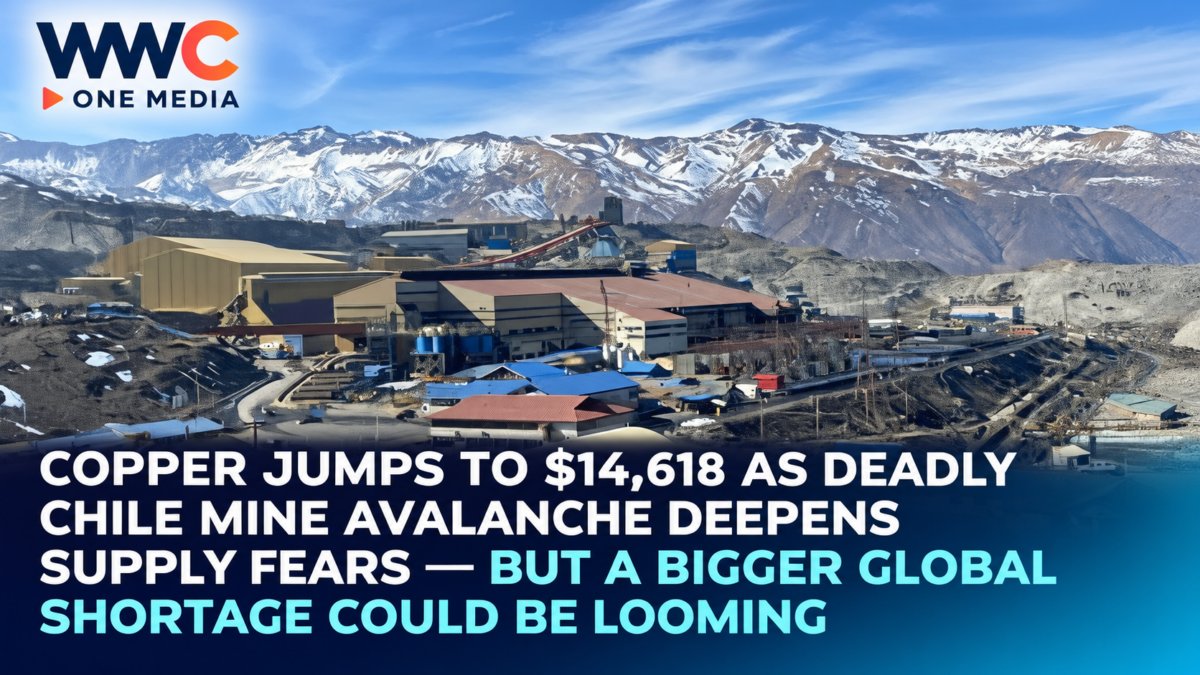
The rally followed a deadly avalanche at Codelco’s El Teniente mine, where two subcontractor workers lost their lives during severe weather.
Benchmark copper on the London Metal Exchange rose 0.5% to $14,618 per metric ton as of 11:54 a.m. Singapore time, after advancing as much as 0.6% earlier in the trading session, according to Bloomberg.
The industrial metal had already gained nearly 2% during the previous week, extending a period of heightened volatility driven by geopolitical risks, monetary policy uncertainty and supply concerns.
But behind the latest price increase lies a more complicated story.
As demand for copper expands across power grids, electric vehicles and artificial intelligence infrastructure, mounting difficulties at major mines are raising questions about whether the global mining industry can keep up.
Copper Rises as Oil Prices Retreat and Interest-Rate Fears Ease
One of the primary drivers of Monday’s rally was a decline in international oil prices.
Lower energy prices raised hopes that inflationary pressure could ease, potentially reducing the need for central banks to increase interest rates further.
For copper, that is an important development.
The metal is widely used in construction, manufacturing, transportation and electrical infrastructure — industries whose investment decisions can be sensitive to borrowing costs.
Higher interest rates can discourage spending on new factories, buildings and equipment while increasing the cost of financing large infrastructure projects.
They can also make interest-bearing investments more attractive relative to commodities.
Conversely, expectations of less restrictive monetary policy can improve sentiment toward industrial metals.
However, the outlook remains uncertain.
Investors continue to monitor geopolitical tensions in the Middle East, volatile energy markets and upcoming US inflation data.
If inflation proves stronger than expected, financial markets could renew expectations of higher borrowing costs, potentially placing pressure on copper.
Deadly Avalanche Strikes Codelco’s El Teniente Mine
The rally also followed a tragic incident at one of Chile’s most important copper mining operations.
On Sunday, October 11, an avalanche struck the open-pit section of Codelco’s El Teniente mine in Chile’s O’Higgins Region.
Three workers were affected by the emergency.
One was rescued and taken to a medical facility, while emergency teams launched operations to reach two others.
Codelco subsequently confirmed that both missing workers had died.
The two victims worked for subcontractor San Lorenzo, which provided services through contractor Aura.
According to Codelco, they had been conducting inspection work in an area where open-pit mining operations had already been suspended because of severe weather.
Chile’s Investigative Police and Public Prosecutor’s Office are examining the circumstances of the incident.
The tragedy has renewed concerns about safety and operational risks in difficult mining environments.
However, an important distinction must be made: the suspension of open-pit operations does not establish that the entire El Teniente mining complex has shut down.
The company has not confirmed a comprehensive copper production-loss estimate directly attributable to the avalanche.
Why Chile’s Copper Production Matters to the World
Chile occupies a central position in the global copper market.
As the world’s leading copper-producing country, disruptions at its largest operations can influence international supply expectations.
Codelco is one of the world’s major copper producers, and El Teniente is an important part of its mining portfolio.
The country’s industry faces multiple challenges, including difficult geological conditions, declining ore grades at mature operations, labor disputes and increasingly demanding infrastructure requirements.
Severe weather can add another layer of uncertainty.
Because copper is produced through complex and capital-intensive operations, replacing lost output is not always straightforward.
Even a temporary disruption at a major mine can affect market sentiment when inventories are tight.
Nevertheless, the size of any actual supply shortfall must be established through production data rather than assumed from the announcement of an incident.
Chile’s Centinela Mine Faces Separate Labor Dispute
The El Teniente tragedy follows another development affecting Chile’s copper industry.
On October 7, workers at Antofagasta Minerals’ Centinela mine began a strike after negotiations over a collective agreement failed.
According to Reuters, two unions rejected the latest proposals following unsuccessful talks involving the company and labor representatives.
The dispute added to uncertainty surrounding mining operations in Chile.
A prolonged strike could affect production, depending on its duration, the extent of operational disruption and the outcome of further negotiations.
But the final production consequences remain uncertain.
For copper traders, the combination of labor disruptions and severe weather increases concern about supply reliability in a country that plays a vital role in the world market.
China’s Copper Inventories Signal Renewed Demand
Another factor supporting prices is the prospect of renewed buying from China.
China is the world’s largest consumer of copper, using the metal extensively in electrical equipment, industrial production, infrastructure and construction.
Bloomberg reported that Chinese copper inventories remained relatively low following a weeklong national holiday.
At the same time, an indicator of import demand reached its highest level in four years during the preceding week.
The development suggests that some Chinese buyers may be preparing to replenish inventories.
When domestic stocks are tight, businesses may increase purchases from international suppliers to ensure adequate supplies for manufacturing and other activities.
Stronger Chinese import demand can support global prices because of the country’s importance in the copper market.
However, an increase in an import-demand indicator does not necessarily prove that China’s wider industrial economy is accelerating.
Analysts will still need to examine actual import volumes, factory activity, infrastructure spending and the condition of the property sector.
AI Data Centers and Electrification Create Long-Term Copper Demand
Beyond short-term trading, copper is attracting growing attention because of its importance to modern electrical systems.
The metal is used in power cables, transformers, motors, industrial machinery and transmission networks.
Those applications make it essential to the expansion of electricity infrastructure.
Artificial intelligence data centers require reliable electrical connections and substantial supporting power systems.
Electric vehicles, charging stations and renewable energy installations also depend on copper-intensive equipment.
As more countries invest in electricity networks, copper demand could receive additional long-term support.
However, the strength of that demand will depend on economic growth, technology choices, project investment and efficiency improvements.
The expansion of AI and electrification does not guarantee uninterrupted copper-price increases.
Higher recycling rates, technological changes, substitution and slower industrial activity could also influence future demand.
Why Copper Supply Cannot Expand Quickly
Increasing copper production is often a lengthy process.
Developing a major mine can require years of exploration, environmental permitting, financing, construction and testing.
Established operations may also face declining ore grades, requiring miners to process more material to produce the same amount of metal.
Mining companies must manage rising capital costs, water availability, energy requirements and community concerns.
These challenges can make supply expansion difficult even when copper prices are high.
A sustained period of strong demand combined with insufficient new investment could tighten the market.
But an actual shortage is not inevitable.
Future supply will depend on mine development, existing producers’ performance, recycling, technological advances and changes in consumption.
For investors, the distinction between projected future tightness and a confirmed present-day shortage is essential.
Rising Copper Prices Could Affect Global Manufacturing
Copper is a critical input for numerous industries.
Electrical equipment manufacturers, construction businesses, automakers and renewable energy developers all depend on the metal.
If copper prices remain elevated, some companies could experience higher production expenses.
Power transmission projects may also face increased costs for cables, transformers and related equipment.
The impact would vary according to purchasing contracts, currency movements, inventories and the ability of businesses to absorb additional expenses.
Higher copper prices do not automatically translate into equivalent increases in retail prices or household electricity bills.
For Southeast Asian economies, including the Philippines, the balance can be complicated.
Domestic mineral producers may benefit from higher export prices, while infrastructure developers and businesses importing copper-intensive equipment may face additional costs.
Global Markets Await the Next Interest-Rate Signal
Copper’s near-term direction could depend heavily on the next round of US economic data.
Investors are watching inflation figures expected during the week of October 12.
A softer inflation reading could reinforce expectations that central banks may avoid further rate increases.
That might support industrial commodities through improved financial conditions.
Stronger inflation, however, could produce the opposite reaction.
Copper prices may also respond to changes in the US dollar, Chinese demand and developments at Chilean mining operations.
The market is therefore being pulled in several directions.
Supply disruptions can support prices, while weaker manufacturing activity or tighter monetary policy can limit demand.
That creates conditions for continued volatility.
The Bigger Question: Is Copper Heading Toward a New Supply Crunch?
Monday’s rally reflects the intersection of financial-market optimism and renewed mining-sector uncertainty.
Lower oil prices have reduced some concerns about additional interest-rate increases.
A deadly avalanche at El Teniente has drawn attention to safety and supply risks in Chile.
Meanwhile, Chinese import indicators suggest possible restocking by the world’s biggest copper consumer.
Longer term, investments in power grids, electric vehicles and data centers could increase the amount of copper required by the global economy.
But the immediate priority at El Teniente remains the investigation of the fatal incident and the safety of workers.
The additional impact on mining output has not yet been established.
For copper markets, the central question is whether producers can maintain reliable supplies while expanding production fast enough to support future industrial demand.
If Chile’s mining disruptions prove temporary and global economic growth slows, copper prices could retreat.
But if supply problems persist while consumption strengthens, the market may face additional upward pressure.
Copper is rising as investors welcome easing rate-hike fears and assess another Chilean mining tragedy — but the bigger test is whether the world’s mining industry can deliver enough metal for the coming wave of electrical infrastructure and technological investment.