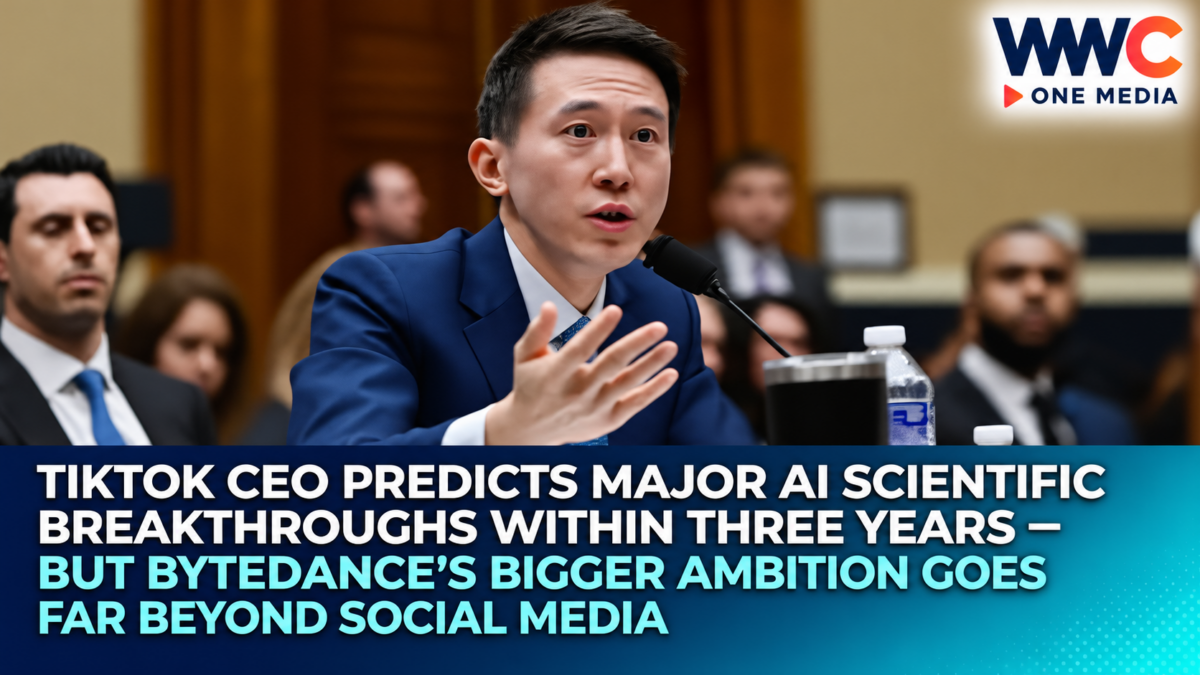
SINGAPORE — Artificial intelligence could deliver major scientific breakthroughs in medicine, biotechnology, physics, chemistry and materials science within the next two to three years, according to TikTok Chief Executive Officer Shou Zi Chew, as parent company ByteDance accelerates its transformation from a social media giant into a major global AI developer.
Speaking at the DBS Asia Future Forward Conference in Singapore on October 12, 2026, Chew expressed optimism that rapid advances in artificial intelligence could unlock discoveries that have traditionally required years of scientific research.
The prediction comes at a time when technology companies are investing heavily in systems capable of analyzing complex biological structures, improving scientific simulations and accelerating research.
But behind Chew’s optimistic outlook lies a much bigger business story.
ByteDance, best known for TikTok and China’s Douyin, is rapidly expanding into artificial intelligence research, biotechnology, drug discovery, cloud computing and specialized AI infrastructure.
The company’s ambitions suggest that the next stage of the AI race may be fought not only over chatbots, video generation and online platforms, but also over who can use machine intelligence to solve difficult scientific problems.
TikTok CEO Sees AI Transforming Science Within Two to Three Years
During the DBS conference, Chew predicted that AI could contribute to significant advances across several scientific disciplines.
He identified physics, biotechnology, chemistry and materials science as fields where the technology could have a particularly important impact.
His comments reflect growing expectations that AI could move beyond generating text, images and videos to become a more powerful tool for scientific research.
Traditional scientific discovery often requires researchers to test large numbers of hypotheses, examine complex data and carry out extensive laboratory experiments.
AI systems could potentially accelerate parts of that process by identifying patterns, proposing promising molecular structures and helping scientists prioritize experiments.
In pharmaceutical research, for example, machine learning models can help predict how proteins and other molecules interact.
In materials science, similar approaches could assist researchers searching for compounds with useful characteristics, including improved energy storage, strength or conductivity.
However, Chew’s prediction is an outlook rather than a verified scientific timetable.
AI-generated findings must still undergo experimental validation, and successful laboratory results do not necessarily translate into approved medicines or commercially viable technologies.
ByteDance Moves Beyond TikTok Into Advanced AI Research
Chew’s comments come as ByteDance strengthens its position among China’s leading artificial intelligence developers.
The company has invested in large language models, AI-powered consumer applications, video-generation systems and cloud computing infrastructure.
Its expanding portfolio includes Doubao, a widely used AI assistant in China, and Seedance, a generative AI system focused on video creation.
ByteDance also operates the Seed research organization, which develops advanced AI models and investigates applications beyond traditional consumer technology.
The company’s strategy increasingly resembles that of a diversified AI platform developer rather than a business dependent exclusively on social media advertising.
According to Financial Times reporting in August 2026, ByteDance has committed substantial resources to AI infrastructure, model development and specialized research.
The expansion reflects intensifying competition among Chinese technology companies, including Alibaba, Tencent and other AI developers.
ByteDance’s growing AI ambitions also place it in a broader international race involving companies such as Google DeepMind, Microsoft-backed research initiatives and specialized biotechnology startups.
The competition is increasingly focused on the practical value AI can deliver rather than simply the size or popularity of consumer chatbots.
ByteDance’s Protenix-v2 Targets Complex Biological Research
One of the strongest examples of ByteDance’s scientific AI ambitions is Protenix, a research project focused on predicting molecular structures.
On April 8, 2026, ByteDance’s research team released Protenix-v2, an updated model designed to improve predictions involving biomolecular structures.
The technology is particularly relevant to understanding interactions between proteins, antibodies, antigens and other molecules.
These interactions play important roles in biological processes and can be valuable in pharmaceutical research.
According to the project’s official technical documentation, Protenix-v2 achieved improvements in antibody-antigen structure prediction compared with an earlier version.
The developers reported gains of approximately 9 to 13 percentage points on selected benchmark evaluations.
These are research benchmark results, not evidence that the system has discovered an approved treatment or produced a proven clinical breakthrough.
The distinction matters because computational predictions represent only one part of the scientific discovery process.
Researchers must still verify results through laboratory studies and, where applicable, animal studies and human clinical trials.
Nevertheless, tools such as Protenix demonstrate how AI companies are attempting to accelerate research that previously required substantial computing resources and experimental work.
TikTok Parent Enters AI Drug Discovery Race
ByteDance’s growing interest in scientific applications extends beyond molecular structure prediction.
The company has also developed Anew Labs, an AI-focused drug discovery initiative exploring the design of therapeutic molecules.
According to a May 2026 report by the South China Morning Post, the research operation has established activities in Shanghai, Singapore and California.
The group has worked on AI-assisted drug discovery programs and presented early-stage research at international scientific conferences.
One reported program focused on a molecule targeting IL-17-related biological processes associated with autoimmune diseases.
The research illustrates how generative AI can be applied to molecular design, allowing scientists to explore chemical structures and potential therapeutic candidates.
However, identifying a promising experimental molecule does not mean a medicine is ready for patients.
Drug development requires extensive testing to establish safety, efficacy, manufacturing quality and regulatory compliance.
The commercial opportunity is significant, but so are the scientific and financial risks.
For ByteDance, Anew Labs signals an effort to explore opportunities in a field far removed from the short-video entertainment business that originally made the company famous.
AI Could Reshape the Economics of Scientific Discovery
The wider technology industry is increasingly interested in using AI to address costly and time-consuming research problems.
Developing new medicines, advanced materials and specialized industrial technologies often involves years of experimentation and significant financial investment.
AI could improve parts of these workflows by helping researchers narrow down promising candidates before conducting expensive physical tests.
Potential applications include:
- Predicting protein and molecular structures for biological research.
- Helping scientists design and screen experimental drug candidates.
- Identifying materials with properties useful for batteries and electronics.
- Supporting complex simulations in physics and chemistry.
- Analyzing large scientific datasets to uncover potential relationships.
- Assisting researchers in planning and prioritizing laboratory experiments.
These applications could make research more efficient, although the actual benefits will vary by scientific discipline and technical maturity.
The greatest value may come from combining computational systems with laboratory automation, high-quality scientific data and experienced researchers.
AI alone cannot establish whether a scientific hypothesis is correct.
Its contribution must ultimately be judged against experimental evidence.
China’s AI Companies Intensify Competition With US Technology Leaders
ByteDance’s expansion comes amid fierce technological competition between China and the United States.
Chinese companies are investing heavily in advanced AI models and seeking ways to reduce dependence on foreign semiconductor technologies.
At the same time, US firms continue developing increasingly capable AI systems and specialized infrastructure.
The competition is complicated by restrictions on advanced chips, geopolitical tensions and concerns over data security.
In August 2026, Reuters reported that ByteDance founder Zhang Yiming had advised the company’s AI researchers against relying on model distillation as a shortcut to advancing model capabilities.
Distillation is a family of techniques that can train or improve one model using outputs generated by another model.
Zhang’s reported position suggested a preference for building original AI capabilities rather than relying primarily on systems created by competitors.
Separately, The Information reported that ByteDance was developing specialized AI chips to improve its computing infrastructure.
These initiatives highlight the company’s attempts to strengthen its technological independence.
However, developing competitive AI systems requires sustained investment in hardware, data, engineering talent and research.
A strong position in consumer AI applications does not automatically guarantee leadership in scientific AI.
ByteDance’s AI Spending Is Already Affecting Profits
The company’s AI transformation also carries a significant financial cost.
According to September 2026 reporting by The Wall Street Journal, ByteDance generated approximately $120 billion in revenue during the first half of 2026, representing growth of more than 30%.
However, net profit reportedly declined to about $20 billion as the company increased spending on AI development and infrastructure.
The figures underscore the tension confronting major technology companies.
AI could create entirely new sources of revenue, but building competitive systems requires large upfront expenditures.
Advanced computing chips, data centers, electricity, specialized research teams and commercial deployment can all increase operating costs.
For ByteDance, the challenge is to turn AI technology into profitable products and services while maintaining its established advertising, social media and commerce businesses.
Scientific applications may eventually create opportunities in healthcare, research software and industrial technology.
But their commercial potential remains uncertain, particularly when products require years of testing before generating meaningful revenue.
AI Safety Concerns Grow Alongside Scientific Ambitions
The rapid development of increasingly capable AI systems is also raising questions about transparency and risk management.
On October 9, Reuters reported findings from research firm SemiAnalysis indicating that publicly available safety evaluations accompanied only a small proportion of Chinese AI model releases examined between 2021 and September 2026.
The analysis covered 857 model releases and found that approximately 3.6% had published model-specific safety evaluations.
The review included developers such as ByteDance, Alibaba, Tencent and Baidu.
The absence of a published evaluation does not necessarily mean a company performed no internal testing.
However, limited public disclosure can make independent assessment more difficult.
Scientific AI systems raise additional questions involving research reproducibility, model reliability, sensitive biological applications and the potential misuse of advanced capabilities.
As AI becomes more involved in scientific research, developers and regulators will face increasing pressure to balance innovation with responsible deployment.
Singapore Emerges as a Major Venue for Asia’s AI Debate
Chew delivered his remarks at the inaugural DBS Asia Future Forward Conference, which brought together business leaders, technology executives and investors to examine AI’s economic implications.
The October 12 event was organized around the theme of intentional AI — using artificial intelligence with clear objectives and measurable economic or societal benefits.
DBS said the conference would explore technological infrastructure, business transformation, investment opportunities and the future of work.
Other announced participants included senior executives from Intel and Broadcom, alongside Singapore Prime Minister Lawrence Wong.
The gathering highlights Singapore’s role as a regional center for discussions on AI adoption, investment and governance.
For Southeast Asia, advances in scientific AI could eventually create opportunities in pharmaceutical research, manufacturing, digital infrastructure and higher-value technology services.
However, realizing those opportunities will require investment in education, computing infrastructure, research institutions and appropriate safeguards.
The Bigger Question: Will AI’s Next Breakthrough Come From Science, Not Social Media?
For much of the recent AI boom, public attention has focused on chatbots, image generators, digital assistants and increasingly realistic AI-produced videos.
But Chew’s prediction points toward a potentially more consequential phase.
If AI can significantly accelerate scientific discovery, the economic effects could extend far beyond the technology sector.
Better tools for studying biological systems could support pharmaceutical research.
More efficient materials discovery could contribute to advancements in electronics, energy storage and manufacturing.
Improved scientific simulations could help researchers investigate problems that are difficult or expensive to study through conventional methods alone.
Yet important obstacles remain.
AI-generated predictions can be inaccurate, scientific experiments require independent validation, and technological progress does not always produce rapid commercial results.
Chew’s forecast that major scientific breakthroughs could emerge within two to three years is an optimistic prediction, not a confirmed development timeline.
For ByteDance, the opportunity is equally ambitious.
The company that built one of the world’s most influential social media platforms is now investing in technologies that could support scientific research, biotechnology and entirely new commercial industries.
But succeeding in those fields will require more than sophisticated algorithms.
It will depend on scientific credibility, experimental results, access to computing resources and the ability to convert technical progress into useful real-world products.
The next chapter of the global AI race may not be defined by which company creates the smartest chatbot or the most viral video. It could be determined by which organization can translate artificial intelligence into genuine scientific discoveries.
And if Chew’s prediction proves correct, the world’s next major technological breakthrough could arrive sooner than many researchers expect.